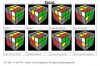
New method: ROCKET BOOSTERS!!!
Step 1: Rocket Boosters
Description: The user builds two 2x2x1 in LD and RD.
Average moves: 9
Move set: All
Step 2: T
Description: The user builds a T on the front face using FLD, FD, FRD and UF whilst making sure
no U layer or D layer pieces get to the E-slice. This is done in an F2L style.
Average moves: 8
Move set: <FMLRU>
Step 3: Finish the corners
Description: The user completes the corners while conserving UF and UB by doing an M move, then
executing an algorithm, then undoing the M move.
Average moves: 9
Moves set: <FMLRU>
Algs:
The algorithms have all been documented and are known as CLLs.
Step 4: Place UB and BD
Description: The user moves the pieces belonging in UB and BD into their position.
Average moves: 9
Move set: <FMU>
This should be intuitive, but here are some algs if you need them:
UL to UB: M2 U' M' U2 M U' M2
UR to UB: M2 U M' U2 M U M2
LU to UB: M' U' M U2 M' U' M
RU to UB: M' U M U2 M' U M
UR to BD: M' U M' U2 M U M
RU to BD: U' M U2 M' U'
UL to BD: M' U' M' U2 M U' M
LU to BD: U M U2 M' U
Step 5: L4E
Description: Similar to ELL, but the pieces are in different locations. A good strategy would be to
just learn new algorithms, as there are only 29 cases.
Average moves: 10
Algs:
I'll generate them later. 29 is a bit too much for now.
Example solve:
Scramble: D2 B' U2 B' R2 B2 L2 B' D2 R2 F2 L R' U B D U R2 B2 U' R'
z2 R B U' B' L2 B' D2 B2 - Rocket Boosters (8 moves)
F' U R' F R2 U2 L2 B' R' L2 - T (10 moves)
R' U L U' R U L' U' - Corners (8 moves)
U' F2 M2 U' M U F2 U M - UB + BD (9 moves)
R E R' E' S R' S' R - L4E (8 moves)
Total moves: 43
Method Ratings:
Inspection use: 10/10
The method solves 6 pieces through inspection - that is two more than CFOP.
Ergonomics: 8/10
Although there are occasionally F moves and slice moves, these can be done quickly with
practise. I myself have a pretty neat fingertrick for S and E moves, so I am fine with them.
Otherwise you're mostly using M, U, L and R moves.
Lookahead: 8/10
Lookahead is nice for some steps such as the corners and the T, but the lookahead for the
UB/BD and L4E steps isn't excellent.
Recognition: 8/10
The only thing keeping this from a 10/10 is the L4E recognition and the fact that pieces might get
stuck in BD during the UB/BD step.
Movecount: 10/10
The movecount is excellent with an average speedsolving movecount of 45 moves, which is great
compared to the most mainstream methods.
Algorithm count: 9/10
This method has a relatively low alg count compared to methods like CFOP. There are only about 60
algorithms.
Ease of learning: 9/10
Any user of one of the mainstream methods will find a transition to this method to be easy.
Although CFOP users may find the first step's blockbuilding a bit challenging, it is easy to get
used to. The others steps are either VERY easy, like the T step and the UB/BD step, or they are
algorithmic.
Overall rating: 62/70
The rating I gave CFOP (my main method): 57/70
BETTER THAN CFOP CONFIRMED!!!!!!!!!!!
It looks nice at a guick glance but really any algset with adjacent F and M moves is not nice. And no one wants to do S or E moves in a speedsolve... Some are even against the idea of M moves so i would give the ergonomics maybe a 2 on a scale of one to ten as they can't be executed anywhere near as fast as PLL or OLL or CMLL even if they are shorter.
Also, 60 algs is more or less average for a speedsolving method nowadays (if we ignore ZB or Heise) so if normal is 5, i would give it maybe a 6 or 7
Also, there's nothing stopping you solving more pieces in inspection with CFOP, many people can plan up to at least Cross+1, most faster ones more than that. So inspection maybe a 5 if CFOP is average as well.
Also, average movecount for CMLL is closer to 10 not 8 unless you learn unfingertrickable optimals.
I would give it (if CFOP is a 5)
Inspection use: 5
Ergonomics: 2
Lookahead: 4 (harder than just looking for pairs in CFOP)
Recognition: 5, no easier than OLL/PLL really.
Movecount: 8 (i still think you're a bit optimistic though)
Algorithm count: 6 (If you want lower, check out my methods or Roux.
Ease of learning: 5, no worse nor better than CFOP, easier than say ZZ but harder than Waterman
Total: 35/50
CFOP:35/50
Also, for speedsolving i would say that it's how everything works together and only really focus on ergonomics, lookahead, recognition and movecounts. In this way the scoring system doesn't quite work.
For example: beginner's method
inspection use: 4
ergonomics: 7
Lookahead: 9
Recognition: 9
Movecount: 2
Algorithm count: 9
Ease of learning:9
Total:49
Ok, everyone, we better switch to the beginner's method!!!!!!!
So, this method is good for movecount (though i think you're a bit optimistic) but the rest is either bad or meh.



 Paired edges -