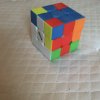
I like permute/orient methods for their algorithm efficiency, i.e. not requiring many algorithms. The downside I see is that it requires commutators for corner permutation. If you can use corner commutators, you can permute and orient the corners at the same time so there is no reason to use two different steps for this.
Having to deal with parity is also a downside. You can avoid both of these problems by permuting corners before edges, which will also reduce the number of algorithms needed. But, then it is just PCMS.
Of course, methods are not all about efficiency. I like trying new methods just to get a unique challenge. I’ll try it out.
Edit: It worked and I solved the cube. I’m not sure who this method is for though. It has a low amount of algorithms, but more than beginner Petrus for example. It requires knowledge of commutators, but uses long algorithms where commutators would be more efficient. Edge permutation on the first side is easy, but it would be almost as easy to permute edges using M moves, which would not disturb corners. I’m not seeing any real advantage to permuting edges first. What were your goals in making the method?
And congratulations on formulating a method btw.