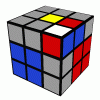
It's on the
wiki, and probably places like cubefreak.net.
One thing you can do for that case is first learn this one:
U' r U' R' U R U r'
Setup: r U' R' U' R U r' U
Obviously the U turns are not necessary, that's just how the picture is off the wiki.
So, you can convert to that case with R U' R' U:
(R U' R' U) r U' R' U R U r'
Setup: r U' R' U' R U r' (U' R U R')
That's 11 moves, two more than the 9 move F U R U' R' F' R U' R', but it's the only decent way I know of to avoid a rotation and not use F turns with that case. It's pretty easy to mirror for all four slots as well, because there's no B turns for the back slots. It can be really fast because it's just quarter turns on U R and r.
To understand the case in the first picture a little more intuitively, do this set up: R U' R' U' R U R'. The resulting F2L case is this one, except at the back instead of above the slot like in the picture:
Notice which edge is at UF. Now solve the F2L pair, and look at which edge is at UF afterward. Notice that it's the same edge as before. So, the edge that is at UF ends up back in the same place after inserting that pair. In fact, if you watch it, it just gets put in the FR slot then removed right away. This means that if an important edge were there after a setup move, it would not matter because undoing the set up move would place it back where it was correctly.
Now do the set up: r U' R' U' R U r'. See that with an M', you convert to the previous case. Also note that doing this brings the front cross piece to the UF position, but that's okay because we know that it will not be affected by the insertion of F2L pair. So after that M', do R U' R' U R U R' to insert the F2L pair. The cross piece is back where it needs to be, so finish with M. Of course, you can just do r instead of M' R, and r' instead of R' M, resulting in r U' R' U R U r', a great rotationless insert for that case. This is nice because most people probably already have the muscle memory for it, and just need to use a wide turn at the start and end. The R U' R' U flows nicely into it to solve the case in the second picture.