
Navigation
Install the app
How to install the app on iOS
Follow along with the video below to see how to install our site as a web app on your home screen.
Note: This feature may not be available in some browsers.
More options
Style variation
You are using an out of date browser. It may not display this or other websites correctly.
You should upgrade or use an alternative browser.
You should upgrade or use an alternative browser.
The New Method / Substep / Concept Idea Thread
- Thread starter elrog
- Start date

PhanPhuocan
Regular
My idea for a variant of the ZZ method.
Step 1:EOLine
Step 2: ZZF2L-1
Step 3: EPLS (Edge permuation last slot) and to do that, you need to create a free pair.
Step 4: Orientation and permutation of the corners of the last layer.
Step 1:EOLine
Step 2: ZZF2L-1
Step 3: EPLS (Edge permuation last slot) and to do that, you need to create a free pair.
Step 4: Orientation and permutation of the corners of the last layer.

43Quintillionaire
Member
I have developed a version of OP that I believe is even simpler and more accessible than the most basic OP available. It swaps center stickers (the cube's core), a technique which has appeared before in this forum. I bring two things which may be new. First, I have developed many original algs. More importantly, in my system there are only 23 setups to learn (one per letter) instead of the usual 43, which reduces the mental overhead and increases the chance of a successful solve. The solver does not need to know whether the parity case is present. There are 2 algs to learn, no parity alg, no pseudoswaps, no substitutions, no cycle changes.
The cube's core can rotate in one of 6 ways in this system. I will use (y2 z) today, which swaps the following faces (think order-2 alg): U-R, D-L, F-B. Try that with a solved cube.
Corner alg (2 choices):
F' r U r2 U2 r D' R r2 F R D r' U r' f r2
F2 U2 f D' R' D F r F' R' D' R U R' F2 r D F
Edge alg (2 choices):
U f D' R2 U M' U' R2 D F' U M' U2
x' y (R2 S R2') U2 (R S R') U2 (r S' r') y' x
I am indebted to bcube for introducing me to a thread where Vincent Trang, Lucas Garron and others were discussing algs that function like these. They were doing this work long before I started, which I did not know. Here's what I'm hoping my system brings to the table: My algs use an AK/AK buffer-target system. The corner and edge algs both use buffer A and target K. Buffers and targets become domino-shaped "zones" (in highly visible spots) instead of individual stickers. This gives a small benefit to memo, because for both edges and corners, a new cycle CAN begin on B, but CANNOT ever begin on A, eliminating the A-B confusion problem. It gives an enormous benefit to setup moves. Normal OP algs make use of edge dummies for the corner solve, which swap back and forth. And vice versa for the edge solve. Because the algs above use CENTER DUMMIES instead, the setups do not have to maneuver around dummy roadblocks!
With no roadblocks, and a shared-K target, an edge and corner sticker with the same letter can use the SAME setup. So: Corner P = edge P = R' D'. Corner T = edge T = R2 F. You might think the resultant 23 setups would be long and awkward in some cases. They are not. Every one is 3 turns or less, and every one is face-turn only. By my calculations, the total number of setup turns performed in a typical solve is exactly the same as the number in the basic plain OP system. Here they are:
Bb: R' F
Cc: F R' D'
Dd: U R' F
Ee: BUFFER / r2 U r2
Ff: r F r'
Gg: D
Hh: B' R D'
Ii: F2
Jj: F
Kk: none
Ll: F'
Mm: R2 D'
…For the rest, see my CHEAT SHEET (yellow column): https://rebrand.ly/845197
Simple demo scramble:
D R2 D2 F' D2 R' D2 L' F U' L2 D' L' D2 R2 F'
Solution, speffz (I'll begin with corners. You may begin with corners or edges):
B J B || J B L C M
[ R' F ] F' r U r2 U2 r D' R r2 F R D r' U r' f r2 [F' R]
[ F ] F' r U r2 U2 r D' R r2 F R D r' U r' f r2 [ F' ]
[ R' F ] F' r U r2 U2 r D' R r2 F R D r' U r' f r2 [F' R]
|| -- corners solved, centers mixed up --
[ F ] U f D' R2 U M' U' R2 D F' U M' U2 [F' ]
[ R' F ] U f D' R2 U M' U' R2 D F' U M' U2 [ F' R ]
[ F' ] U f D' R2 U M' U' R2 D F' U M' U2 [F ]
[ F R' D' ] U f D' R2 U M' U' R2 D F' U M' U2 [D R F' ]
[ R2 D' ] U f D' R2 U M' U' R2 D F' U M' U2 [D R2 ]
Note the commonly repeated setups between corners and edges. This will happen in every solve.
Using the Stickersolve desktop app, I have created 93 million algs for this system. They are graded and organized, and I will make them all available!!
Due to personal and family reasons, I hope to put out my YouTube video tomorrow, Saturday, if possible. But I would certainly like feedback first, about which parts of my system are old, and which are new. Most importantly, I want to give credit where credit is due. It would help me very much if members could direct me to threads and other locations where these ideas have been discussed. My video is already filmed, but I can make adjustments and do the right thing.
I have 3 working names for this system. But is this system too similar to another that already exists and has a name?
OP-3K. 3K means 3 Kingdoms: Corners, edges, centers
23 Skidoo (emphasizes the 23 setup moves)
No Parity Pochmann
bcube directed me to these two links:
www.cubinghistory.com/BlindfoldSolving/Methods/VoidSwap#previous-proposal
Thanks for listening!
The cube's core can rotate in one of 6 ways in this system. I will use (y2 z) today, which swaps the following faces (think order-2 alg): U-R, D-L, F-B. Try that with a solved cube.
Corner alg (2 choices):
F' r U r2 U2 r D' R r2 F R D r' U r' f r2
F2 U2 f D' R' D F r F' R' D' R U R' F2 r D F
Edge alg (2 choices):
U f D' R2 U M' U' R2 D F' U M' U2
x' y (R2 S R2') U2 (R S R') U2 (r S' r') y' x
I am indebted to bcube for introducing me to a thread where Vincent Trang, Lucas Garron and others were discussing algs that function like these. They were doing this work long before I started, which I did not know. Here's what I'm hoping my system brings to the table: My algs use an AK/AK buffer-target system. The corner and edge algs both use buffer A and target K. Buffers and targets become domino-shaped "zones" (in highly visible spots) instead of individual stickers. This gives a small benefit to memo, because for both edges and corners, a new cycle CAN begin on B, but CANNOT ever begin on A, eliminating the A-B confusion problem. It gives an enormous benefit to setup moves. Normal OP algs make use of edge dummies for the corner solve, which swap back and forth. And vice versa for the edge solve. Because the algs above use CENTER DUMMIES instead, the setups do not have to maneuver around dummy roadblocks!
With no roadblocks, and a shared-K target, an edge and corner sticker with the same letter can use the SAME setup. So: Corner P = edge P = R' D'. Corner T = edge T = R2 F. You might think the resultant 23 setups would be long and awkward in some cases. They are not. Every one is 3 turns or less, and every one is face-turn only. By my calculations, the total number of setup turns performed in a typical solve is exactly the same as the number in the basic plain OP system. Here they are:
Bb: R' F
Cc: F R' D'
Dd: U R' F
Ee: BUFFER / r2 U r2
Ff: r F r'
Gg: D
Hh: B' R D'
Ii: F2
Jj: F
Kk: none
Ll: F'
Mm: R2 D'
…For the rest, see my CHEAT SHEET (yellow column): https://rebrand.ly/845197
Simple demo scramble:
D R2 D2 F' D2 R' D2 L' F U' L2 D' L' D2 R2 F'
Solution, speffz (I'll begin with corners. You may begin with corners or edges):
B J B || J B L C M
[ R' F ] F' r U r2 U2 r D' R r2 F R D r' U r' f r2 [F' R]
[ F ] F' r U r2 U2 r D' R r2 F R D r' U r' f r2 [ F' ]
[ R' F ] F' r U r2 U2 r D' R r2 F R D r' U r' f r2 [F' R]
|| -- corners solved, centers mixed up --
[ F ] U f D' R2 U M' U' R2 D F' U M' U2 [F' ]
[ R' F ] U f D' R2 U M' U' R2 D F' U M' U2 [ F' R ]
[ F' ] U f D' R2 U M' U' R2 D F' U M' U2 [F ]
[ F R' D' ] U f D' R2 U M' U' R2 D F' U M' U2 [D R F' ]
[ R2 D' ] U f D' R2 U M' U' R2 D F' U M' U2 [D R2 ]
Note the commonly repeated setups between corners and edges. This will happen in every solve.
Using the Stickersolve desktop app, I have created 93 million algs for this system. They are graded and organized, and I will make them all available!!
Due to personal and family reasons, I hope to put out my YouTube video tomorrow, Saturday, if possible. But I would certainly like feedback first, about which parts of my system are old, and which are new. Most importantly, I want to give credit where credit is due. It would help me very much if members could direct me to threads and other locations where these ideas have been discussed. My video is already filmed, but I can make adjustments and do the right thing.
I have 3 working names for this system. But is this system too similar to another that already exists and has a name?
OP-3K. 3K means 3 Kingdoms: Corners, edges, centers
23 Skidoo (emphasizes the 23 setup moves)
No Parity Pochmann
bcube directed me to these two links:
www.cubinghistory.com/BlindfoldSolving/Methods/VoidSwap#previous-proposal
- Vincent Trang's Void Swap method. Includes Stefan Pochmann's joyous discovery of an alg just like the edge algs above, but from 2005. Good grief!
- Void Swap post. Vincent Trang, Lucas Garron and others describe the center-sharing OP plan seen in my method.
- Void Swap itself is very clever but different. The edge alg induces a 4-cycle on the center stickers, not a swap. The corner alg does not affect the centers.
Thanks for listening!
M
Mr.Ducky
Guest
the method is called 8355
Many beginners might struggle with understanding rubiks cube methods, maybe they would take a day or two to be able to solve the rubiks cube after seeing some toturials... But there is one problem. Not enough intuition! Have you ever heard of a fully intuitive method?
I call it IO (intuition only) or CCEC(cross corners Edges corners again)
anyway it has ZERO algroithems (if you dont count triggers and intutive algrorithems as true algroithems)
So basically heres how it works and for legal purposes I got these from youtube and this is not my method:
Step 1: Basically beginner cfop
You firstly do the cross, and heavily based off on intuition, I cannot really explain this one with text and i would send a toturial if anyone wants to try this method
Then you would use R U R triggers to put the white corners in their places, very similar to Cfop. Make sure to leave 1 corner unplaced for the next steps.
Step 2: Middle layer edges
In beginner cfop you would put the edge on top of its color move it to the left/right do triggers and stuff, but this method is different: Firstly, you move the E layer (middle layer) depending on where the edge needs to be placed, then do Right or left triggers to insert the edge and undo the middle layer turn. Do this until all the edges are in their spots except the one where there arent a white corner fixed (the one you didnt insert in the first step)
Step 3: orientation of the yellow edges and the f2l edge you didnt place
You can do this by the "anchor" method where you have a yellow edge which is fixed, and the unfixed f2l slot is the waiting place where you put the yellow edges in and move them up according to where the anchor is and where it would go after doing the triggers. (If there is no anchor you make one)
Step 4: fishing method (orientation of corners)
when the yellow corner is in the bottom layer, you do the fishing method while the place the corner needs to go is on top of it. The fishing trigger is : D' R' D R, repeat this trigger untill the yellow corner is in its spot. And NOTE: do not worry about the broken f2l pieces , after doing 6 fishing triggers, they get fixed. After the yellow corner is in spot, move the upper layer depending on the corner which is in the bottom layer and do the same step. If there are no yellow corners in the bottom layer, simply insert one using the fishing trigger.
And there you go, fully intutive method, (that is if you can understand step 4 intuitively).
anyway i will send example practice with toturial soon if anyone wants to see how it works and maybe we could help beginners learn about the cube with this method its kind fast
( There are some parity cases in some steps ill go over them too)
For further context and legal purposes this is NOT my method, and there are posts about it
43Quintillionaire
Member
Here is my YouTube presentation (fleshed out, and with super-simple setups) of Stefan Pochmann's idea of OP without parity. BONUS POINTS if you find the clues in the thumbnail.
Advantages:
CHEAT SHEET:
https://rebrand.ly/845197
Advantages:
- No parity alg
- 23 setups to learn (down from 43)
- Corner and edge buffer pieces share 2 colors and are easier to "hunt for"
- No A-B confusion in memo
CHEAT SHEET:
https://rebrand.ly/845197
43Quintillionaire
Member
I encourage all top-tier BLD solvers to read this post, even though they don't need to 
In this third and final post in the New Method thread, I'd like to share the feedback I've gotten and suggest a place for "No Parity Pochmann" in the BLD landscape. There has been a palpable sense of relief, even joy, in some of the responses to my YouTube video. There is indeed a group of people for whom this system is their best shot at a blindfolded solve.
People destined for intermediate and advanced BLD methods may view No Parity Pochmann (OP-3K) as simply a mathematical curiosity. For these gifted cubers, the mental hurdles of OP and M2 are not a barrier, so why bother with the bulky algs of No Parity Pochmann?
But I submit that No Parity Pochmann has the simplest logic of any BLD method. For myself, the repetitive nature of the algs overshadows their bulkiness, and for cubers who happen to share my temperament and skill set, alg execution is not where errors are going to happen. And although the speed of M2 reduces the time in which memory can fade, for many the substitution logic is the straw that breaks the camel's back.
Here are the practical, meaningful advantages No Parity Pochmann delivers to people working at the threshold of their cognitive ability:
I frame this method (discovered by Stefan Pochmann in 2005) not as a "beginner method", but as a vibrant second-tier BLD method. I am proud to be able to solve a Rubik's Cube blindfolded by ANY method, and I wonder if we should re-name the method OP-GRIT, for the gritty determination of the many cubers out there whose talents, like mine, are just normal-human-level !
I ask all BLD cubers to consider keeping this method in the public consciousness, for those who need it. Thanks for reading!
In this third and final post in the New Method thread, I'd like to share the feedback I've gotten and suggest a place for "No Parity Pochmann" in the BLD landscape. There has been a palpable sense of relief, even joy, in some of the responses to my YouTube video. There is indeed a group of people for whom this system is their best shot at a blindfolded solve.
People destined for intermediate and advanced BLD methods may view No Parity Pochmann (OP-3K) as simply a mathematical curiosity. For these gifted cubers, the mental hurdles of OP and M2 are not a barrier, so why bother with the bulky algs of No Parity Pochmann?
But I submit that No Parity Pochmann has the simplest logic of any BLD method. For myself, the repetitive nature of the algs overshadows their bulkiness, and for cubers who happen to share my temperament and skill set, alg execution is not where errors are going to happen. And although the speed of M2 reduces the time in which memory can fade, for many the substitution logic is the straw that breaks the camel's back.
Here are the practical, meaningful advantages No Parity Pochmann delivers to people working at the threshold of their cognitive ability:
- No A-B discrepancy in memo. For both corners & edges, a new cycle may begin with B (speffz system), but never A. I no longer experience A-B confusion when juggling the difficult mental task of beginning a new cycle.
- Better edge setups. With URF and URB eliminated as barriers, and with the edge target now antipodal to the buffer just like the corner's always has been, there is an easy creativity in the setups. They are also just plain shorter, and face-turn only. And if you like, you can adopt my "shared-K domino" setups, where the 48 stickers of the cube are reduced to 24 domino-shaped "zones", each with its own setup regardless of identity as edge or corner.
- Corner & edge buffer pieces share two colors, so during memo they are no longer two random pieces in a sea of color, but can be identified quickly.
- There is no parity algorithm to learn, and no parity algorithm to forget to execute, or execute poorly.
I frame this method (discovered by Stefan Pochmann in 2005) not as a "beginner method", but as a vibrant second-tier BLD method. I am proud to be able to solve a Rubik's Cube blindfolded by ANY method, and I wonder if we should re-name the method OP-GRIT, for the gritty determination of the many cubers out there whose talents, like mine, are just normal-human-level !
I ask all BLD cubers to consider keeping this method in the public consciousness, for those who need it. Thanks for reading!
Charles Solves
Member
The 3E method (or 3 Edges) is a interesting method that’s a combination of solving without one edge, roux, cfop, Petrus, and Cll for 2x2 somewhat
Another nice thing is you can have PLL skips be more common since the corners would be already solved if your using CLL (which you prob should)
1: 2x2 block
2: expand it to a 2x3 block while keeping it right next to you (and solve the white corners) when your done with this step, do a D’/D/Dw/Dw’ to rotate without rotating
3: CLL to solve the corners, or if you don’t know it just use algs like sune to put the corners into the (wrong) position (sometimes right)
4: The intuitive part. You solve trying to get “the arrow case” and when you solve the arrow case, you are on PLL!
5: PLL if you used CLL you will only have edge plls which give an advantage. If you didn’t then you would have to learn all 21 PLL algorithms
Thank you for reading! It’s not the best method, but at least it’s not the belt method
Also before anyone says, or you could just use petrus
Last edited:
Charles Solves
Member
This is the BELL method.
It seems it’s similar to the LEOR method for the 2x3 block and ZBLL
Step 1: Solve 2x3 Block
Step 2: solve one bottom edge and one pair
Step 3: ZBLS or if that’s to much do this one algorithm that’s just T perm but instead of R2 it’s just R
Step 4: ZBLL or do OLL and PLL
Bell:
Block
E+1Pair
zbLs
zbLl
This isn’t the best method but it’s still decent it also relies heavily on algs which is always good

Sub 20 Cuber
Veteran
Hey guys today I’m going to share a new method I made!
Step1 cross:In this step you will be solving the cross just like on CFOP
Step2 second layer:Here you will be solving the second layer edges
Step3 last layer edges:solve the last 4 edges by orientation and permeatating them
Step4 solve the corners:By finishing the solve you will be putting the pieces in the right spot and sometimes you have to permeate them with the algs of the last step of the beginner method
I didn’t go too far of how the method works because the method is very simple
M
Mr.Ducky
Guest
Yo I appreciate the method but isnt this just 8355 or other methods I think there is one that solves all edges and leaves corners you do algrorithems to solve the corners step by step of course these arent really designed to be speed methods you can look into the methods I talked about to find resources for yours

rafsky
Member
I made a conceptual method where you solve half a cross, F2L, BLEP, CMLL, ELL. There are 67 algorithms in total, and the half cross lets you exploit the S slice to make pairs before solving. The name of the method is H - Half Cross, F - First 2 Layers, C - CMLL, E - ELL, giving HFCE. I would need some testers but i get around the same as my CFOP solves (23s).
The method works like this:
The method works like this:
- Solve a half cross, 2 edges opposite eachother
- Solve F2L optionally exploitng the S-slice to make pairs
- Solve BLEP (Bottom Layer Edge Permuation)
- Solve CMLL (42 algs)
- Solve ELL (25 algs)
Last edited:
M
Mr.Ducky
Guest
Yo beo this mefhod is goated I actually was going to make this exact method after I failed with my FRNB method but gave it up because for me being sub 30 replacing roux or CFOP last layer with step 4 and 5 wasnt very efficient and people told me about that.I made a conceptual method where you solve half a cross, F2L, BLEP, CMLL, ELL. There are 67 algorithms in total, and the half cross lets you exploit the S slice to make pairs before solving. The name of the method is H - Half Cross, F - First 2 Layers, C - CMLL, E - ELL, giving HFCE. I would need some testers but i get around the same as my CFOP solves (23s).
The method works like this:
see an OVERVIEW for HFCE here.
- Solve a half cross, 2 edges opposite eachother
- Solve F2L optionally exploitng the S-slice to make pairs
- Solve BLEP (Bottom Layer Edge Permuation)
- Solve CMLL (42 algs)
- Solve ELL (25 algs)
anyway, I could help you in making your method because I have alot of resources, it's actually really good and cool for beginners and some intermediates.
Post in thread 'The FRNB method' https://www.speedsolving.com/threads/the-frnb-method.96964/post-1700069 so basically I though the solving of the last layer edges was called Anti-Pll and I was trying to fix the first step of needing to do some M moves to redo white edges ,but you kinda fixed that by doing y move after 2 blocks and having algroithems for those
rafsky
Member
Thanks, I basically optimised the last layer step to be easier for beginners and compressed down to 67 algs using CM and ELL.
M
Mr.Ducky
Guest
Thats actually the goated part,like I saw a video showing anti-plls for after doing CMLL when you have cross and f2l done but it didn't get that much attention, its kinda pretty good way of solving last layer but critics say it is difficult to recognize cases although I found pretty op recognition sheetThanks, I basically optimised the last layer step to be easier for beginners and compressed down to 67 algs using CM and ELL.
Charles Solves
Member
CSTOP Method, The Worst method ever:
Step 1: Cross
Step 2: Second layer
Step 3: Top Layer Edges (F R U R’ U’ F’)
Step 4: Orient edges so they are solved
Step 5: Seperate Corners
Step 6: OLL Parity
Step 7: OLL
Step 7: PLL Parity
Step 8: PLL
Step 9: OLL
Step 10: PLL
this can be 8-12 steps depending on parity
Or you could learn 2Look OLL and 2Look PLL and make it a lot more

Garf
Legend
- Joined
- Sep 4, 2020
- Messages
- 4,387
- Location
- the table, eating lasagna.
- WCA ID
- 2022TIND01
- YouTube
- Visit Channel
C-stop and think about what you are doing

CrossPetrus
Veteran
I have a new Aurora method! This is Aurora III now:
1. 223
2. dfR square (but in dbR/do an R’)
3. 4th pair into fR
4. rf2g (Recombinant F2L to 2 gen reduction: 12 algs, <R, U, F, f, S>, averaging 8.17 stm to solve f2l and put into a 2gll state.
5. 2gll
Example solve (from example solve thread):
rf2g algs:

 docs.google.com
This method could only be 3 looked at best, and movecount may not be sub50. But I think 2gll is a nice last step and rf2g, while having bad ergonomics, is pretty short. It probably has trash lookahead, too. My conclusion: fun, but not viable.
1. 223
2. dfR square (but in dbR/do an R’)
3. 4th pair into fR
4. rf2g (Recombinant F2L to 2 gen reduction: 12 algs, <R, U, F, f, S>, averaging 8.17 stm to solve f2l and put into a 2gll state.
5. 2gll
Example solve (from example solve thread):
rf2g algs:
algs 18.xlsx
This method could only be 3 looked at best, and movecount may not be sub50. But I think 2gll is a nice last step and rf2g, while having bad ergonomics, is pretty short. It probably has trash lookahead, too. My conclusion: fun, but not viable.
SpeedSkewber
Regular
Hi everyone! First post in a decade. 
I've been thinking about a last-layer framework that I haven't been able to find described elsewhere, and I'm looking for feedback.
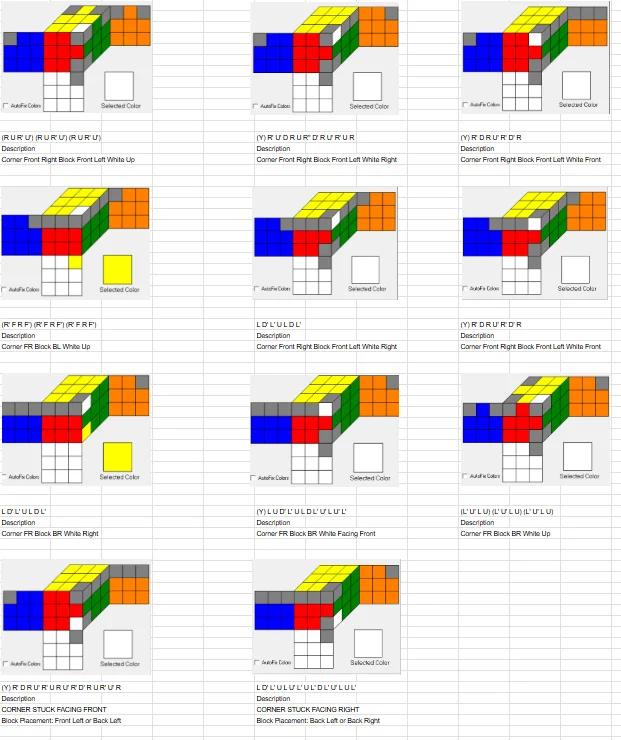
The idea is to intentionally build a 1×2×2 block on the last layer during the final F2L pair. I have attached the insertions needed to preserve the last layer block for when an edge is already inserted. I got lazy and didn't finish the set, but if this gets some attention I'll go back and add more insertions.
Rather than treating the last layer as completely unrestricted, the solve enters last layer with this block already solved. This greatly reduces the number of reachable last-layer states.
Think of BBLL or VAJ as edge control on steroids: instead of only controlling the last-layer edges, you're also controlling one corner to enter last layer with a solved 1×2×2 block.
From my current case analysis:
So this isn't intended to be "another OLL/PLL subset." It's a different way of entering the last layer that constrains the state before recognition even begins.
I'm still developing the method and would appreciate feedback from anyone familiar with ZBLL, VLS, WV, or other advanced last-layer systems.
Specifically:
I've been thinking about a last-layer framework that I haven't been able to find described elsewhere, and I'm looking for feedback.
The idea is to intentionally build a 1×2×2 block on the last layer during the final F2L pair. I have attached the insertions needed to preserve the last layer block for when an edge is already inserted. I got lazy and didn't finish the set, but if this gets some attention I'll go back and add more insertions.
Rather than treating the last layer as completely unrestricted, the solve enters last layer with this block already solved. This greatly reduces the number of reachable last-layer states.
Think of BBLL or VAJ as edge control on steroids: instead of only controlling the last-layer edges, you're also controlling one corner to enter last layer with a solved 1×2×2 block.
From my current case analysis:
- The complete method requires only 56 last-layer algorithms, using only cases that preserve the 1×2×2 block.
- The orientation step is flexible—any OLL (or equivalent algorithm) that preserves the block can be used.
- After orientation, the remaining permutation is restricted to only V, A, and J PLLs.
- In fact, if you choose one of the three block-preserving OLLs, the entire last layer (OLL + PLL) is reduced to just nine algorithm combinations—what I've jokingly been calling the VAJ finish.
So this isn't intended to be "another OLL/PLL subset." It's a different way of entering the last layer that constrains the state before recognition even begins.
Potential advantages
- Smaller algorithm set than full ZBLL.
- Easier recognition due to the permanent 1×2×2 block.
- Flexible orientation step—you're not locked into one algorithm family.
- Could potentially serve as a middle ground between standard OLL/PLL and full ZBLL.
I'm still developing the method and would appreciate feedback from anyone familiar with ZBLL, VLS, WV, or other advanced last-layer systems.
Specifically:
- Has this concept already been explored?
- Does it overlap with an existing method I'm unaware of?
- Are there any obvious edge cases that would prevent complete coverage?
- Would anyone be interested in helping verify the case count and test solves?
Last edited:
M
Mr.Ducky
Guest
Yo pretty interesting method, I think its a really cool variation of winter variation and its likes(atleast thats what I'm understanding), could you also make a toturial on how to make the 2×2×1 block efficiently
Similar threads


- Replies
- 10
- Views
- 3,599


