
LBr
Veteran
Eo is simpler as it only requires f sexy f’ triggers and co isn’t much worse except the u case. Eo is slightly worse when you need to preserve co so it’s not worth it. The originality of this is very questionable as well

Follow along with the video below to see how to install our site as a web app on your home screen.
Note: This feature may not be available in some browsers.


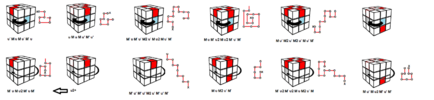
Sounds interesting. I find doing edges first to be good as we get some good EO cases.Ive created an OLL method where its like 2-look oll but instead of orienting edges then corners, but then you do corners and then edges.
There are 8 algoriithms.
Step 1) You look at the corner orientation of the OLL, and use one of the 2x2 OLL Algorithms to orient the edges
Step 2) You use only 2 algorithms for the 2 cases that exist to orient the edges
Step 3) Oriented!
yeah i forgot about it im sorryThere are three cases with misoriented edges

This isn't new.Ive created an OLL method where its like 2-look oll but instead of orienting edges then corners, but then you do corners and then edges.
There are 8 algoriithms.
Step 1) You look at the corner orientation of the OLL, and use one of the 2x2 OLL Algorithms to orient the edges
Step 2) You use only 2 algorithms for the 2 cases that exist to orient the edges
Step 3) Oriented!
Exactly right. I'll upload video soon.From how I understand
Step1 solve all Edges
Step2 solve all corners
Also they call both Method and Algorithm a Formula.

a worse variant of zz-4cStep 1 - eoline
Step 2 left block
Step 3 - right block with the opposite colour
Step 4- ocll
Step 5 weird pll
Step 6 put the opposite colour line that is on top um the bottom to solve the cube

It is a pretty cool methodHello,
I wanted to share a method I designed some months ago and make it open for discussion.
It is a column-first method that mixes some elements from Roux and also adds an unseen part based on uM-Moves.
The core idea is to solve all centers in the last step and let them open during the first parts of the solve to give access to some l/r/S/E/M based improvements.
The method has 4 parts:
1: column building on first 2 layers. (very well known and easy to do for both CFOP and Roux solvers)
2: CMLL (With the case that DL/DR-edges and R/L-centers are not solved, so I guess here is some space for improved algs, but I haven't worked on that yet)
3: DL/DR edge solve (intuitive): Easy to do, good lookahead, normally <6 moves. (It can also be DF/DB which can be completed with an additional d/d' move or whole cube twist)
4: CLSE: (corners & last six edges,): The signature part of this method which gives it it's name:
You solve the R & L centers and orient all 6 remaining edges in one uM-based algorithm! This results in a pre-oriented LSE case that can be solved in just some more moves (known from Roux)
See the slow example solve
And a real-life example solve:
I also want to submit the (unfinished) list of uM-algs for the last step (with some visuals to make them easier to memorize)
View attachment 20851
Another example solve
Scramble: R2 F' B2 R' U2 D' B U' L' R' B' R' L2 D2 R L B' L' F2 U' B2 F2 R D U'
R u' L' U L U' M2 U2 R' U R M U' M2 F U2 F' //Columns
U2 L' U2 L U2’ L F' L' F //CMLL
U M U2 M' D' M' E' //D(RL)-Slotting
M' u M2 u' M U2 M2 U M U2 M U2 M2 //CLSE
Thank you for listening!

Beguinner method :
1-cross
2-f2l
3-ocll- like cfce but you do not need to do cmll , just ocll
4-finish with 134 algs(1lll)
Yes , I am sure , they are the rarest , só they can not have that many algs , but I am sureNever though I'd hear of a "beginner" method that requires 134 algs, as well as full f2l. My concern with this technique, aside from large alg counts for a beginner method, is the ergonomics. If I'm understanding this correct, you wish to solve CP, EP, and EO in one alg, and I would imagine there would be lots of awkward turns required to orient the edges.
Also, are you sure that 134 is the correct number of algs? Maybe I'm misinterpreting something, but that number seems quite low.

I’m gonna set aside the slightly incorrect number of LL algs for a sec.Beguinner method :
1-cross
2-f2l
3-ocll- like cfce but you do not need to do cmll , just ocll
4-finish with 134 algs(1lll)
Intermidiante method:
1 cross
2 f2l-1
3 wv to orient corners
4 finish with 134 algs
Advanced method :
1 cross
2 f2l-1
3 zz Ols - see corner orientation and preform 1of 501 algs to Orient the corneta
4- finish with 134 algs
No , but you ONLY need to see the corners , and if that so , how can you preform WV when the edges are not oriented ?I’m gonna set aside the slightly incorrect number of LL algs for a sec.
You can’t use just ZZ OLS since it requires EO of the last F2L edge. Because you do not state eo to enable this you actually have around 1000 algs for LS. The total alg count is 72+40+22+21 for LL.

Forgive me if I'm wrongAlso, are you sure that 134 is the correct number of algs? Maybe I'm misinterpreting something, but that number seems quite low.
You are right . It is not 134 cases because I did not Counted Pll Soo , it is 155 algsForgive me if I'm wrong
4x21(for the adj unprinted edges) - (3+2+2+3+3)(for H,Z,E,Ns symmetry) + 2x21(opp unoriented) - (1+1+1)(H,N symmetry) + 21 + 21 = 152
That's what I'm asking YOU. You said to use ZZ OLS but that requires the F2L edge to be oriented. You need double the algs to orient LL corners with CFOP F2L-1 as there are more LS cases due to not having EONo , but you ONLY need to see the corners , and if that so , how can you preform WV when the edges are not oriented ?
I agree with the f2l edge stuff, but there'll still be less cases since u don't need to care about whether the last layer edges end up oriented or not, so it would probably be less by a factor of 8(since there are 8 ols cases for each different corner case)That's what I'm asking YOU. You said to use ZZ OLS but that requires the F2L edge to be oriented. You need double the algs to orient LL corners with CFOP F2L-1 as there are more LS cases due to not having EO


