
Neuro
Veteran
- Joined
- Dec 23, 2016
- Messages
- 622
CubeExplorer, ksolve, Acube, HARCS. There are probably more but these are the main ones (HARCS is not meant to gen algs so use it as a last resort)

Follow along with the video below to see how to install our site as a web app on your home screen.
Note: This feature may not be available in some browsers.

Cool idea I had while thinking about 2GR
1: CP Line- Solve pair and insert LC while solving CP. No real preservation required so it's really efficient
2: F2B and Pinkie Pie setup- MUuRr and E technically
3: 2GOLL- 57 algs, super easy
4: LSE- Very short bc of Pinkie Pie setup
F2B probably takes a lot of moves but this could be a pretty good method because CP Line is actually quite easy to do as minimal tracking of corners while doing initial pair is required; and the last 2 steps are pretty much algorithmic (Only a few 4C cases are possible and BU makes it super fast/easy to recognize so it's basically like an alg from that point) Let me know your thoughts!

Check the SSC wiki pageOne idea, i call it ZZ-M, m standing for messy, or Mortensen, my last name. Eoline is done with any two yellow edges, same with the yellow edges in the blocks. Then coll is done, leaving the top and bottom edges to be permuted, with one algorithm. I've only found 1 alg, which is M2 U' M2 U' M2 U' M2 D M2 D M2 for two z perms. Does anyone have the full algset?
I thought up of this a while, but with planning first square+2 DR Corners in inspection, then doing porky2 to insert the last F2L pair, then SB. but instead of 2GOLL(which it ended up being) I thought of it as the 2.5-gen subset of OLLCP(2.5-gen being <R,rU>)Cool idea I had while thinking about 2GR
1: CP Line- Solve pair and insert LC while solving CP. No real preservation required so it's really efficient
2: F2B and Pinkie Pie setup- MUuRr and E technically
3: 2GOLL- 57 algs, super easy
4: LSE- Very short bc of Pinkie Pie setup
F2B probably takes a lot of moves but this could be a pretty good method because CP Line is actually quite easy to do as minimal tracking of corners while doing initial pair is required; and the last 2 steps are pretty much algorithmic (Only a few 4C cases are possible and BU makes it super fast/easy to recognize so it's basically like an alg from that point) Let me know your thoughts!
UHow does this method sound?
1. Cross -1
2. 2 adjacent f2l pairs
3. Solve corners
4. Place the cross piece in the FD slot and the edge in the UB slot.
5. L5E
What I just realized with this is if you have F open with this you can do <RrLlUFM> which is actually a pretty good moveset that's reminiscent of Roux and ZZ. Also, if you wanted to go the HK route, being able to use M slice makes both HKOLL and HKPLL much more efficient. This may not be very good for OH due to the reliance on F moves but this is actually quite nice and still very efficient. As for CFCE, I find that EO->L5EP is very easy to recognize and is usually more efficient than EODF->EPLL. I think it's just preference though. I might use this for 2H if I can get my F2L fast enoughOkay, so y'all remember Hawaiian Kociemba? well, I think solving only 3 cross edges is actually really good. I can usually plan xcross-1 edge in inspection, and the L5EOP algs are nice(L5EOP is EO+DF, then EPLL), and the L5EP algs are pretty nice(much of the algs can be done with a conjugated EPLL, or an H-perm and then a conjugated EPLL). So here's what I use when I solve it, and though I didn't invent it (it's called 3CFCE on the wiki), it's pretty nice:
-3 Cross edges(and whatever F2L you can plan in inspection)
-F2l without the edge(often you can use the open face to make pairs really efficiently)
-CLL(I use CMLL's, they work usually)
-Edges(L5E). there are 2 ways to do this, L5EOP(L5EO->EPLL) and EO->L5EP. the alg count is the same, but L5EO is pretty intuitive for Roux solvers because you just force the Edge on D, so I suggest that strategy.
I actually got a nice scramble a while back and got a 12 sec solve with this, so it's pretty good. Any thoughts?


not only was it 4 years ago (as Teodius pointed out), but he had a point. If someone posts a new method I'd much rather they skipped the long boring paragraphs and just listed the steps clearly at the very beginning, before going into any detail. It's far more difficult to follow what's going on that way.This just comes across as flat out rude and pretentious. Did you check your own post?

Nice! However, this is kind of worrying me. You're making me want to switch methods (yet again) and I just started getting fast (for me) with Roux!In other news, my 2GR Examples page finally has 100 solves on it!
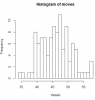
Here are the data. Mean 44.35, median 45, std 4.365. For comparison, 100 of my roux solves yields mean 46.58, median 47, std 4.91, and an ao100 from feliks yields mean 58.
And a nice histogram of the distribution of movecounts below.
View attachment 8016


