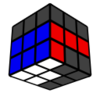
I made a new method:
Peridot Method

1. Locate a bottom layer corner and have it oriented in the DBL spot(0 moves)

2. Using only RrUuFf moves solve a 2x2x2 around the corner(8 moves)

3.Orient remaining edges while solving dFL 1x1x2 block(10 moves)

4.Build a 2x2x1 block in dbR(10 moves)

5.TSLE (127 cases)(7 moves)

6.PLTP(453 cases)(14 moves)


580 algs total
49 moves average
Rotationless
 
I am very interested in learning the Ribbon algs, and I've been thinking about a technique for the Ribbon method.

Quick recap of what Ribbon is:
  • F2L minus corner
  • TOLS (basically OLL with twisted corner)
  • TTLL (permute everything to finish)
In the original video, Justin mentions 2 ways of doing F2L minus corner
  1. Start by solving cross+edge, then finish F2L
  2. Do F2L normally and just insert edge at the end
I'm not a huge fan of these approaches. The first approach, solving cross+edge, takes away good opportunities to do xcross. The second approach is not great because it only saves 1 trigger on average (it takes 2 triggers to solve a pair and 1 trigger to solve an edge on average)

You can save 2 triggers with an opportunistic approach. While solving F2L pairs, look for cases that take 3 triggers. If one comes up, then just solve the edge and don't worry about that corner.
Cool idea!
 
3x3 picture cube/supercube method

This is so silly a lot of people must have found this method...

But if you solve cross+centers except for last layer center, then solve f2l and last layer with center safe algs, you will be left with a 50% chance of a solved last center or then you'll just have to rotate it 180 degrees with this alg:

((R L) U2 (R' L') U)2
 
I have a new method I call it RAI, it stands for Roux all Inuitive

The steps are Roux but basically as the name states no algs

1. F2B
2. LSE
3. Corner commutators

the average movecount is 43 moves, 20 moves for F2B, 11 moves for LSE and 12 moves for corner commutators

it is not meant to be a speedsolving method but more FMC kind of method
 
Has anyone tried Triangular Francisco, Quadrangular Francisco, and Hexagonal Francisco and realized that 3 is an odd number? Why not 4!

May I introduce Trapezoidal Francisco!

(not better than the other methods, made just to give the Francisco trio a new friend)

Trapezoidal Francisco


  1. Solve the trapezoid
  2. Belt
  3. Orient corners
  4. Solve Bottom layer corners
  5. Solve DR edge
  6. L5EOP
  7. PLL
 

Attachments

  • IMG_3673.png
    IMG_3673.png
    8.7 KB · Views: 2
Here's a dumb idea

1. F2L minus 2 diagonal corners (such as DLB and DRF)
2. Orient everything
3. Permute everything

This is inspired by Ribbon and CFOP. It will be a lot of algs, but it might be feasible to learn if you take advantage of symmetry with D2.

Anyone who is a nerd for generating algs want to figure out things like number of algs and average movecounts? 🤠

I think alg sets in the low hundreds are the sweet spot because you can accomplish a lot in one look while still being feasible to learn by someone who is highly motivated.
One thing bad about this method is that you have to look at the d-layer for orientation, and unlike TTLL you will have to look at the specific corner cuz u can’t just tell which corner it is by looking at the top sticker. Also how does diagonal corners help the method be better. Why not adjacent corners on the left?
 
Also how does diagonal corners help the method be better. Why not adjacent corners on the left?
Reduces cases by about half because of the symmetry with D2

The beauty of CFOP is that OLL and PLL take advantage of symmetry a lot. With any case, you can do U, U2, U', or nothing, and that gives you 4 times less cases to learn

An AUF is really just a conjugate, and it's the most powerful and simplest conjugate
 
Here's a dumb idea

1. F2L minus 2 diagonal corners (such as DLB and DRF)
2. Orient everything
3. Permute everything

This is inspired by Ribbon and CFOP. It will be a lot of algs, but it might be feasible to learn if you take advantage of symmetry with D2.

Anyone who is a nerd for generating algs want to figure out things like number of algs and average movecounts? 🤠

I think alg sets in the low hundreds are the sweet spot because you can accomplish a lot in one look while still being feasible to learn by someone who is highly motivated.
Having 2 F2L pairs diagonally mis slotted might be better, as if you do that, then your last layer recognition won't have to change.

anyway, the number of algorithms for the your method is 57 for OLL and 22 for PLL.
 
How many times has like, 2x2x2 in back left, then 3 f2l pairs, then some shenanigans to finish l4c and l6e been proposed? And what are yall's thoughts on it?
 
Back
Top