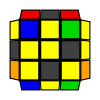
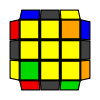
i think it's a really good method.
2x2x2
2 F2L pairs.
pair and PLS
permute U-layer corners while inserting a D-layer edge
last 5 edges per columns first.
or
2x2x2
3 F2L pairs
CLL (of some sort)
insert 1 D-layer edge while orienting U-layer edges.
EP5 (really good alg set)
Where are last five edges algs? I've looked before and can't find them.
ALSO:
not really a full idea, but when I tried and failed to solve a square one intuitively (just got it and didn't know any method) it was not in a square shape but I managed to solve everything but three pieces: two edges and a corner. I determined it would be impossible to solve them with a commutator because of the irregularities in shape making too many turns impossible, but it got me thinking: would a "direct solve" method be competitive? It would be something like this:
Solve cube shape
Get as many pieces as possible solved relative to each other, maybe one or two blocks misplaced and a few pieces totally unsolved (even in the wrong layer)
Solve the rest with algs.
Like I said, this is totally undeveloped, I'm just asking if something like that could be fast.
Last edited: