
cuberswoop
Veteran
It's actually the same alg I use, it's pretty good. I also don't think it's that dumb.

Follow along with the video below to see how to install our site as a web app on your home screen.
Note: This feature may not be available in some browsers.


Thanks Ben, I just added this to another section of my forum post.It’s actually even easier to do R U R' U' (parity alg) U R U' R'.

 timkoop.com

Oh yeah, I remember your thread. But isn't your idea and his have conflicting objectives for a beginner's guide? He's not against using move sequences, for example.I developed an algorithm to discover if your 4x4x4 is in parity long before it is almost solved. You might find it interesting.


Thanks for the idea, but this isn't really a new algorithm. Most everybody knows it. I would suggest looking at Speedcubedb if you want to find abnormal, more interesting algs.I felt like making this thread because I haven’t found any yet so I thought this would be a good idea to post some interesting/new algorithms
New algorithm for Aa perm:
Basically Tperm just with wide R’ moves
r U r’ U’ r’ F r2 U’ r’ U’ r U r’ F’
(Orientation)
View attachment 18679
from JPerm’s PLL trainer

Don't make threads just to make them. If you are going to make a thread it should be over a unique topic with a purpose. Otherwise, just post in the thousands of existing threads. You will more than likely find a thread that discusses something you would make a thread on.What kind of thread should I make?

r U' r U2 R' F R U2 r2 Fyou can use one of edge parity alg for 5x5 to ZBLL alg.
the parity alg for 5x5 is Lw' U2 Lw' U2 F2 Lw' F2 Rw U2 Rw' U2 Lw2
can be used for zbll alg . just ommit the wide moves
L' U2 L' U2 F2 L' F2 R U2 R' U2 L2
Is OLL cancel into T perm really a common solution? I know Feliks did it in one of his world record averages or something, but I haven't seen that recommended as an alg on its own.usually this ZBLL U case will be solved with regular oll alg + T perm with cancelled moves.
but i prefer to use oll parity alg from 4x4 which is Rw U2 x Rw U2 Rw U2 Rw' U2 Lw U2 Rw' U2 Rw U2 Rw' U2 Rw'
on 3x3 it will be R U2 x R U2 R U2 R' U2 L U2 Rw' U2 R U2 R' U2 R'

i do the reverse of that algJust learned a Z Perm for OH
R' U' R U' R U R U' R' U R U R2 U' R'
Oki do the reverse of that alg
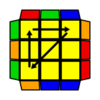
A shorter modified Jperm for this case:this zbll case = solve with this alg
F' (Na perm) F
this zbll case is easy to recognise.
Na perm is R U R U (Jb perm) U2 R U' R'

V Perm being the one Permutation where there is no consensus on what the standard alg is.try this : F (V perm) L'
maybe u confuse why L' not F'
well , standard V perm alg have rotation, so instead of doing y' then F' , just do L'


