I guess it only counts people who have never had a DNF, not people who had at some point in the past never had a DNF. For example, my first two 5BLD attempts were successful but I have DNFd since then.
I guess it only counts people who have never had a DNF, not people who had at some point in the past never had a DNF. For example, my first two 5BLD attempts were successful but I have DNFd since then.
Almost. Bernett also has 1/1 in 5BLD and Jasmine is 34/34 in Clock, not 38/38. (Yes, I know you understood the task differently, but you made me check this ).
Kudos to Jean-Louis and Laetitia for their impressive feats. Must be a French thing.
And ha, I just realized Tim once set the official 24/24 multiblind WR and now he holds this 25/25 multiblind WR.
CREATE TABLE DNFless
SELECT
personId,
eventId,
sum((value1>0)+(value2>0)+(value3>0)+(value4>0)+(value5>0)) solves
FROM Results
GROUP BY personId, eventId
HAVING sum((value1=-1)+(value2=-1)+(value3=-1)+(value4=-1)+(value5=-1)) = 0;
SELECT tmp.eventId Event, max_solves Solves, group_concat(concat(personId,'#',tmp.eventId) separator ', ') Who
FROM DNFless
join (SELECT eventId, max(solves) max_solves FROM DNFless GROUP BY eventId) tmp
on DNFless.eventId=tmp.eventId and solves=max_solves
join Events on Events.id=tmp.eventId
GROUP BY tmp.eventId
ORDER BY rank;
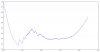
I should have calculated the graph first and asked you about the Top300 . Don't know what causes that mountain.
There are a few special cases, btw.
- 38 people have a round avg5 but no rolling avg5 (example). DNSs are "used" in round avg5s but I ignored them for rolling avg5s.
- 80 people have a rolling avg5 but no round avg5 (example).
I used all people with a rolling avg5 and checked how many of them have a best round avg5 equal to their best rolling avg5. One might prefer a different way, but it won't affect the statistic much. Anyway... 15218 people have only one round average (pretty much guaranteeing a match between it and their best rolling avg5, if they have one). And 21016 of the 29590 people with a rolling avg5 have a best round avg5 equal to their best rolling avg5. Now if I subtract 15218 from those two numbers, I get (21016-15218) / (29590-15218) = 40.3%, so in that sense you were close.
fastest 3x3 solvers who have smallest time difference between their average and single solve (sorted by average for example: 9.5avg 9.2 single 0.3 difference )
fastest 3x3 solvers who have biggest time difference between their average and single solve (sorted by average for example: 9.6 avg 6.8 single 2.8 difference )
Almost. Bernett also has 1/1 in 5BLD and Jasmin is 34/34 in Clock, not 38/38. (Yes, I know you understood the task differently, but you made me check this ).
I did interpret it differently. I was thinking it was longest streak of solves without a DNF, but based on the results I figure that the question is asking for the largest number of solves by a person who has never received a DNF in that event.
SELECT
  personId Cuber,
  sum((value1>0)+(value2>0)+(value3>0)+(value4>0)+(value5>0)) Solves,
  count(distinct eventId) Events
FROM Results
GROUP BY personId
HAVING sum((value1=-1)+(value2=-1)+(value3=-1)+(value4=-1)+(value5=-1)) = 0 and Solves >= 100
ORDER BY Solves desc, Events desc;
What's the smallest total time difference between two competitors who have competed in at least 10 of the same events?
For example, between Faz and Mats:
333single: |5.66-5.55|=0.11
333average:|6.54-7.66|=1.16
444single:|24.66-26.47|=1.81
444average:|28.47-30.93|=2.46
etc.
What's the smallest value of the above where both competitors have 10 events in common?
SELECT
  personId Cuber,
  eventId Event,
  sum((value1>0)+(value2>0)+(value3>0)+(value4>0)+(value5>0)) Solves
FROM Results
GROUP BY personId, eventId
HAVING Solves >= 700
ORDER BY solves desc;
How can I check what is the time that appears more times in MY profile?
I found manually that in 2x2 I did two 5.78, but is there any program that can find more? Imagine being François Courtès, you won't check manually.






 )


