
• Welcome to SpeedSolving.com — the world’s largest puzzle community!

    You’re currently browsing as a guest, which means you have limited access to discussions, resources, member profiles, and community features.

    Join 50,000+ cubers and puzzle enthusiasts from around the world to ask questions, share solves, improve faster, and be part of the community.

    Registration is free, fast, and easy — create your account today.

    Already a member? Log in here to hide this message and start participating.
I need a special kind of 4x4 OLL Parity alg:

So from researching on Google alone I'm not getting far, I found a site with hundreds of Algorithms for parities on 4x4 but nothing I'm actually looking for.

So I know and can execute the basic OLL Parity alg:
r U2 x r U2 r U2 r' U2 l' U2 r' U2 r U2 r' U2 r'

The thing is, this algorithm as well as most other Algorithms are designed to not only flip the top front edge, but also preserve the first 3 layers.

So naturally there should be faster and simpler Algorithms to flip a single edge if you don't care for the first 3 layers.

So now my question is do any of you know (or know a site/way to figure out) a 4x4 "OLL" Parity (a single dedge flip) that doesn't care about the remaining edges and corners?

So things it must do:
1. keep all the centers intact
2. keep all edges intact
3. Flip a single edge
4. Obviously don't flip any single other edge

Things that would be very nice but aren't mandatory:
5. Keeping all other edges oriented
6. Keeping bottom front and bottom back edges in place
see the description here
..
 
I need a special kind of 4x4 OLL Parity alg:

So from researching on Google alone I'm not getting far, I found a site with hundreds of Algorithms for parities on 4x4 but nothing I'm actually looking for.

So I know and can execute the basic OLL Parity alg:
r U2 x r U2 r U2 r' U2 l' U2 r' U2 r U2 r' U2 r'

The thing is, this algorithm as well as most other Algorithms are designed to not only flip the top front edge, but also preserve the first 3 layers.

So naturally there should be faster and simpler Algorithms to flip a single edge if you don't care for the first 3 layers.

So now my question is do any of you know (or know a site/way to figure out) a 4x4 "OLL" Parity (a single dedge flip) that doesn't care about the remaining edges and corners?

So things it must do:
1. keep all the centers intact
2. keep all edges intact
3. Flip a single edge
4. Obviously don't flip any single other edge

Things that would be very nice but aren't mandatory:
5. Keeping all other edges oriented
6. Keeping bottom front and bottom back edges in place
There is a page on the wiki(the biggest page on the wiki, in fact) about parity algorithms, they range from pure flips, easy flips to about every oll parity algorithm discovered.
If you don's wanna search for yourself @xyzzy and @Christopher Mowla will probably gladly help you.
 
(lol was in the middle of writing a reply when I got distracted, then I saw Thom S.'s mention above)

I need a special kind of 4x4 OLL Parity alg:

So from researching on Google alone I'm not getting far, I found a site with hundreds of Algorithms for parities on 4x4 but nothing I'm actually looking for.

So I know and can execute the basic OLL Parity alg:
r U2 x r U2 r U2 r' U2 l' U2 r' U2 r U2 r' U2 r'

The thing is, this algorithm as well as most other Algorithms are designed to not only flip the top front edge, but also preserve the first 3 layers.

So naturally there should be faster and simpler Algorithms to flip a single edge if you don't care for the first 3 layers.

So now my question is do any of you know (or know a site/way to figure out) a 4x4 "OLL" Parity (a single dedge flip) that doesn't care about the remaining edges and corners?

So things it must do:
1. keep all the centers intact
2. keep all edges intact
3. Flip a single edge
4. Obviously don't flip any single other edge

Things that would be very nice but aren't mandatory:
5. Keeping all other edges oriented
6. Keeping bottom front and bottom back edges in place
(This digression section mostly concerns 3×3×3, so "edge" here really means two adjacent edge pieces on a 4×4×4.)

Edge orientation isn't well defined when you're talking about edges that aren't in their home positions. If the top-front edge is an F move away from being solved, is it flipped or not? What about an R move away? Impossible to say without first defining what "flippedness" means for edge pieces in non-home positions.

Some definitions are broken and don't have the nice properties we expect. You might see this in e.g. attempts to define edge orientation on a megaminx that aren't careful enough. Some definitions are very practically useful and are freely assumed in the context of a specific solving method, e.g. ZZ uses the definition of "if edge is solvable with only U, D, L, R turns, it's oriented correctly; otherwise it's flipped". (Exercise #1: Prove that in this definition, the number of flipped edges is always an even number if you start from a solved cube and do legal moves. Exercise #2: Try adapting this definition to a megaminx and see if your proof still works.)

What most people don't seem to appreciate is that there are multiple reasonable ways of defining edge orientation. The one I mentioned above for the ZZ method clearly has a distinguished axis, so it a priori probably doesn't behave well under cube rotations, which it indeed doesn't. (z rotations preserve EO, but x rotations and y rotations don't.) There's a different way of defining edge orientation that is invariant under any cube rotation, still with the properties that (i) some moves affect edge orientation and (ii) the number of flipped edges is always even. (Exercise #3: Specify this explicitly. Exercise #4: There's a common 3×3×3 shape mod where this type of EO is useful; which is it?)

What you really mean in your points 3 and 4 ("Flip a single edge / Obviously don't flip any single other edge") should be that an odd number of edge pairs get flipped, under any of the reasonable definitions of edge orientation.

There's shorter, but to my knowledge, nothing that's truly faster or simpler. The parity wiki page, maintained by Christopher Mowla, has a section on OLL parity algs that don't need to preserve anything at all. The first example there is r B U2 B' 2R B2 2L B2 2R B' D2 B r (in SiGN notation), which is certainly shorter (13 moves in block turn metric (BTM)), but I doubt you can execute that as fast.

The "double parity" alg from the video weruoaszxcvnm linked is also shorter, and you can omit the last U2 move if you don't care about preserving the first three layers. (15 moves with the U2 at the end, 14 without.)

The OLL parity alg I actually use is r2 B2 r' U2 r U2 F2 r F2 l' U2 l U2 B2 r2 (executed as r2 B2 r' U2 r U2 x U2 r U2 r' U2 l U2 B2 r2), which also clocks in at 15 moves.
 
Last edited:
lol was in the middle of writing a reply when I got distracted, then I saw Thom S.'s mention above
I just think about you two, at the topic of parity(or puzzle theory in general) as I don't know any more well suited active members as you two.
I'm sorry for the mention.
 
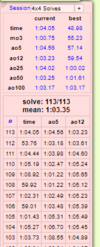
I average Sub-1:05 4x4. my current breakdown is ~5 seconds for F2C, ~10 seconds for F3E, ~15 seconds for the rest of the centres and the Last Cross Edge, ~15 Seconds for L8E, and ~20 seconds for 3x3 stage. I use the Qiyi Qiyuan 4x4 and on a good day, without any lockups, I can get sub-1 times. What should I be working on to get Sub-50?

*Edit: I forgot to add, I average 13 seconds 3x3
 

Attachments

  • 1648393206418.png
    1648393206418.png
    15.6 KB · Views: 3
I average Sub-1:05 4x4. my current breakdown is ~5 seconds for F2C, ~10 seconds for F3E, ~15 seconds for the rest of the centres and the Last Cross Edge, ~15 Seconds for L8E, and ~20 seconds for 3x3 stage. I use the Qiyi Qiyuan 4x4 and on a good day, without any lockups, I can get sub-1 times. I average 13 seconds 3x3. What should I be working on to get Sub-50?
How to sub-50? or at least consistent sub-1?
 
I average Sub-1:05 4x4. my current breakdown is ~5 seconds for F2C, ~10 seconds for F3E, ~15 seconds for the rest of the centres and the Last Cross Edge, ~15 Seconds for L8E, and ~20 seconds for 3x3 stage. I use the Qiyi Qiyuan 4x4 and on a good day, without any lockups, I can get sub-1 times. What should I be working on to get Sub-50?

*Edit: I forgot to add, I average 13 seconds 3x3
Get a good 4x4, like an MGC or Aosu WRM 4x4. Then you will start averaging sub-1 minute without too many lock-ups, if that is what is stopping you from reaching your goal of consistent sub-1 minute/sub-50
 
is blindfolded method the only method without parity on 4x4 ?
disclaimer : i dont hate parity
I don't know of any method that avoids PLL parity but Triforce is an interesting method that completely avoids OLL parity. It's not a reduction method though so it will take getting used to. It also has a neat way where you can do a faster and more efficient PLL parity.

I have a friend who uses the F3L method with 3-2-3 edge pairing (I believe Cube Master also does this.) but he also implements and advanced method called OPA where you trace edges during inspections and determine whether you need an odd number or an even number of quarter turns during your centers. This is much harder though and would take a lot of practice.
 
Back
Top