• Welcome to SpeedSolving.com — the world’s largest puzzle community!

    You’re currently browsing as a guest, which means you have limited access to discussions, resources, member profiles, and community features.

    Join 50,000+ cubers and puzzle enthusiasts from around the world to ask questions, share solves, improve faster, and be part of the community.

    Registration is free, fast, and easy — create your account today.

    Already a member? Log in here to hide this message and start participating.
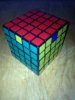
But isn't that like saying "You can't get there from here?" :)

I scrambled the cube, there must be an inverse operation.

Of course there is a way to solve the cube. You asked:

So is there an algorithm for moving just the two center-most cubes without disturbing the rest of the cube?

and we are telling you the answer is no. There isn't a super-simple way to fix what you have in the picture you attached. You need to move the "outer" center pieces around so they match their corresponding inner center.
 
Crap! :)

I am going to write a program to find the shortest path to correct this :)

You could do this, but is it really worth it? All of that trouble to basically cheat, when you could just start over, and have the cube completed in max 5 minutes? If you really want to learn how to solve a 5x5 without cheating, you will need a little bit of practice, just think of it as added practice.
 
The algorithm has basically no purpose though, because it will probably be at least (probably much more) 50 moves which nobody will want to memorize when they can just do it intuitively almost as fast. Not only this, but there are not many cases at all where someone would need to move the centers around like this.
 
here is another one:
E
Lw Rw Dw2 Rw' E Rw Dw2 Rw' E' Lw'
S' Rw S Lw' S' Rw' S Lw
Rw E2 Rw' D2 Rw E2 Rw' D2


actually you don't need any alg for this, really


EDIT: another one
Lw' Dw' Lw E Lw' Dw Lw
E' Rw' Dw Rw E Rw' Dw' Rw
Bw E2 Bw' D2 Bw E2 Bw' D2
 
Last edited:
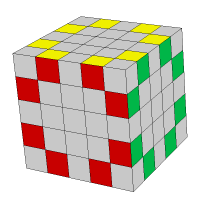
Here is an "alg" that solves the exact fixed center and middle edge case you have in the picture without visually disturbing anything else (38 btm).

That was a great start, thanks! After applying that and fiddling around for a bit, I managed to land in what looks like a 3-cycle for the middle edge cubes

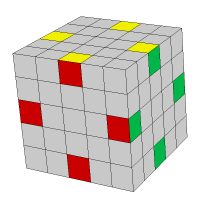
5x5x5 3cycler for middle edge cubes.jpg

The unseen back face is blue and has the Red/Green edge in the middle position. So that would make this a counter-clockwise 3-cycle.
I am hoping there is an alg for this but I have not found a 5x5x5 page like the 4x4x4 parity wiki. Please tell me there is one :)
 
That was a great start, thanks! After applying that and fiddling around for a bit, I managed to land in what looks like a 3-cycle for the middle edge cubes

View attachment 3792

The unseen back face is blue and has the Red/Green edge in the middle position. So that would make this a counter-clockwise 3-cycle.


I am hoping there is an alg for this but I have not found a 5x5x5 page like the 4x4x4 parity wiki. Please tell me there is one :)

if you have red on top and yellow in front, just do M2 U M U2 M' U M2
 
I tried that, and I must have zigged instead of zagged. I had to resolve some centers, leaving me with this:

View attachment 3793

No clue how to proceed.
You can pair up the blue yellow and green yellow tredges with just normal edge pairing using the flipping algorithm which shouldn't mess up any of your F4L and then use the OLL parity algorithm from 4x4 to pair up the orange and yellow tredge and then just use normal reduction for the last layer. For future reference though, always finish edge pairing before you go into reduction.
 
You can pair up the blue yellow and green yellow tredges with just normal edge pairing using the flipping algorithm which shouldn't mess up any of your F4L and then use the OLL parity algorithm from 4x4 to pair up the orange and yellow tredge and then just use normal reduction for the last layer. For future reference though, always finish edge pairing before you go into reduction.

Don't do this
 
You can pair up the blue yellow and green yellow tredges with just normal edge pairing using the flipping algorithm which shouldn't mess up any of your F4L and then use the OLL parity algorithm from 4x4 to pair up the orange and yellow tredge and then just use normal reduction for the last layer. For future reference though, always finish edge pairing before you go into reduction.

Rocky, first of all, NOOB ALERT :)

I am sure OLL and F4L means something to you speed cubers, but to me.... ummm, yeah, no clue.

I got the original Rubik's Cube in 1980 when I was about to enter high school and was able to solve it before there were any solutions (though it took me a few months).

I was stunned to see there was a 5x5x5, I had a 4x4x4 before I graduated in 1984 and solved that "in layers" much unlike the reduction method you guys use. And, as you can see, I tried to solve the 5x5x5 in layers.

I am wondering, is there a 5x5x5 version of this 4x4x4 page?

http://www.speedsolving.com/wiki/index.php/4x4x4_Parity_Algorithms

That page was a real eye-opener for me.

And, I don't know if this is a "big deal" or not for you speed cubers, but I can solve any 2 centers on 4x4x4 or 5x5x5 without messing up any other cubes. That is required when you solve in layers. If someone could tell me how to punch in and save algs on that 3D-java-solver thingee, I would be happy to share.
Don't worry i am almost as much of a noob as you :P
OLL stands for orientation of last layer, this means that you do make the top layer all yellow. http://cubefreak.weebly.com/uploads/1/4/8/1/1481035/6796512.gif
F4L is just the 5x5 way of saying F2L, which when solving a 3x3 means first two layers, but with 5x5 that means the first four layers instead of two.
For the speedsolving wiki parity algorithms, you can just do the same algorithms and on a 5x5 and they will work the same, but on a 5x5 PLL (Permutation of last layer) and OLL (previously explained) don't exist, however you can end up with this case http://i.imgur.com/wsTqj.png of case number one where all of your tredges (triple edges) are paired up except for one is like the first case on that picture, where the center of the edge is right, but the corners of the edge are flipped. This is where you can use an OLL parity algorithm from the speedsolving wiki parity algorithms page. I hope that helped. BTW the easiest method to solve a 5x5 is a method called reduction, it is very easy if you already know how to solve a 3x3 which i am sure you do. Good luck! :tu
 
View attachment 3793

No clue how to proceed.

You could do something like this.

Hold yellow top orange front.
Flip the middle green and orange edges with this. Only turn the very inner slice for the M turns. Click on the alg to see an animation to make sure you are doing the M turns in the correct direction (you can slow down playback speed in the options on the right half of that page). M2 U M U2 M' U M' U M' U2 M U M'

Then do a y rotation (so now blue is in front), and do the following commutator to fix the last few pieces. Try to look at this alg and see how it works; it's basically {slice, flip edge in place, slice, flip edge back}. Again click on the link and then the play button to watch the alg performed. 2R' (U' R U F R2 F') 2R (F R2 F' U' R' U)
 
I tried that, and I must have zigged instead of zagged. I had to resolve some centers, leaving me with this:

View attachment 3793

No clue how to proceed.
You can do what others suggested about reduction, but if you don't want to do that, then just use commutators as in the K4 Method (which assumes that you solve all layers except the last layer, complete all centers, and solve all corners before finally solving the last layer edges).
Here is a K4 solution to your exact case (with orange as the front face and yellow as the top face).

For Wing Edges
In fact, Thom Barlow (Kirjava) founded the K4 Method in 2006. His current website, specifically a page with all last layer algorithms for wing edges (for which I got [r: [U2, l D2 l']] from in the solution above) is here.

If you need a program to expand commutators and conjugates for cube sizes 2x2x2 through 7x7x7 in SiGN notation or WCA notation, and you have Microsoft Excel, I wrote a program that expands it for you. You can download it here (and in that post, there are instructions on how to use).


For Middle Edges
For middle edges, just use an alg like F' R' U F' M' F U' R F' U M U' F2 to flip two adjacent middle edges, an alg like M U' F R' U F' M' F U' R F' U to flip two opposite middle edges and combine either two to flip all 4.
+
F2 U M' U2 M U F2 (for clockwise 3-cycle called the "Ub Perm" on the 3x3x3),
F2 U' M' U2 M U' F2 (for anticlockwise 3-cycle called the "Ua Perm" on the 3x3x3),
M2 U M2 U2 M2 U2 U' M2 (for the 2 2-cycle called "H Perm" on the 3x3x3),
and M2 U' M2 F2 M2 F2 U M2 (for the 2 2-cycle called "Z Perm on the 3x3x3).

By the way, if you are wondering what's the maximum number of short algorithms required to solve any given case of wing edges, Thom mentioned years ago that it is 3. If you want to learn to solve the last layer wing edges of any cube larger than the 3x3x3 with commutators with a step-by-step method, I created a 3 algorithm method to solve every possible case that can arise in every set (orbit) of wing edges.

View attachment cmowla'sK4LLMethod.pdf

(As implied in the PDF, all algorithms, unless mentioned, will work on any cube size larger than the 3x3x3.)
​


, but on a 5x5 PLL (Permutation of last layer) and OLL (previously explained) don't exist,
Speaking of OLLs on the 5x5x5,
cuBerBruce figured out how to count the number of possible OLL cases on the nxnxn cube, and I made a formula from his algorithm. So there are 3799 OLL cases on the 5x5x5 (as opposed to only 57 on the 3x3x3)!

Here's a link to the number of OLLs for cube sizes from 2x2x2 to 20x20x20 (these numbers exclude the correctly oriented case, where all of the top layer is yellow), and here is the thread I started which ultimately ended up with my explicit formula.


For the speedsolving wiki parity algorithms, you can just do the same algorithms and on a 5x5 and they will work the same
Well many of them will, but many algorithms need to be properly translated to odd cubes before it can be successfully applied to the 5x5x5, for example. But surely all of the oldest and most common <U2, F2, D2, B2, l, r> solutions can be directly translated. (Some algorithms cannot be translated to work on odd cubes at all, or will not have the same/desired effect on odd cubes that it does on even cubes).
 
Last edited:
You could do something like this.
Click on the alg to see an animation to make sure you are doing the M turns in the correct direction (you can slow down playback speed in the options on the right half of that page). M2 U M U2 M' U M' U M' U2 M U M'

An amazing site and the perfect resource for experimentation! Interestingly, I always solved those two flipped cubes diagonally away from each other by a different method.
 
Wow, dude, my hat is off to you! Tremendous work!
Thanks.

So is there like a mega-library of these cube moving/flipping formulas, or were they all done by hand one at a time?
Well,

[A]
If you were referring to my K4LL method PDF,
All algorithms (move sequences) except for those on page 11 and the algs on page 9 (except for the first one which only works on the 4x4x4 cube) for the 6 wing edge "OLL" were found by hand. If you are asking specifically about the 2 2-cycles, here's my document where I both collected and created the shortest sequences for all 58 unique 2 2-cycles in the last layer. I have the human author's name attributed an algorithm (if no name is attributed to it, I found it by hand).

The algs on page 11 and those on page 9 that I mentioned I found using CubeExplorer, a 3x3x3 solver. If you are interested to see new algorithms I found by hand for the cases on page 11, see this post.


If you were referring to the algorithm set on Thom Barlow's K4 page,
I'm sure he found most of the 3-cycles and 2 2-cycles by hand, I found a few of those 3-cycle algs by hand, and either he or others used a 3x3x3 solver to create the parity algs (the 2-cycles and the 4-cycles).

[C]
If you were referring to the middle edge algorithms,
I'm sure many people have found them by hand independently (including myself).

Lastly, I'm not sure if this would also spark your interest, but I also created a complete set of algorithms for all 211 F(n-1)L (for a cube size n > 3) to solve two wing edges simultaneously in a single composite edge in the middle layer with one short alg. All of these algs I found by hand (but some people found the 2 3-cycles in it by hand and obviously Stefan Pochmann found the PLL Parity Algorithm I use in it by hand). This is nothing more than an extension to Thom's F3L step in K4, except that we assume the first layer corners are already correctly placed. These algorithms work on all size cubes, not just the 4x4x4.


I apologize for the information overload, but please don't consider learning or trying to comprehend my work right now! I'm happy you have enjoyed the 4x4x4 parity algorithms wiki page (I designed most of it and contributed most of the content on it), but if I were to tell you how I found all those algs by hand (a few I found with Cube Explorer), that would take months!! (I could easily write a comprehensive 500 page textbook on big cube wing edge parity algorithms alone).
 
Last edited:
Back
Top