• Welcome to SpeedSolving.com — the world’s largest puzzle community!

    You’re currently browsing as a guest, which means you have limited access to discussions, resources, member profiles, and community features.

    Join 50,000+ cubers and puzzle enthusiasts from around the world to ask questions, share solves, improve faster, and be part of the community.

    Registration is free, fast, and easy — create your account today.

    Already a member? Log in here to hide this message and start participating.
I have this on my 4×4 Rubik's cube and I'm not sure what to do. Does anyone know what to do?
I also didn't mess where the pieces were.
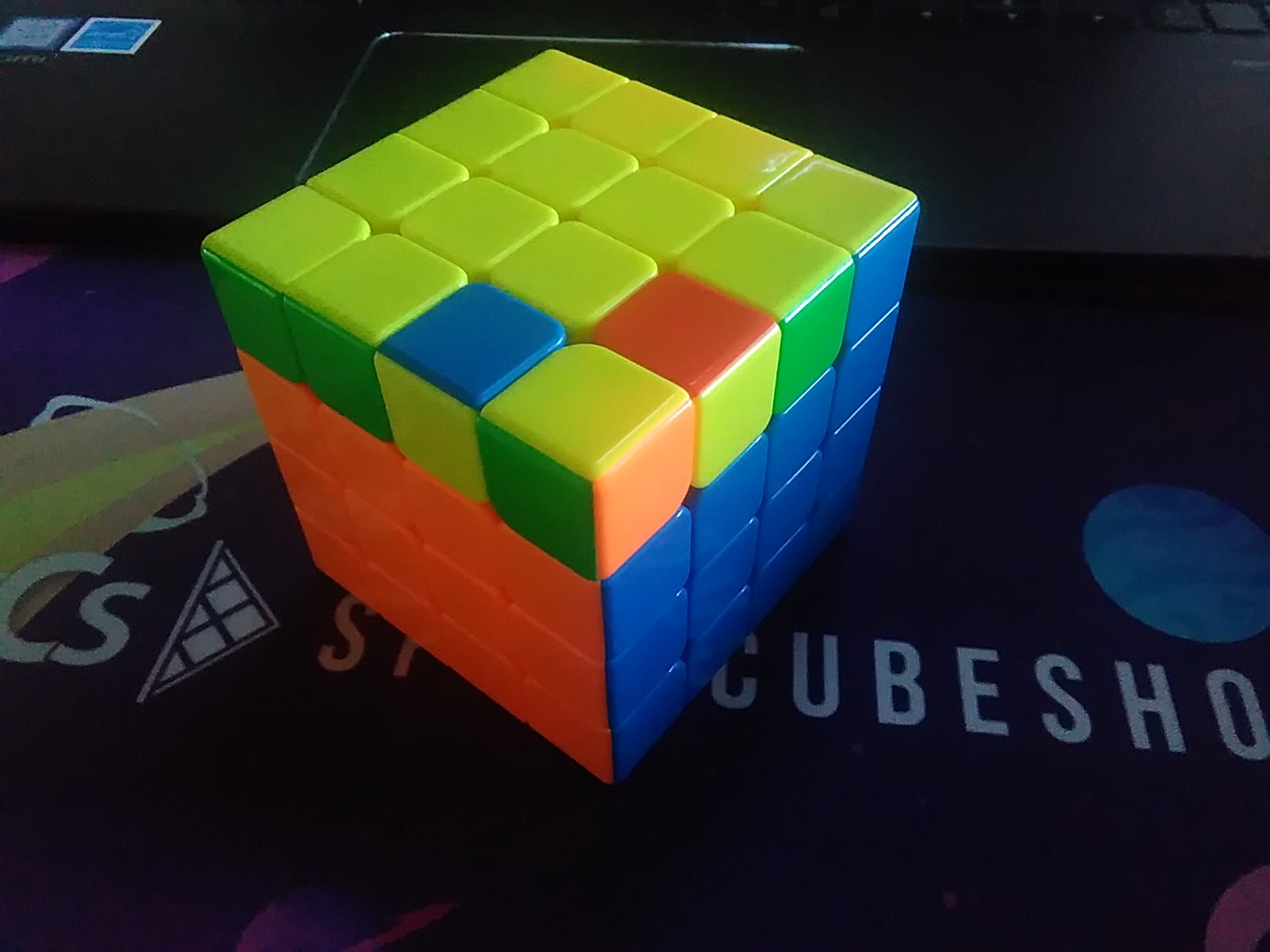
IMG_20201125_181829.jpg
 
I tried it but got the same result. Is it possible in the 4x4 for one corner piece side to correspond to the right colour but the others dont? Because in the 3x3 this is impossible. Either all three sides are wrong or all are correct. In 3x3 on side right and other two swaped isnt possible for corner pieces.
 
I tried it but got the same result. Is it possible in the 4x4 for one corner piece side to correspond to the right colour but the others dont? Because in the 3x3 this is impossible. Either all three sides are wrong or all are correct. In 3x3 on side right and other two swaped isnt possible for corner pieces.
No, that's not possible. You've got the centers in the wrong spots. You need to swap red and orange.
 
6B7E1835-4577-4059-B7C5-913638E2BF3F.jpeg

After getting the edged paired i solved it like a 3x3. But i’ve never encountered this. Red and blue are complete tho. Any formula for only swapping these neighbouring edges?
 
View attachment 15325
After getting the edged paired i solved it like a 3x3. But i’ve never encountered this. Red and blue are complete tho. Any formula for only swapping these neighbouring edges?
You have PLL parity. Opposite PLL parity is solved by r2 U2 r2 Uw2 r2 Uw2, where r is the second layer from the right, U is just the top (Up) layer, and Uw is the top 2 layers. For adjacent parity you can either do opposite parity and then a U perm, or set up the two adjacent edges so they're opposite, and the resulting algorithm is R U R' U' r2 U2 r2 Uw2 r2 Uw2 U' R U' R'.
 
Back
Top