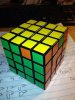
May I know if there's any approach to improve lookahead during edge pairing for 6x6/ 7x7?
For some reason, I feel that the way I'm finding pieces isn't as effective as it could be
 
May I know if there's any approach to improve lookahead during edge pairing for 6x6/ 7x7?
For some reason, I feel that the way I'm finding pieces isn't as effective as it could be

I can't think of anything, it's just a matter of practice. Over time you'll naturally get better at not only looking for certain pieces, but also remembering where something was that you had seen before you were actually actively looking for it.
 
Would lubing my ss 5x5-7x7 make them a lot better?

Also,
7x7: I avg 7:45. About 4-3-:45 splits. The bad thing is the l4e which is usually about one minute which is kinda slow. Are my centers slow too or is it really just full solve?
 
I've only had my 5x5 for a few days and have run into this 4x4 looking parity case a few times. I try doing the algorithm as I would do for the 4x4 but it doesn't work.
http://imgur.com/CksJ8tj

Help would be appreciated!
 
I can't think of anything, it's just a matter of practice. Over time you'll naturally get better at not only looking for certain pieces, but also remembering where something was that you had seen before you were actually actively looking for it.

Okay, thanks
I've only had my 5x5 for a few days and have run into this 4x4 looking parity case a few times. I try doing the algorithm as I would do for the 4x4 but it doesn't work.
http://imgur.com/CksJ8tj

Help would be appreciated!
Can't really tell anything from the photo, but Meep''s site may have the answers
 
I've only had my 5x5 for a few days and have run into this 4x4 looking parity case a few times. I try doing the algorithm as I would do for the 4x4 but it doesn't work.
http://imgur.com/CksJ8tj

Help would be appreciated!

err... that looks like an OLL... r U r' U R U' R' U R U' R' r U' r'

Can't tell exactly from the image, but all the edges seem paired and an even number of edges are oriented.
 
I've only had my 5x5 for a few days and have run into this 4x4 looking parity case a few times. I try doing the algorithm as I would do for the 4x4 but it doesn't work.
http://imgur.com/CksJ8tj

Help would be appreciated!

Assuming that your F3Ls are finished, that is just a normal OLL. Do [F : [R, U]] to orient the two yellow edges and then proceed to OCLL.

Can ZZ be used on 4x4 efficiently?

It took me ages to come to a conclusion: no. You can use Z4 and get fast with it, but it's not the most efficient method. Plus, it is harder to transition between L moves and R moves on big cubes, parity is annoying too.
 
Big Cubes and practice

I am an athlete and am going to college after this summer, so I am really busy and don't have a lot of time for cubes (they are just a hobby). I currently average around 2:15 for 5x5, 3:45 for 6x6, and 5:50ish for 7x7. I only have time to practice one of these cubes, so which should I practice?

Meaning, if I want to just practice general skills that will make me faster with all big cubes, which cube should I focus on?

Edit: What I mean to ask is, if I only practice 5x5 and do 15-20 solves a day, will I get slower at 6x6 and 7x7?
 
Last edited:
No one will have an answer with any evidence, but my response would be along the lines of:

Practising any of those will improve your "basic speed" anyway, so once you have time to get around to practising the others, you might be a bit slower at first, but you will quickly accelerate until you reach your new "basic speed" level. I'd recommend choosing your favourite.
 
6x6 Help

Hi! I am still a little new to cubing and I have had a Shengshou 6x6 sitting in my room scrambled for a whle now. I am trying to learn from a few tutorials but I want to start with the cube solved so I can get to know it better. I don't have the time to take it apart so I wanted to know if there was a website that I could use that would solve it for me. Thanks for your help!
 
I assume you know how to solve a 4x4?

If not, I'd suggest searching some general 6x6 tutorials online. Those will teach you how to solve it probably by using the reduction method.

If you know how to solve a 4x4 just apply that knowledge to the 6x6: centres first, then edges then like a 3x3.

Unfortunately there aren't any sites that will be able to solve the cube for you, I'm assuming you handscrambled the cube as well.
 
4x4x4 Question 2 Edges Remaining Only

I should probably preface this post with the fact I am no speedsolver (did my name give it away?)

I tried to solve the 4x4x4 by myself first. It has taken me over a month to get to my current level of proficiency, which is to say I can almost solve it. I do it "in layers" from the top side down. I know that is not that way you speed cubers do it, but nonetheless, that is how I proceed. What I encounter at the end of the solve are edges on the bottom that are pretty tough to orient. I flip the cube upside-down and then "work the top."

Here is where I get stuck: just 2 edges remaining (image attached).

I have just TFr and TRb unsolved. Does anyone have formulas for moving just 2 edges around on a cube with 4 sides solved? If so, I would very much appreciate it!
 

Attachments

  • stuck_4x4x4.jpg
    stuck_4x4x4.jpg
    66.5 KB · Views: 31
I should probably preface this post with the fact I am no speedsolver (did my name give it away?)

I tried to solve the 4x4x4 by myself first. It has taken me over a month to get to my current level of proficiency, which is to say I can almost solve it. I do it "in layers" from the top side down. I know that is not that way you speed cubers do it, but nonetheless, that is how I proceed. What I encounter at the end of the solve are edges on the bottom that are pretty tough to orient. I flip the cube upside-down and then "work the top."

Here is where I get stuck: just 2 edges remaining (image attached).

I have just TFr and TRb unsolved. Does anyone have formulas for moving just 2 edges around on a cube with 4 sides solved? If so, I would very much appreciate it!
In WCA notation:
R U R' U'
r U2 r' U2 r' U2 l U2 r' U2 r U2 F2 r2 F2 l'
Uw2 Rw2 U2 r2 U2 Rw2 Uw2
U R U' R'
First part is put edges opposite each other, next is to swap the two edges next to the ones you want to swap, third line is swapping both pairs of edges (these two steps swap the two edges you want to swap, but in two steps instead of one), and last is to undo the setup move.

Wow, thanks!

Are there any more tough "endgame" ones like this that I might run into?

Like TFl <--> TRf?

I am trying to prepare for all reasonable contingencies.
 
In WCA notation:
R U R' U'
r U2 r' U2 r' U2 l U2 r' U2 r U2 F2 r2 F2 l'
Uw2 Rw2 U2 r2 U2 Rw2 Uw2
U R U' R'
First part is put edges opposite each other, next is to swap the two edges next to the ones you want to swap, third line is swapping both pairs of edges (these two steps swap the two edges you want to swap, but in two steps instead of one), and last is to undo the setup move.

...wtf
Or you could just
(R U R' U') l' U2 l U2 l U2 r' U2 l U2 l' U2 F2 l2 F2 r (U R U' R')
instead of doing an extra alg for no reason
 
Wow, thanks!

Are there any more tough "endgame" ones like this that I might run into?

Like TFl <--> TRf?

I am trying to prepare for all reasonable contingencies.
That case can be done by removing the third line:
R U R' U'
r U2 r' U2 r' U2 l U2 r' U2 r U2 F2 r2 F2 l'
U R U' R'
Look at this page (or this one if you can't read commutator notation) for algs to solve the T layer; they may have to be adapted for some situations but that should be all you need.
However, I would recommend learning the reduction method, or redux, which is fast and easy to learn. There are many tutorials for it; a google search should find quite a few.

(Also, most people use U (for Up) instead of T.)
 
Back
Top