
Old Tom
Regular
You also need an alg to correct parity when necessary. I use Ra for that.Isn’t it just T, Y, Ja and Jb?

Follow along with the video below to see how to install our site as a web app on your home screen.
Note: This feature may not be available in some browsers.

You also need an alg to correct parity when necessary. I use Ra for that.Isn’t it just T, Y, Ja and Jb?

My daughter actually learned this method many years ago (T perm). She struggled with learning algorithms, so a method with just one algorithm was ideal. She came 2 twisted corners away from being the youngest person (at that particular time) to ever solve a 3x3x3 BLD in WCA competition. So close - so sad.Only 1 alg will work, too.
You can use T perm for both corner & edge, and swap UL/UR if there is a parity.
Same logic can be used for J perm, Y perm. Setup will be slightly more complicated, though.

Not really, just cycle round the edges and see if they’re in the memo. There are only 12 to do. I just do top layer edges, middle layer edges, bottom layer edges. Don’t forgot an edge has two stickers, eg for Speffz D and E are the same.I've opted for the easiest OP method for now. The part that immediately strikes me as difficult is if when I working through my edges or corners I land on the buffer piece and have to start a new cycle from another unsolved piece, how to remember which unsolved pieces I have not yet taken into account, is there a trick for this?

I've opted for the easiest OP method for now. The part that immediately strikes me as difficult is if when I working through my edges or corners I land on the buffer piece and have to start a new cycle from another unsolved piece, how to remember which unsolved pieces I have not yet taken into account, is there a trick for this?

I think most people have a small set of targets they like to use to break into new cycles. Then as they memo, they mentally tick them off if they have been seen already and become unavailable to start new cycles. For example, for edges I prefer to start cycles on A, B, C or D. If I've traced through B and C then I'll keep note that A and D are still available. Very occasionally they'll all get used and I'll have to figure out another target to start on, but that's rare.I've opted for the easiest OP method for now. The part that immediately strikes me as difficult is if when I working through my edges or corners I land on the buffer piece and have to start a new cycle from another unsolved piece, how to remember which unsolved pieces I have not yet taken into account, is there a trick for this?

I use Y modified, R perm, J perm and T perm. I don't know if it's Ja or Jb, it's the one with the J on the right.Isn’t it just T, Y, Ja and Jb?

That's Jb.I use Y modified, R perm, J perm and T perm. I don't know if it's Ja or Jb, it's the one with the J on the right.



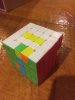
You need to swap the wings alongside the midges. D’ L2 D M2 (F2 Rw2 F2 U2 r2 U2 F2 Rw2 F2) D’ L2 D. (I don't have a 5x5 on me, I hope I got that right!)First full 5BLD attempt, I’m very happy with the result:
View attachment 11194
I can’t seem to attach both pictures to get the whole cube, but I think I was off by 3 x-centers, 3 wings, midge parity, and 5 midges.
Edit: it just occurred to me that I’m an idiot. I need a different strategy for 5BLD midge parity than 3BLD parity. Hmmm. What’s the best approach there? Using U2/U2/r2/M2/OP in that order, at this point. 3BLD parity alg is D’ L2 D M2 D’ L2 D, executed after edges and before corners.
Thanks! That looks like it does what needs to be done! Another alg to learn.You need to swap the wings alongside the midges. D’ L2 D M2 (F2 Rw2 F2 U2 r2 U2 F2 Rw2 F2) D’ L2 D. (I don't have a 5x5 on me, I hope I got that right!)

I don't use M2, but if you mean the DF/UB flip alg, it's (U M')3 U M (U M')4.A question about blind. I'm going camping in the mountains a few hours from Cape Town in the next couple days and I want to spend the time getting back into blind. When using Speffz there is an alg for Q (Edges using M2) which uses M and U moves which is easier to remember than the standard alg. Does anyone know offhand what it is. I cannot remember it for the life of me and I did not write it down or save it to any doc.
That's exactly it, thanksI don't use M2, but if you mean the DF/UB flip alg, it's (U M')3 U M (U M')4.
I knew it was simple, just couldn't figure out.
That's exactly it, thanks
I have a similar one for the flower OLL, (M' U')3 M' U (M' U')3 M' U .... which was why I was getting confused
Thanks again


