oneshot
Regular
Also, where does everyone buy their blindfolds nowadays? Thanks

Follow along with the video below to see how to install our site as a web app on your home screen.
Note: This feature may not be available in some browsers.

I am pretty sure the maximum number is 26 targets (13 letter pairs) without floating buffers.Is there a maximum number of targets to be solved in 3BLD? I’m trying to figure out how to setup my journey for multi blind and am trying to figure out how big my memory palaces need to be. Thanks

I buy my blindfolds from cubelelo.com, they are good for doing noddon. Nod up is a bit difficult using it though.Also, where does everyone buy their blindfolds nowadays? Thanks
yea kindaHave you tried making a story out of it? It worked for me when i was a beginner
Thank you, I have already read that topic but I don't understand solution theory. And after a few days of studying solution theory, I more understand about Orozco.Have you referred to any video tutorials or written document/threads for Orozco corners?
For example: https://www.speedsolving.com/threads/how-the-orozco-bld-method-works.60487/


Memorize one part of the flipped edge, then memorize the other part. When you flip the edge this way, it also flips the buffer. EX: AQ, CI, DE, ED, etc. What part of the edge you choose does not matter, as long as it keeps the memo smooth.Hi. I've been recently trying to get back into 3BLD, and there's something I don't quite remember. (BTW, I use OP/OP) If I am tracing edges and get to my buffer piece (red/white), and I see that it will be flipped in place, how do I know which other edge will be flipped? I know that there can never be just one edge flipped, I just don't remember how to find the other one. After I know that I've done all my edges, and that there is just my flipped buffer and one other flipped edge, I don't really know what to do.

Since you start your memo with the buffer piece, you'll notice immediately that it's flipped in place. Just start your memo with another piece, I usually start with the A sticker (UB). Just check every other edge and see which one is also flipped in place and then do what theepiccuber said, memo the flip as 2 letters. You'll also find which edge it is at the end of your memo, because it'll be the only edge you haven't traced yet.Hi. I've been recently trying to get back into 3BLD, and there's something I don't quite remember. (BTW, I use OP/OP) If I am tracing edges and get to my buffer piece (red/white), and I see that it will be flipped in place, how do I know which other edge will be flipped? I know that there can never be just one edge flipped, I just don't remember how to find the other one. After I know that I've done all my edges, and that there is just my flipped buffer and one other flipped edge, I don't really know what to do.
The pictures aren't showing up, so I'm not entirely sure what the problem is.
If you want to know whether you have the correct AUF at the end, try doing it to a solved cube with your eyes open. If it swaps the UR corners and the UB edge with the UL edge, it's probably correct.
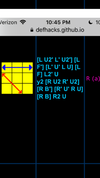
E.g. (U) (R U2 R' U2 R B' R' U' R U R B R2) should work, as should (U') (L U2 L' U2 L F' L' U' L U L F L2) (U2).

If you use the first alg there, start with a U', end with a U2I’m sorry, here’s the picture.
So at the end of the R perm, if I did the U at beginning, it should set it back to where it needs to be with a U’?
You could just skip parity all together. If you use speffz, then if you memorize your C corner as your A corner and vice versa, you will skip parity altogether and will be able to move onto the edges much easier.Pardon the long, drawn-out explanation.
I'm still having trouble using an R perm for parity.
The R perm I normally like in the attached picture, only the second part. I of course never do a y2, I just U turn to get it opposite of the pictire, then perform the 2nd alg(basically backwards)
Now I've been trying to incorporate this R perm as my bld parity alg for the old pochmann method I'm using.
I solve corners then edges. I've been doing it this way because I have a good memo for edges that will keep, and I can so a sound memo for corners and execute them quickly.
For parity I've just been doing an edge swap in between. It works well enough and I seldom make a mistake with it, however it's slower than a single alg, because it's basically an alg done 3 times with a setup and undo move.
In the old pochmann method I'm using the buffer edge piece is on the UR, which would make the swapped pieces the UB and UL, plus the corners on the UR
When parity occurs, the cube in the picture would be look like it was turned clockwise to begin with.
Now, when I attempt to do the R perm, the second one listed, I prlerform a U turn first.
I always end up with a messed up cube when I do this. Should I do a U' at the end of the alg? I've tried this but it still messes up.
I've practiced shutting my eyes, swapping the edges with the edge swaping alg, then, U turn plus R perm, then look and the cube is solved...however when I try to perform the R perm during a blindfold solve, it doesn't work.
Shouldn't it work then if it works when I flip the edges?
I'd appreciate any help. I'd like to use this R perm because it's the easiest for me.
If this perm works in my regular solves, it should work for parity, right?
Thank you!
The second one is the one I use. Yes I did what xyzzy suggested and triedit both ways, eyes open and found this to be the case.If you use the first alg there, start with a U', end with a U2
For the second one, start with U and do no AUF at the end
Exactly as xyzzy said.
The pictures aren't showing up, so I'm not entirely sure what the problem is.
If you want to know whether you have the correct AUF at the end, try doing it to a solved cube with your eyes open. If it swaps the UR corners and the UB edge with the UL edge, it's probably correct.
E.g. (U) (R U2 R' U2 R B' R' U' R U R B R2) should work, as should (U') (L U2 L' U2 L F' L' U' L U L F L2) (U2).
You could just skip parity all together. If you use speffz, then if you memorize your C corner as your A corner and vice versa, you will skip parity altogether and will be able to move onto the edges much easier.
Ex. U' R2 D B2 L2 D R2 U2 F2 U B2 U' B F2 L' U R2 B F' D L Uw
Memo with parity:
Edges: VE JQ RK WI GL C
Corners ( I use E as my buffer sticker, and U-L-B as my buffer): PU BF WH N
Memo using parity-skip trick:
Edges: VQ RK WI GL CJ EJ
Corners: PU BF WH N
When you follow the scramble and try the trick, you will find it pretty easy to use. A lot better than the R-perm algorithm.
As for to fix the problem, I would recommend this R-Perm algorithm if you don't want to "Skip Parity":
(R U R') F' (R U2' R' U2) (R' F R) U (R U2 R') U'
You have to solve edges before corners if you want to do the trick. If you do the corners first and also supply the trick I mentioned, you will end up swapping the A/Q and D/E edges. In the end, 3 pieces will always be swapped if you use your method.Could you tell me a little more please?
It seems by your example that you are only swaping on the edges, would this be of I solved the corners first?
Am I locked into solving the corners first or can I switch it and memo swaping corners if I start with solving the edges.
I'm sorry I'm a bit confused, but the idea intrigues me.
If I'm going through and memorizing, then get to the end and see I'll need parity, will I have ro memorize again, or do I just mentally swap say E for A during my solve using the memo I have?
When I tried this before I messed something up every time, so I gave up on it, but it does seem like it'd be better than an algorithm.
Thank you!