
• Welcome to SpeedSolving.com — the world’s largest puzzle community!

    You’re currently browsing as a guest, which means you have limited access to discussions, resources, member profiles, and community features.

    Join 50,000+ cubers and puzzle enthusiasts from around the world to ask questions, share solves, improve faster, and be part of the community.

    Registration is free, fast, and easy — create your account today.

    Already a member? Log in here to hide this message and start participating.

CEOR help and discussion thread

bcube

Member
Joined
Sep 8, 2010
Messages
759
Hi,

CP beginner here.

I skipped all previous steps from the yruru tutorial and got straight to the pictures at https://devagio.github.io/YruRU/CPLINE/DLS/dls.html.

I grabbed a 2x2x2 cube, did a T-permutation and expected I would be in the swap UFR-UBR case now. However, when applying the F' U F algorithm, it will not bring me to the <R,U> reduction as expected. How do the picture and algorithm work then?

Also, I could start from a solved 2x2x2 cube, do a T-permutation, then do a y' rotation. I would expect that the swap UFR-UBR case is changed to the swap UBR-UBL case now because the DL corners are still solved even after the y' rotation. That means I could take the algorithm F' U F from the swap UFR-UBR case and modify it to the R' U R for the swap UBR-UBL case. However, R and U turns only can not swap 2 corners. So again, how do the picture and algorithm work?
 
I grabbed a 2x2x2 cube, did a T-permutation and expected I would be in the swap UFR-UBR case now. However, when applying the F' U F algorithm, it will not bring me to the <R,U> reduction as expected. How do the picture and algorithm work then?

Oops, I have been doing F' U' F instead of F' U F. Never mind this part then.
 
Also, I could start from a solved 2x2x2 cube, do a T-permutation, then do a y' rotation. I would expect that the swap UFR-UBR case is changed to the swap UBR-UBL case now because the DL corners are still solved even after the y' rotation. That means I could take the algorithm F' U F from the swap UFR-UBR case and modify it to the R' U R for the swap UBR-UBL case. However, R and U turns only can not swap 2 corners. So again, how do the picture and algorithm work?

Ok, now I get. It would still be 2-gen, only <B,U> instead of <R,U> due to the y' rotation.
 
Hi,

CP beginner here.

I skipped all previous steps from the yruru tutorial and got straight to the pictures at https://devagio.github.io/YruRU/CPLINE/DLS/dls.html.

I grabbed a 2x2x2 cube, did a T-permutation and expected I would be in the swap UFR-UBR case now. However, when applying the F' U F algorithm, it will not bring me to the <R,U> reduction as expected. How do the picture and algorithm work then?

Also, I could start from a solved 2x2x2 cube, do a T-permutation, then do a y' rotation. I would expect that the swap UFR-UBR case is changed to the swap UBR-UBL case now because the DL corners are still solved even after the y' rotation. That means I could take the algorithm F' U F from the swap UFR-UBR case and modify it to the R' U R for the swap UBR-UBL case. However, R and U turns only can not swap 2 corners. So again, how do the picture and algorithm work?
 Twizzle link 
 Setup 
R U R' U' R' F R2 U' R' U' R U R' F' y'
 Moves 
F R F' //cpfb
Rw U R' U' Rw' //eo stripe + right block
R' U' R U' R' U2 R U2 R' U2 R U R' U R U //2gll


after T perm + y' rotation, your possible swaps are UBR/UBL, UFR/DFR, UFL/DBR... so, do F R F' to solve CP
 
after T perm + y' rotation, your possible swaps are UBR/UBL, UFR/DFR, UFL/DBR... so, do F R F' to solve CP

Two follow-up questions:

1) I don't want to memorize algorithms. Is there an intuitive way to figure out what moves do I have to do to swap UBR and UBL pieces? I mean, to swap those 2 pieces, F R F' alg is not obvious to me.

2) in the table at https://devagio.github.io/YruRU/CPLINE/DLS/dls.html there are 2 algorithms for each case. What is your thought process for choosing F R F' as opposed to choosing F' U2 F?
 
Here is how I use CEOR; not suitable for speedsolving, but it's fun, and you don't have to learn new algorithms. I know this method as "Noah's CP2".

1. Solve a 1x2x3 block on the left.
2. Put the DFR and DBR corners into their places, with "synced orientation". By that, I mean either both of them are solved; or one needs to be twisted CW while the other CCW.
3. In this case, looking at the top corners you can recognize which two you need to swap; similar how you recognize CLL/CMLL cases.
4. I use F' U' F to swap the two front corners (UFL and UFR). If I need a diagonal swap, I use R' F' U' F.
5. EO with R/r/M/U.
6. Solve DF and DB with R/R/M/U, forming a 2x2x3 on the left.
7. 2-gen F2L.
8. 2GLL, or 2-gen OLL/PLL.

Extra: In step 2, you can place DFR and DBR in a swapped position relative to each other; in that case, when it comes to recognition in step 2-3, you have to "create a diagonal case", so swap the opposite 2 U-corners compared to what you'd normally swap. If the case you "read" says UFL and UFR needs to be swapped, swap the other two corners! (U2 F' U' F in this case)

There are a few examples in the Example Solve forum:

EDIT: Here as you can see, I placed the DFR and DBR corners swapped! Because that was easier. The CLL case shows I need to swap the corners on the BACK, BUT because of this, I had to swap the FRONT corners. So, F' U' F right away!
 
Two follow-up questions:

1) I don't want to memorize algorithms. Is there an intuitive way to figure out what moves do I have to do to swap UBR and UBL pieces? I mean, to swap those 2 pieces, F R F' alg is not obvious to me.

2) in the table at https://devagio.github.io/YruRU/CPLINE/DLS/dls.html there are 2 algorithms for each case. What is your thought process for choosing F R F' as opposed to choosing F' U2 F?

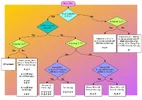
1. learn from this flowchart, on how to solve CP. it's not really algorithms, you kinda just gotta get used to it
2. usually just QTM, but in a real solve, you should see how each way of solving CP influences other pieces for a shorter solution.
 

Attachments

  • CP-Line_Flowchart_PERSO.webp
    CP-Line_Flowchart_PERSO.webp
    78.3 KB · Views: 5
1. Solve a 1x2x3 block on the left.
2. Put the DFR and DBR corners into their places, with "synced orientation". By that, I mean either both of them are solved; or one needs to be twisted CW while the other CCW.
3. In this case, looking at the top corners you can recognize which two you need to swap; similar how you recognize CLL/CMLL cases.

Your way might seem a little overcomplicated for beginners like me to do the CP part on a 2x2x2 cube. Let me simplify it a bit.

In step 2, put DFR and DBR into the bottom layer regardless of their permutation and orientation.

In step 3, you don't need to know how to recognize CLL/CMLL cases by heart.

Extra: In step 2, you can place DFR and DBR in a swapped position relative to each other

Nice tip, thanks for mentioning it.

in that case, when it comes to recognition in step 2-3, you have to "create a diagonal case"

What Renslay meant by that is that if you have adjacent corner swap in the bottom layer and diagonal corner swap in the top layer, that case is already reduced to the <U,R> group.

1. learn from this flowchart, on how to solve CP. it's not really algorithms, you kinda just gotta get used to it

Too difficult for me, I guess I will keep using my intuitive way then :-)
 
Back
Top