• Welcome to SpeedSolving.com — the world’s largest puzzle community!

    You’re currently browsing as a guest, which means you have limited access to discussions, resources, member profiles, and community features.

    Join 50,000+ cubers and puzzle enthusiasts from around the world to ask questions, share solves, improve faster, and be part of the community.

    Registration is free, fast, and easy — create your account today.

    Already a member? Log in here to hide this message and start participating.
I would do:

Holding the cube blue in front and yellow up:

(note that here M and M' means only the middle slice, NOT the 3 innermost slices...)
(R B) M' U M' U M' U2 M U M U M U2 (B' R') that solves midges


I modified my 4x4x4 code to solve the 5x5x5 cube. Knowing it would be too long to solve the position shown, I broke it up into 2 steps. My program found this solution:

F- R- T+ F- {middle f towards t} F+ T- R+ F- T+ {middle t towards f} T- F2

which translate to

F' R' U F' M' F U' R F' U M U' F2 which is only 13 turns, but it took like 5 hours to solve.

This is probably one of the shortest combo algorithms for this case.
(2R2 B2 U2 2L U2 2R' U2 2R U2 F2 2R F2 2L' B2 2R2)(R2 U B' R 3D R' B U' R B' 3D' B R)

Yeah that worked! You are going to have to tell me how to "command" the web page to set up and solve positions. It is a very cool utility!
 
Last edited:
Hey Chris,

I bet I have a 5x5x5 arrangement that you have never seen :)

It's like a U-perm but with both wing edges on each of the 3 sides that need to be solved. Orientation is correct, but cubie placement is needed.

Red side has 2 orange wing edges
Green side has 2 red wing edges
Orange side has 2 green wing edges

Middle edges are fine.

Top, Left, and Bottom sides are all completely solved.

I looked on your K4LL pdf file and could not find this one.

http://www.ryanheise.com/cube/commutators.html

Here. Just learn how commutators work and you will be able to solve ALL the cases you will ever see on a cube...

Just asking a solution for every individual case you come up with doesn't really teach you that much.

However your current case can be solved by either:
1. Just use 2 commutators to solve the wings.
2. do normal U-perm to solve wings (and mess up the midges) then use 1 commutator to solve the midges again.

Just learn COMMUTATORS pelase
 
It was actually easy to solve and I solved it before posted. I just said "I bet you never saw it" because I thought it had to be exceedingly rare.

Plus I have a 5x5x5 solving program now for cases when I get stuck or when I want to see if shorter solutions exist. So far I have found 11 new ways to solve last layer arrangements that are shorter than what I have seen.
 
I looked on your K4LL pdf file and could not find this one.
My K4LL PDF files does not list every one of the 8! cases. It's a substep method for a single orbit of wing edges on the nxnxn cube that only requires 66 algorithms to solve the last layer wing edges in at most 3 steps (including parity).

If you would like to see how either I and/or my K4LL PDF file solves your case, I would request that you either post images or simply give an algorithm setup which generates that case on a cube.
 
Last edited:
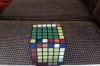
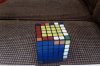
I have a really weird case on the last two edges of my 6x6. I can't find any solutions anywhere, so if somebody could help me with this one case, and maybe point me to another page with many more last two edges on 6x6 cases, it would be greatly appreciated!

Photo on 8-4-14 at 7.28 PM #2.jpg
Photo on 8-4-14 at 7.28 PM.jpg
 
I have a really weird case on the last two edges of my 6x6. I can't find any solutions anywhere, so if somebody could help me with this one case, and maybe point me to another page with many more last two edges on 6x6 cases, it would be greatly appreciated!

View attachment 4342
View attachment 4343
I'm assuming you know the flipping algorithm.

It would be flip the right edge, 3U', flip the right edge, 3U, flip right edge, 2U', flip the right edge, 2U, parity on right edge. It could be done much more efficiently, but this is a very simplistic example. In general, just reduce 6x6 L2E cases to 5x5 L2E cases by solving the inner edges just like you would on a 4x4.

And as far as 5x5 L2E go, here's my guide:
No bars: Slice, flip, slice back.
Checkerboard bar: slice so that the other piece of the bar takes the place of the checkered piece, flip, slice back. You may need to flip one of the edges to position the other piece this way.
Solid bar: same as above except pretend the solid bar is checkered
Double parity (two checkered edges): slice the innermost E slice, flip, slice back.
 
How do I get weight 2 lube to stay in my 6x6 for more than 2 days?

Also, how to fingertrick the 'parity' alg that goes like : Lw' U2 Lw' U2 F2 and so on?
Or do fast people use something else?
 
Last edited:
How do I get weight 2 lube to stay in my 6x6 for more than 2 days?

Also, how to fingertrick the 'parity' alg that goes like : Lw' U2 Lw' U2 F2 and so on?
Or do fast people use something else?

I have the same problem with weight 2 assorted cubicle lube. Perhaps it just isn't good lubricant and we should both get something else.

The parity algorithm most of the fast people use is Rw2 B2 U2 Lw U2 Rw' U2 Rw U2 F2 Rw F2 Lw' B2 Rw2, I believe.
 
Last edited:
To those who use yau5 for 5x5, what are your ratios for cross and centres to average. I'm about 45 to 1:30 and don't know which stage needs the most improvement.

I would just work on whatever "feels" particularly bad to you, because my proportion seems to be waaay different than Pedro Roque's, since his 56.99 SAR (which is faster than my PB single) had cross+centers that would just be "okay" for me
 
Good evening everyone,
I'm a new member and a new cuber.
I recently bought a V-Cube 7 and I'm slowly starting to get better at solving it but something weird (to me at least) happened and now I can't solve it anymore. Basically after I solved it for the first time, I decided to try out some of the algorythms with the solved cube to see the effect they had on the whole cube.
The idea was to do one at a time reversing it before getting to the next one but it didn't go well, I screwed up pretty soon and wasn't able to reverse so I just decided to scramble it and solve it again...
I ended up (I'm not kidding, I swear) with an unsolvable cube, at least according on the info I gathered around: after completing the edges, one of them (and only one edge) had the middle piece flipped over.

Since then I scrambled it very hard another couple of times and every time I got a single edge with flipped pieces (now I'm looking at the blue/white edge with both the inner pieces flipped) which is again, if I'm not wrong, an unsolvable state.

Is there any other way to fix this situation without taking it apart? Has anyone else managed to mess up his cube like this just by screwing up an algorythm?

Thank you all in advance for the support and sorry for my bad english.
--
Michele.

First of all, your English is fine! Second of all, Have you popped it before? If not then the only possible outcome is that you have to do the parity alg. But just take it apart anyway and fix it.
 
First of all, your English is fine! Second of all, Have you popped it before? If not then the only possible outcome is that you have to do the parity alg. But just take it apart anyway and fix it.

Thanks for the fast reply. I never popped it before and I will need to watch videos carefully before attempting to take it apart. As for the parity alg. I know it and tried multiple times despite having read that parity errors always come in pairs. As a matter of fact every time I try and apply the alg, it corrects the orientation of the pieces I'm currently working with (for reference I always put the pieces I wanna flip in the right edge of the F face) but it flips the same pieces on the edge that's across the one I solved.

I also tried to cause the same parity error in a solved edge but it created another one on the opposite edge so I ended up with an odd number of parity errors again. I can solve two at once but the third will stay flipped.

It's hard to believe that a wrong move (or a combination of) would leave the cube in an unsolvable state but I have no clue at all on how I could possibly have generated a single parity error...

Don't worry, taking it apart isn't too hard. But if your case is true then the only plausible case is that it popped. So my advice, you just have to take it apart and fix what is wrong with the cube.
 
Thanks for the fast reply. I never popped it before and I will need to watch videos carefully before attempting to take it apart. As for the parity alg. I know it and tried multiple times despite having read that parity errors always come in pairs. As a matter of fact every time I try and apply the alg, it corrects the orientation of the pieces I'm currently working with (for reference I always put the pieces I wanna flip in the right edge of the F face) but it flips the same pieces on the edge that's across the one I solved.

I also tried to cause the same parity error in a solved edge but it created another one on the opposite edge so I ended up with an odd number of parity errors again. I can solve two at once but the third will stay flipped.

It's hard to believe that a wrong move (or a combination of) would leave the cube in an unsolvable state but I have no clue at all on how I could possibly have generated a single parity error...

From the way you describe it, I would guess that your cube IS solvable. Can you post a picture of the cube? This sounds like edge pairing parity. The middle edge piece isn't flipped. It's correct, and the edge pieces that aren't in the middle are flipped in pairs of two.
 
Back
Top