Random Cubing Discussion

Ok, I just wasn't sure how you would define 'parity' when not on the 3x3 stage, but that sounds like a good definition.

If you need an odd number of slice moves to solve the edges, it's parity.
In this case (l' U2 l' U2 F2 l' F2 r U2 r' U2 l2), the slice moves are: l', l', l', r, r', l2. That's 7 slice moves. 7 is odd. Therefor this is parity.
 
Wolfram|Alpha thinks you must be on drugs to solve a big minx: http://www.wolframalpha.com/input/?i=petaminx
It thinks you mean 'ketamine', which is used as an anesthetic and as a recreational drug.

What I find to be a more complicated situation is when you get the same scramble for the second time.
[...]
What I do: When I inspect and think it is the same scramble, I will say to the judge "I think it is the same scramble". Then I will solve it, if possible using the same solution to go sure. If I am sure that it's the same scramble, I will tell the delegate.
Yeah, it's tough. A long time ago this happened to me right after a really good OH solve (16 seconds, which was amazing at the time). I got the same scramble, said "yeah, I'm pretty sure this is the same scramble", solved it with the same solution just to make sure, and got another 16, which of course wasn't legitimate :p It took me more than 2.5 years to get another real 16.
 
Last edited:
Also the judge is really doing a bad job if he asks the competitor about the penalty. When a judge asks me if I get a penalty, I tell him or her to ask another judge or the delegate.

What I find to be a more complicated situation is when you get the same scramble for the second time. In that case:
- You can never be sure if it's the same scramble again, and in theory there could be the same scramble twice in a row.
- You can't be sure if it's the wrong scramble, or the last scramble was the wrong one.
- That means, you still should solve the scramble! But if you solved it, and then tell the judge it's the same scramble, you can't prove it ...
- I'm sure this is happening many times, and people don't tell their judge, because they propably get a good time. (Someone once had a WR because of this, and admitted it years later)
- etc.

How should one react as competitor / judge?
What I do: When I inspect and think it is the same scramble, I will say to the judge "I think it is the same scramble". Then I will solve it, if possible using the same solution to go sure. If I am sure that it's the same scramble, I will tell the delegate.

When a judge asks me about a penalty I tell them what I would tell them as a judge, not based on what's in my favor.
 
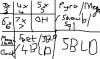
Video idea: Have a 5BLD solve throughout the whole video, whilst showing other solves in smaller boxes around the video space. Example with my pro MS Paint skills. Video idea.png
 
Has anyone tried scrambling a Skewb 2-gen (using only R and L moves) and then solving it 2-gen? If you can do it, what's your method? I can't actually do it...

This question could probably be asked somewhere else, but it's relevant to this post and I don't want to post unnecessarily, so: if you start with a scrambled Skewb and then solved two opposite corners of a layer (like the block you get if you scramble 2-gen), can you always solve it with 2-gen? If not, why not? I don't know much about Skewb...
 
Last edited:
Has anyone tried scrambling a Skewb 2-gen (using only R and L moves) and then solving it 2-gen? If you can do it, what's your method? I can't actually do it...

This question could probably be asked somewhere else, but it's relevant to this post and I don't want to post unnecessarily, so: if you start with a scrambled Skewb and then solved two opposite corners of a layer (like the block you get if you scramble 2-gen), can you always solve it with 2-gen? If not, why not? I don't know much about Skewb...
No you cant. if you scramble 2gen, After inserting 2 corners, you'll always get either Pi or solved corners and either solved centers or H/Z conjugates. I have no idea why though.
 
No you cant. if you scramble 2gen, After inserting 2 corners, you'll always get either Pi or solved corners and either solved centers or H/Z conjugates. I have no idea why though.
I've just managed to get a U perm of centres (FL -> U -> BR). I thought I had an L case for corners once, but then realised I had two opposite corners swapped in D... I'm still trying to get an L case for corners with the D layer corners solved, but it's hard enough solving the D layer corners :p
E: got an L case for corners.
... are you sure you always get what you said? ;)

By 2 gen, you mean turning two adjacent corners right? I tried using K solve a while ago and it could not do a Uperm 2 gen, which is when I realized this. Are you sure your not turning a third face?
 
Are there any adjacent states that are both optimally solved in 20 turns (HTM)? So for example, I have a state that is optimally solved in 20 moves HTM, I perform one turn in HTM and the new state is also optimally solved in 20 moves HTM?
 
Are there any adjacent states that are both optimally solved in 20 turns (HTM)? So for example, I have a state that is optimally solved in 20 moves HTM, I perform one turn in HTM and the new state is also optimally solved in 20 moves HTM?

How can this possibly work? If I make 1 move on a 20 HTM optimal position, shouldn't you get closer to the solved state?

(If I'm missing something here, please correct me)
 
Are there any adjacent states that are both optimally solved in 20 turns (HTM)?

If there is a state that has A R2 as an optimal solution (A represents any 19 moves), then the state A R' is one move away from the first state, and also has a 20 move optimal solution. But I guess you want 2 states where the last move of the optimal solution is different :)
 
How can this possibly work? If I make 1 move on a 20 HTM optimal position, shouldn't you get closer to the solved state?
(If I'm missing something here, please correct me)

Well, let's say we have a state optimally solved in 20 turns.
Let's do U, there are 2 possibilities:
- The new state is optimally solved in 20 turns. (NO optimal solve for the 1st state starts with U)
- The new state is optimally solved in 19 turns. (One of the optimal solve for the 1st state starts with U)

- The new state can't be optimally solved in 18 turns or less. (The optimal solve for the 1st state will be in 19 turns or less)
- The new state can't be optimally solved in 21 turns or more. (because god's number is 20)

S <-----------------------20 irreducible moves-----------------------> V state
O................................................................................................|
L................................................................................................U
V................................................................................................|
E................................................................................................V
D <-----------------------19 or 20 irreducible moves ? -----------------> W state


If there is a state that has A R2 as an optimal solution (A represents any 19 moves), then the state A R' is one move away from the first state, and also has a 20 move optimal solution. But I guess you want 2 states where the last move of the optimal solution is different :)

Are you sure ? If there is a state that has A R2 as an optimal solution (A represents any 19 moves), then why B R can't be an other optimal solution (B represents any other 19 moves) ? I mean if A R2 is an optimal solution, maybe B R is an other optimal solution and so the state A R' may have B (19 moves) as an optimal solution...

S <-----------------------19 irreducible moves-----------------------> X state ----
O................................................................................................|...............R2
L................................................................................................R.................. -----> V State (with a 20 moves optimal solution)
V................................................................................................|.................. ----->
E................................................................................................V...............R
D <-----------------------20 irreducible moves-----------------------> W state -----
 
Last edited:
How can this possibly work? If I make 1 move on a 20 HTM optimal position, shouldn't you get closer to the solved state?

(If I'm missing something here, please correct me)

That assumes there is a 20-move solution for that position starting with every single possible first move. I think that's unlikely (granted on no evidence) so I'd say, no, you don't necessarily get closer to solved.
 
Odd layered puzzles don't have internal pieces right?
Puzzles as 1x1x1, 3x3x3, 5x5x5, 7x7x7, 9x9x9, 11x11x11... don't need to have internal pieces, except the core (3D cross). But some 3x3x3s have removable torpedoes. My Rubik's brand 4x4x4 don't have internal pieces : it's a ball with some holes (instead of the core). But most of Even layered puzzles are Odd layered puzzles with some hidden pieces.
 
Back
Top