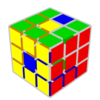
Some thoughts on Pinkie Pie. It is a proposal for Roux where the UL+UR edges are placed, oriented, at DF+DB after F2B. Then the user does OLLCP and ends with L6EP.
The first step of placing the two L/R edges on the D layer is almost equivalent to the common proposal of combining Roux and CFOP by solving F2B then placing the DF+DB edges. Maybe around a move more efficient. If that Roux+CFOP proposal is seen as not a good way to build F2L and end with OLL and PLL, then maybe Pinkie Pie should be viewed the same. Maybe it should be viewed as better to do a cross with the UL+UR edges at DF+DB then the four F2L pairs and end with OLLCP and L6EP. It is the non-EO version of ZZ-4c, which also isn't highly regarded. More details:
Movecount
Normal Roux:
- CMLL - .75 AUF + 10.5 alg = 11.25
- LSE - 14
- Total - 25.25
Pinkie Pie:
- LR to DFDB - 4
- OLLCP - .75 AUF + 12 alg (based on current docs and those developing OLLCP) = 12.75
- L6EP - 7
- Total - 23.75
Algorithms
Normal Roux:
- CMLL - 42
- LSE - 0, intuitive cases for EOLR
Pinkie Pie
Ergonomics
Normal Roux:
- CMLL is free to disturb six edges and four centers. This makes for a lot of freedom in finding great algorithms.
Pinkie Pie:
- OLLCP isn't able to disturb much and it has a very specific goal with more than one step combined. This means the algorithms are more restrictive and won't be as ergonomic overall compared to CMLL.
Number of Looks
Normal Roux:
- CMLL is one look. Some users can predict the OCLL before getting to the step, making CMLL take less time to recognize.
- LSE is three sub steps but is pretty much one look and can be executed almost as fast as if the step was a single algorithm. EO can be seen during execution of CMLL.
Pinkie Pie:
- LR to DFDB is one look. Much can be seen during F2B.
- OLLCP is one look. The CLL case or EO can likely be seen during the previous step. Overall a big longer to recognize compared to CMLL.
- L6EP is one look. Part of the case can be seen during OLLCP.
So overall you would be learning 331 algorithms which are less ergonomic and slower to execute than CMLL just to save maybe 1-2 moves. With OLLCP recognition being slightly longer and the algorithms for that step being worse overall than CMLL, that 1-2 move save is cancelled out or possibly even brought into the negative compared to normal Roux. There are other Roux advancements which I think should be the focus for Roux users. Advancements which save many more moves, have better ergonomics, or require fewer algorithms to memorize.