• Welcome to SpeedSolving.com — the world’s largest puzzle community!

    You’re currently browsing as a guest, which means you have limited access to discussions, resources, member profiles, and community features.

    Join 50,000+ cubers and puzzle enthusiasts from around the world to ask questions, share solves, improve faster, and be part of the community.

    Registration is free, fast, and easy — create your account today.

    Already a member? Log in here to hide this message and start participating.
Status
Not open for further replies.
If the tracing it's ok, the odd number mean a parity.
What I was talking about is if sides are even and corners are odd(and vice versa), that means I made a mistake... they have to both be even or odd.

I just don't get why sometimes no matter how many times I recheck it, it comes out un even, because I know that and even number on both means no parity and odd means parity.
Sighted solves can help a lot in identifying your tracing mistakes (other types of mistakes, too). Just solve two pieces and check if the cube looks as you expected. Once you reach the last one or two pieces, it should be much easier to find your mistake. Works for edges and corners.
 
Sighted solves can help a lot in identifying your tracing mistakes (other types of mistakes, too). Just solve two pieces and check if the cube looks as you expected. Once you reach the last one or two pieces, it should be much easier to find your mistake. Works for edges and corners.

Thank you! Yes, sometimes when I just can't figure out what I've done wrong I go ahead and solve it sighted and see where I was off, but still hard to tell why I'm missing it.

I think my problem arises when I have more than a few cycle breaks, I'm not accounting for something and like standing too close to something, I can't see it.

It's like a blind spot because I've noticed if I go back and change the first piece I got to choose I wind up with all even or all odd. I know nothing has changed except my perspective.

Hopefully with more time I'll get to where the "blind spots" vanish.

Thanks again!
 
Last edited:
What I was talking about is if sides are even and corners are odd(and vice versa), that means I made a mistake... they have to both be even or odd.

I just don't get why sometimes no matter how many times I recheck it, it comes out un even, because I know that and even number on both means no parity and odd means parity.

Ah ok, pay attention to the cycle breaks. When this happen to me, almost always cause it's cycle breaks.
 
Ah ok, pay attention to the cycle breaks. When this happen to me, almost always cause it's cycle breaks.

Between the time I had responded I went back and looked at a scramble that had me scratching my head, so I set it aside, and sure enough there was on edge on a cycle break that was throwing me off.

Thanks!
 
Last edited:
I use Orozco/M2, with an average of 23sec Corners memo, 14sec Edges memo, and 40sec Execution. I've been thinking of switching to 3-style for corners but I feel like what's really hindering my time is how slow my memo is, since I've seen people being able to reach sub-1 with OP/M2 since their memo only takes around 20-30 seconds. My main problem is that for my Corners memo, I take around 10-15 seconds to list the words for the images, then I pause and spend another 10 seconds to come up with the image in my head. I've tried doing the images and the memo at the same time, but I end up not being able to remember what letter belongs to each sticker, ultimately making the overall memo slower. Any tips for me to improve on this?
 
If you memo edges second and execute them first, don't come up with images or even a sentence for them. Most use audio memorization, where you essentially try to "pronounce" each letter pair in your head. It's not a good long term memory technique, but since you do them right away, you don't need them to stick as long.
 
Last edited:
I use Orozco/M2, with an average of 23sec Corners memo, 14sec Edges memo, and 40sec Execution.
Since you are taking more time to memorise corners than edges, I am assuming you are doing CEEC, and using images for corners and audio for edges. If you have the same system for both (like in MBLD), the edge memo will be a bit longer as there are more targets in edges on average (11.xy vs 7.xy).

My main problem is that for my Corners memo, I take around 10-15 seconds to list the words for the images, then I pause and spend another 10 seconds to come up with the image in my head. I've tried doing the images and the memo at the same time, but I end up not being able to remember what letter belongs to each sticker, ultimately making the overall memo slower. Any tips for me to improve on this?
Best way to practice your lettering scheme is to disassemble the cube, and just point at a random sticker, and you should be unconsciously be able to remember the sticker. If not, try deliberate practice until you are comfortable with this process.

Also, a good way to make corner memo faster, is to join two images, and also make a sentence out of it. You do not need a PAO (Person action object) system of letter pairs necessarily for sentence making. With a bit of practice, you can translate letter pairs to sentence.

When I am not tracing on the cube, I like to practice and get faster with this using the amazing tool created by Roman, https://bestsiteever.ru/memotest/

Happy Memorising!
 
I have been wanting to learn 3x3 blindfolded for a long time now, I have tried many times but I just can't seem to understand it if anyone can help me out that would be much appreciated.
 
I suggest learning Old Pochmann method. It's two algorithms plus a possible third - and you already know the algs. So that just leaves learning the memorization. I won't try to explain it in a post but you're basically memorizing a series of piece swaps that will result in a solved cube. You do that by memorizing the letters of the places that need to be swapped.

I found Speedcubereview's tutorial to be the best of the ones I tried.


This is a good tutorial. I used J Perm's v2 BLD tutorial, so you may want to try that as well:


J Perm has a v3, which is newer, but I personally found the v2 most helpful
 
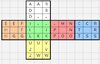
Hi I average 33 with full 3style and I use this letter scheme like the photo under the text
Most top-class BLDers use their absolute orientation like Blue for the up and Red for the front
I don't have it yet. Should I make my own? And is it essential?Screenshot_20210530-213028_Sheets.jpg
 
Last edited:
Hi I average 33 with full 3style and I use this letter scheme like the photo under the text
Most top-class BLDers use their absolute memo face(?) (I don't know what I call this) like Blue for the up and Red for the front
I don't have it yet. Should I make my own? And is it essential?View attachment 15872
It's called orientation and I don't think it's essential to change it if you're ok with your current one I guess.

(I haven't done BLD in ages and used to average 2:00 so take this with a pinch of salt lol)
 
Hello, I was thinking in a form to begin in how to memorize the pairs of PAO, My idea is:

All the words where there's the letter "B", and with a system doing like that:

B (Memorize word) - (Person)
(Memorize word) B - (Action)
B (Memorize word) - (Object)
(Memorize word) B - (Person)
B (Memorize word) - (Action)
(Memorize word) B - (Object)

And repeating this system, like the Orozco Method, but in this case, one word for one letter, including "B", with this system you'll be able to rebember 120 words (to 1680, so that's the 7.14%)

Example: AF-D

BArbie is ForBiding to a BeD
And in the other PAO the same, but chancing the rule of words, What do you think guys?
 
Status
Not open for further replies.
Back
Top