I've got an interesting one for D1: R' D R' D R3 U' R3' D' R D' R
D4 isn't working for me
D6 there is R U2' (R2' F R F') (R U2' R')

C6/B6 are standard, I think (though people usually invert instead of mirror)

F2 is better done as r' U r U2' R2' F R F' R
the F2 algorithm is pretty much the same, but with a wierd semi-cube rotation that makes sense in execution. please dont make fun of my CMLL's many rouxers have CMLL pages in their sigs...
 
Hm, okay.

Not making fun, some algs are just generally better than others.

Speaking of, I should really delete CMLL from my sig. THose algs are old af
 
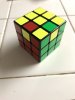
Everything else is solved but these two edge cases. This is my first time using Roux method but don't see any cases like this on other websites. Please help!!!!!!
 

Attachments

  • image.jpg
    image.jpg
    911.8 KB · Views: 14
Everything else is solved but these two edge cases. This is my first time using Roux method but don't see any cases like this on other websites. Please help!!!!!!
How did this happen?
Did you finish solving the corners step and reach this stage? If so, that's really really rare (happens once every few thousand solves). If not, then it's likely that you either missed some edges in the orientation step (4a), or you solved orientation during 4a, but then disturbed it during a later step.

To solve it you can learn an algorithm to flip those two edges in place, but that's probably not worth it for Roux given how rare this case is. A beginner approach that's a little less efficient is to just ignore the solved edges and do the normal steps 4a, 4b and 4c:
(M U M') U2 (M U' M) // orient the edges
U' M' U2 M U2 M2 U' // solve the left and right edges
M2 U2 M U2 M // solve the rest
 
I believe this is just a pure 2 flip for edges. You can solve it the Roux way, or use an algorithm such as
R' U2 R2 U R' U' R' U2 r U R U' r'
 
I am averaging about 14.5 with roux and want to learn how my CMLLs effect EO and move edges. I can find how they effect EO pretty easily but it confuses me when that move and I don't know how to figure out how each alg not only affects EO but moves edges.
 
I am averaging about 14.5 with roux and want to learn how my CMLLs effect EO and move edges. I can find how they effect EO pretty easily but it confuses me when that move and I don't know how to figure out how each alg not only affects EO but moves edges.
(For this post, I assumed all your algs affect the U layer only and not DF or DB. I don't know how to deal with algs that affect either of those pieces, but fortunately not many of my CMLLs do).

Remember that you don't need to know exactly where all the edges are going to end up, only how many edges there are oriented (this part is easier, you only need to know which edges flip when you do the alg) and, if there are 2 oriented, whether or not they are phased.

Reducing it down to only knowing the 2 edge cases simplifies it massively. With algs which solve COLL or do 4-flip, it's merely a matter of learning whether or not it changes the phasing of edges (most do). For algs which do 2-flip, unfortunately you'll have to go through each alg and just experiment a bit with it. Do an LSE scramble, do the inverse alg, then see where the oriented edges are. Then execute the alg and see what effect it had.

(note: if an alg flips two opposite edges and preserves phasing then it won't affect EO if there are two adjacent edges flipped. If there are two opposite edges flipped, you'll get a 4-flip or no flipped edges on U.)

These 2-flip algs are the hardest cases, and to be honest, I didn't do any specific practice with them. I've just done lots of solves and have learned to guess what will happen. Actually doing this practice is optional.

oh, and one final note: remember that commutators (e.g. R' U2 R' D' R U2 R' D R2 and R U' L' U R' U' L) don't affect edges at all, so guessing where the edges will be is easy.
 
I'm average mid 40 seconds with Roux and have a PB of 25.77 with it. Block building is my main weakness. I've trying to watch tutorial and example solve videos as well as use the cubegrass block builder, but both the first and second block building is a hard thing for me to grasp for some reason. Any resources or tips? Knowing someone else's experience with learning block building and improving at Roux would be very helpful as well.
 
I'm average mid 40 seconds with Roux and have a PB of 25.77 with it. Block building is my main weakness. I've trying to watch tutorial and example solve videos as well as use the cubegrass block builder, but both the first and second block building is a hard thing for me to grasp for some reason. Any resources or tips? Knowing someone else's experience with learning block building and improving at Roux would be very helpful as well.
I'm at pretty much the same times, heh. They say up to sub 20 it's just practice.
You should join the Roux facebook group.

A couple of things for now:
FB: teoidus's excellent first block vid
SB: http://tinyurl.com/f2balgs
 
Last edited:
Hey guys, bump. Who here uses 3-sticker sine recog and not the way that I used to use(look all the way around the sune and recog that)
Learning other recognition methods for CMLL has been on my to-do list for a while now but I've not got round to it so far. I eventually want to learn how to recognise every case from every AUF, but not yet.
 
Learning other recognition methods for CMLL has been on my to-do list for a while now but I've not got round to it so far. I eventually want to learn how to recognise every case from every AUF, but not yet.
Okay. Have you looked at my video on the way I recog L cases? that'll help you a lot, mostly because I use a different recog strategy for L and it only needs 3 stickers...
 
Okay. Have you looked at my video on the way I recog L cases? that'll help you a lot, mostly because I use a different recog strategy for L and it only needs 3 stickers...
I can already do L, H and most Pi cases from all angles (two of the Pi cases are very similar). T and U, I can do slowly. Sune/Antisune are the ones I cannot do.
 
How do you recognize 4c for UFUB?

I can usually figure it out but i takes me a long time and i mess up sometimes:(
 
try to create to 3x1 bars, one on U and one on D. that means, opposite colors need to be separated into their corresponding layers (i.e. if you see a (white or yellow)+red edge and a (white or yellow)+orange edge both on U or both on D, that means they've formed a bar, since w/ UFUB you know that those are the only two possible pieces that could form a bar)
 
For Eo during roux is it faster to cycle edges or to solve them directly?

How do you practise roux first and second block?
 
Last edited by a moderator:
Back
Top