dominugget
Regular
- Joined
- Aug 14, 2015
- Messages
- 96
How to recognize L cases for CMLL?
Sent from my iPhone using Tapatalk
Sent from my iPhone using Tapatalk

Follow along with the video below to see how to install our site as a web app on your home screen.
Note: This feature may not be available in some browsers.

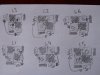

On the daily CMLL list, I include my recognition method (with diagrams). Each case is on a different page unfortunately, so to make it easier I'd suggest learning recognition in pairs: L5 and L4, L1 and L6, L2 and L3. These are separated by the pattern of colours (opposite, adjacent, same) on the U layer.How to recognize L cases for CMLL?

I keep hearing that LSE should be one continuous step, where you look ahead to the next step while performing the previous, but I'm having some trouble wrapping my head around it. For example, I try and track UL/UR while orienting edges, but everything is moving around so quickly that it's hard to see/visualize where they'll end up--same for BU prediction. How do you guys approach this?
Do you actually see the ULUR pieces coming up as you do EO, or are you just familiar enough with EO cases that you know where they'll end up?
How do you recognize the M slice edge cycles quickly/while performing L/R reduction? They all seem to look similar to me. What I'm doing right now is looking at the U/D faces and if there's one square of opposite color on U, put it in it's proper position on the D layer (e.g. by performing M' U2 M U2), but that only covers some of the cases.


Yeah, that's pretty standard.I use CFOP, but I like trying the other methods for fun. Are there any tips for doing the first block? I usually do a 2x2x1 block and then do a f2l pair.
That's seems to me to be two separate alg sets or one very large set... Don't think that has any benefit over ul and ur in D + OLLCP
Sent from my ONE E1003 using Tapatalk
I have now decided that standard FB SB CMLL LSE is the best. Even if I'm gonna get a 6 flip, I'll usually do my standard alg and just cancel into the 6 flip (Unless the flipping alg is just as fast). I basically stopped learning ollcp because there are so many other parts of my solve that can still be improved (most importantly: frickin CMLL recognition! Only pause in my solve). In the time it takes to recognize CMLL and pick an alg to skip EO or separate LR edges, I can probably recognize CMLL and be part way into the algorithm. Also, ollcp and sse's suggested algs are definitely slower than standard CMLLs so slower recog and slower exec for something that can be done in a few moves in the next step is pointless. LSE TPS is also much higher than CMLL TPS, so I would rather get CMLL over with faster so I can take advantage of the sexy 2 gen moo.

So how you would you usually solve this. Setup: M' U M' U2 M2 U2.
The EO case is pretty easy, I'd go for M U M' to solve EO and UF/UB (instead of UL/UR), then just finish with U M2 U2 M2 U'.
The length of this solution is 8 moves, while the optimal solution has 6 moves at max.
The standard EO+ULUR+M approach seems to fail in this simple case. Would an experienced Roux solver be able to solve the LSE optimally in this case? And how am I supposed to approach a case like that?
Another question, how many moves does the worst LSE case take to solve?
Misoriented centres gets 7 if you see the cancellation between EO and ULUR/EP:
M' // EO
M' U2 M2 U2 M' // ULUR+EP
U' M // fix centres
or alternatively a normal misoriented centres approach of M' U2 M2 U E2 M E2 also gives 7 moves. I don't know how you would see the 6 move solution in a speedsolve though...
Thank you. But what exactly is the misoriented center approach then? Didn't find something like that in my Roux tutorial so far. It's a bit hard to follow what's going on and I couldn't find solutions like that for different cases.


