
Q--
Regular
1/720This has probably already been asked before, but what are the chances of a PLL skip on megaminx?

Follow along with the video below to see how to install our site as a web app on your home screen.
Note: This feature may not be available in some browsers.

1/720This has probably already been asked before, but what are the chances of a PLL skip on megaminx?

1/1296. I tried to link the post where this was answered but I can't put in a link without the message needing moderator approval. The last layer skip chance is 1/933120 if you wanted to know that tooThanks!
What about an OLL skip for megaminx?
Thanks again!1/1296. I tried to link the post where this was answered but I can't put in a link without the message needing moderator approval. The last layer skip chance is 1/933120 if you wanted to know that too
1/216 * 1/72 * 1/15552, or 1/241,864,704. Those are the same odds of getting 2 LL skips back to back.Sorry if this has already been asked, what are the chances that I consecutively get an OLL skip, then a Pll skip, and then an LL skip?
The shapes have equal probability (1/3678) if you treat different AUF/ADFs as different shapes.For square-1 random state scrambles, does every cubeshape have an equal probability? I don’t know if some show up more than others, or if something like square and star cases show up less because they’re symmetrical.
Cube scrambles are always random state if feasible. For 3x3, since gods number is 20, scrambler programs can easily find a solution in 20 moves or less. This takes much less time than finding an optimal solution like 17 or 18 moves, so scrambles can be generated incredibly quickly.I know this has probably been answered elsewhere, but how is decided how long a scramble should be?
3*3 is usually 20 moves, but how do we know that would be enough, rather than 30 moves, or 50, etc? Is it because 20 is God's Number for the 3x3? That number is unknown for bigger cubes though, so that can't be a factor in scramble length for them.


Well, if your end goal is to figure out the number of WV cases, you can just take the 8 OCLLs (T, U, L, Pi, H, S, As, O[solved]), account for the AUFs, and then mentally take out a pair. You have 32 cases, but H and O both have symmetry, reducing down to 27 cases total (I'm pretty sure).
And WV is also only the LS cases where the pair is already formed, so you don't need to work out any permutations of the F2L edge or corner.
And WV also doesn't deal with any permutation, so you don't have to calculate that for any of the LL pieces either.
And AUF does matter because you can't AUF without changing the position of the F2L pair.
And then you also have to account for symmetry, because an H case has the same orientation from a y2 away, and you don't want to count that twice.

Oh I didn't notice there was such a thread. ThanksThis is awesome work, Jeff but it should probably go in the probability thread.
So the two F2L pieces need to be paired in the top layer, which is 1 in (4/5)x(1/15).For 3x3, what is the probability of getting a WV case out of all possible OLS cases (every single one of them). *By OLS I mean every case of solving the last f2l slot no matter the relative arrangements of the edge and corner and solving OLL at the same time.
Ah. I would've thought it would be slightly more frequent (maybe 1/60 or 1/70). Thanks.So the two F2L pieces need to be paired in the top layer, which is 1 in (4/5)x(1/15).
Given the f2l edge is in top layer, the other 3 edges need to be oriented, which has probability 1/8
So overall, this is once in 150 solves.
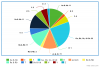 Here's a pi chart I made of the probability of each PLL.


