Heise Method Discussion thread

I'm really quite fond of Ryan Heise at this point. However, I usually use Fridrich to do F2L (except for one corner segment), then use Ryan Heise from there. If I'm going for FM though, I use full Ryan Heise, as it takes way fewer moves than Fridrich.

Athefre, you said you use the "two pairs" approach sometimes? Would you (or someone else) be willing to make a short tut vid?

Cheers.
 
Athefre, you said you use the "two pairs" approach sometimes? Would you (or someone else) be willing to make a short tut vid?

Cheers.

Ryan Heise's site already has a very good tutorial but if you are wanting a tutorial that lists most (or all) cases then I think there are too many cases to go through.

I only have a 16mb card in my video camera so that's only around 1 minute of video so I wouldn't' be able to fit it all in and even if I split it up in segments it would be many many videos...plus I would be too embarrassed to make a video like that (having to speak)...sorry.

But if I had a larger memory card and could just do it without "saying" how to do it, I definitely would. If you can wait maybe a month or two I probably will be able to. My little brother plans to buy himself a digital camera and an 8GB SD card.

If nobody else makes a video then I will try to then.
 
Speaking of parity, are there better ways of fixing edge permutation parities when you already have two pairs + the other edge solved, besides J/V/Y perm?
 
What do video tutorials do that image and text based tutorials don't? All I'm thinking is that people explain it in the videos.

Ryan explains his method very well already on his site and he has lots of examples. I don't like watching video tutorials because it usually takes the person 5 minutes to explain something simple, I hear parts of videos when people go "uh.....and uh.....and....you'll want to uh.....move this piece here then uh..........." and it makes me not want to bother watching it. Also, it's more annoying to rewind a video to watch them do a certain step until you understand it than it is to press the back button on a cube applet. And in a video you don't get to see all angles, instead you have to see what they are doing then follow along with your own cube.

But if there is some reason I didn't think of that makes people enjoy videos more then I would be willing (like I said) to make a non-voiced (maybe it's to avoid my own "uh"s) video tutorial. Of course without voice it would just be a video collection of the cases.

I thought about doing the videos yesterday and decided that it would be helpful to a lot of people so I spent the rest of my evening (about 4 hours) sitting at my desk making sheets with images/lists of all of the cases. I spent two hours this morning finishing that and added a few solutions. Then I decided that maybe I shouldn't do this because how overwhelmed would you feel to see the hundreds of cases and would you be able to solve something on your own after just memorizing these things? I think it's best to see (and understand) the important ones then eventually you will be able to do every (or almost every) case you see.

Some simple help:

1. Go to the two pairs page. Read every thing but don't let your eyes glaze over, you have to focus.

2. Look at every example on his Pair 3-Cycles page

3. Number 3 is.....come on you can guess this one right? You can't? Really?.....ok, it's practice.
 
People like watching a video tutorial because you can see moves and hear details at the same time and it doesn't take much effort to watch a video

With a site with applets you can see the moves and read the explanation of the moves. I don't see much of a difference.

I didn't say it takes a lot of effort to watch a video, I was just trying to say that using a cube applet and text, it seems to me that it would take less time to learn what they are trying to teach. Maybe it's not as much time as I make it sound...I don't know.

I like watching online videos but I don't like trying to learn how to solve puzzles using a video. I guess I'm in a minority that prefers learning from a site.

If there was a best way, people would use only that way. But everyone learns differently.
I prefer pictures/diagrams for learning groups of algs because they are easy to print and take with you.
I prefer applets for learning a method because they are easy to follow and can be manipulated to forward/reverse a move
I prefer videos for learning intuitive methods (intuitive F2L, bigcubes reduction) because the graphics (video) and description (audio) will be synchronised.
I prefer videos for learning video tricks for obvious reasons

I guess we have gotten to discussing opinions now :)

AvGalen said:
I prefer videos for learning video tricks for obvious reasons

Did you mean finger tricks? If so, I agree. When I started cubing, videos like that didn't exist so people had to describe techniques using text but I didn't have any problem. Videos of finger tricks are quicker to learn from.

For the rest of the things you mentioned, I prefer a site and don't usually enjoy audio descriptions.

P.S. I'm glad you make your videos. They are very helpful to people.

Just want you to know that I don't think people should stop making video tutorials.
 
The more I work on Ryan Heise, the more I think I could be just as fast as using all the OLLs/PLLs from Fridrich. Learning finger tricks helps so much, especially the double spin using the pointer and index fingers. :)
 
Are you using "two-pairs" yet? Another thing you really should work on is being able to recognize the last step.

Here is his database page showing solutions to the last three corners.
 
Yeah I'm working on it. I'm also trying to memorize the Fridrich OLLs/PLLs to see how I fare there. A lot going on at once. :)
 
Problem with Heise's method

Hello !

I am currently learning Heise's method. I like it really much but I have the following problem: from time to time the third block (outer square) cannot be finished because one of the needed piece is already used in another block.

I must be missing something enormous but I can't find it.
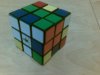
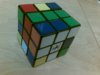
In the photos attached you will see the situation:
- I first built the white/blue/orange outer square
- then green/red as the inner square
- finally green/orange/white as my third block (outer square) but the orange/white edge is already taken

According to Heise, here are the requirements:
Two rules are as follows:
Only 5 out of the cube's 6 colours should be used. In the above example, red is not used.
One square must be an inner square and the other 3 must be outer squares.

I don't see anything breaking these rules (yellow is not used, I have only one inner square).

What am I missing ?

Kiyoshi
 

Attachments

  • L-face2.jpg
    L-face2.jpg
    145.5 KB · Views: 23
  • R-face2.jpg
    R-face2.jpg
    66.3 KB · Views: 14
well Ryan just forgot the rule that you must not use a piece 2 times.

But actually it's obvious because what you really want to achieve is to completely solve the first 2 layers except for one corner and one edge. So any blockbuilding which doesn't bring you closer to this goal is useless.

This is why your getting less and less flexible the more blocks you built. For the 4th block you can only have to possibiliteis to choose from.
 
I had this problem myself and added this rule:

Make the inner block first, and the second block must share only ONE colour with the inner block.

This results in you being only able to make two blocks which can be made without sharing pieces.
 
I have considered switching to Heise many times but I decided it wasn't right for me because I'm already sub-16 with "Roux". I have spent a lot of time thinking about the method and how someone would be able to do the blockbuilding fast. I had a lot of ideas and made a simple page (it's probably bad):

http://athefre.110mb.com/Heise.html

Read the page carefully and you'll see how to get fast.

EDIT: I'll be adding a few more images that show the possible 3rd and 4th squares for each type of (sudo) 2x2x2.
 
Last edited:
Back
Top