Fun WCA Statistics

OtterCuber

Veteran
Joined
Jul 26, 2021
Messages
642
Location
USA
YouTube
Visit Channel
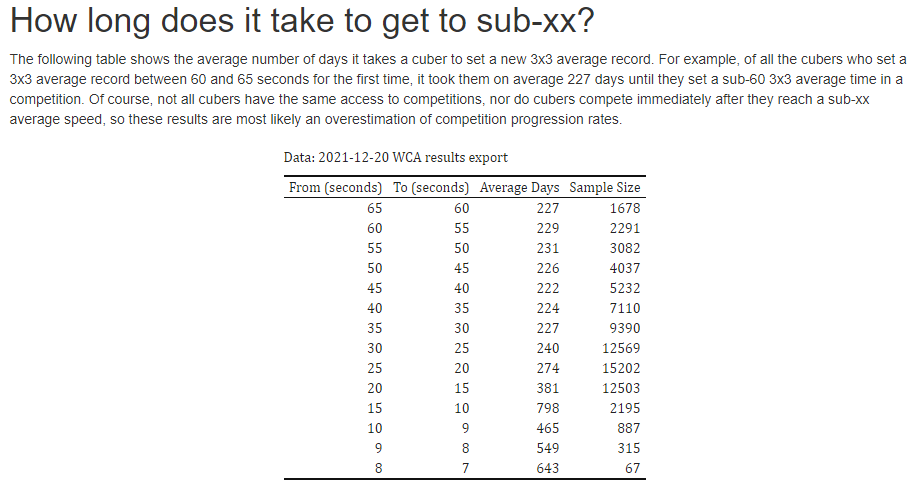
When I'm not practicing, I like to look at WCA stats to gauge my own progress. Perhaps some of these results may be of interest to the community, too. Here are some numbers that I looked at today:
1640128618133.png


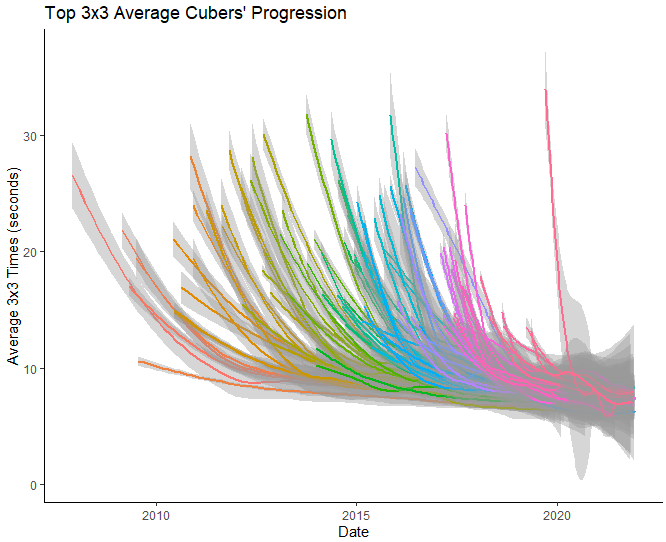
Yesterday, I was also curious at how fast the top 100 3x3 average cubers improved their times:
1640128919758.png


Using a basic model that accounted for time, number of competitions, gender, country of origin, and non-linearity/interactions, I found that, of the top 100 cubers in the world, for every year of cubing, their competition 3x3 average time improved by 1.8 seconds, and for every competition they attended, their time improved by 0.04 seconds.

When looking at all the cubers in the world, for every year of cubing, the average time improved by 5.4 seconds, and for every competition attended, the average time improved by 4.1 seconds.

If you have other questions you'd like to know, feel free to post below, and I might look into it for you!
 
Last edited:
It’s interesting that the 5s improvements from 65 to 35 are all around 220s mark.

At starting times lower than 30s the data really starts to support our intuition that the smaller increments are much harder to achieve and the plateaus we all feel are a very real thing.
 
I'm guessing cubers are improving quicker now? There is more access to knowledge and reasonably performing cubes so that a cuber starting last year could improve quicker on average compared to a cuber from 10 years ago?
Most likely, but I should compare cubers from different periods/cohorts to see how much of a difference --- interesting question!

I'm guessing cubers are improving quicker now? There is more access to knowledge and reasonably performing cubes so that a cuber starting last year could improve quicker on average compared to a cuber from 10 years ago?
I guess the results were a bit more nuanced than I thought:

1640274652254.png


Each little plot represents cubers whose first competition was in that year, so the 2008 mini-plot shows the progression of cubers whose first competition was in 2008. Yes, more recent cubers progress more quickly, but they all seem to set similar times in their first competition, regardless of when they first started competing. Also, cubers who started competing in 2004 or earlier have since then increased their averages, but keep in mind that there were only 19 cubers who competed in 1982, 85 in 2003, and 204 in 2004, so with a larger sample you might not have the same trend (see the table below for a listing of the number of unique people who competed at least once in each year).

1640275325243.png


It’s interesting that the 5s improvements from 65 to 35 are all around 220s mark.

At starting times lower than 30s the data really starts to support our intuition that the smaller increments are much harder to achieve and the plateaus we all feel are a very real thing.

I wonder if it's just because cubers at that skill level tend to compete about once a year. I could probably get more accurate results if I look at cubers who compete multiple times a year.
 
Last edited:
I guess the results were a bit more nuanced than I thought:

View attachment 18157

Each little plot represents cubers whose first competition was in that year, so the 2008 mini-plot shows the progression of cubers whose first competition was in 2008. Yes, more recent cubers progress more quickly, but they all seem to set similar times in their first competition, regardless of when they first started competing. Also, cubers who started competing in 2004 or earlier have since then increased their averages, but keep in mind that there were only 19 cubers who competed in 1982, 85 in 2003, and 204 in 2004 (see table below), so with a larger sample you might not have the same trend.

View attachment 18158
Really interesting that 2021 has less competitors than 2020
 
I didn't know the number comps, but I would think it could be the covid 'effect'. As it has, and is affecting things everywhere.
 
Back
Top