• Welcome to SpeedSolving.com — the world’s largest puzzle community!

    You’re currently browsing as a guest, which means you have limited access to discussions, resources, member profiles, and community features.

    Join 50,000+ cubers and puzzle enthusiasts from around the world to ask questions, share solves, improve faster, and be part of the community.

    Registration is free, fast, and easy — create your account today.

    Already a member? Log in here to hide this message and start participating.

The Algorithm Set Progress Thread

These are easy.

or

It's just a sune with an M Move at the beginning and end.
If you do lefty it's the same for both if not you have to do it mirrored to the X Axis
I use this for righty:

 Twizzle link 
 Setup 
z2
 Moves 
r U R' U R' F R F' R U2 r'
 
Learned another U subset today and practiced everything else a good bit, I am now past the 1/3 mark!

I've also started using Tao Yu's alg trainer with my Giiker cube, which makes everything so much faster since I don't have to do scrambles. I did the math, and this method gives me +50% efficiency when practicing when compared to Roman's trainer! The downside is that Tao's trainer doesn't let you practice algs in a random order without repeats—you either have to do them in order, which makes it much easier to predict the next cases, or totally random, which gives you repeats and means you won't necessarily see every case.
 

Is this transitioning to a "Hazel's ZBLL Progression" Thread 🤔 (should I make one?)
Anyway, I'm really loving training with Tao's site and the Giiker. I've finished up the U set, and I plan to practice these 184 algs quite a bit before I move on, since my average solve time (including recog + execution) is 7+ seconds, which is horrendous.
 
How are you recognizing ZBLL ? I made a site that has info on different ways you can do it.

Is this transitioning to a "Hazel's ZBLL Progression" Thread 🤔 (should I make one?)
Anyway, I'm really loving training with Tao's site and the Giiker. I've finished up the U set, and I plan to practice these 184 algs quite a bit before I move on, since my average solve time (including recog + execution) is 7+ seconds, which is horrendous
 
How are you recognizing ZBLL ? I made a site that has info on different ways you can do it.
I recognize everything from one angle, e.g. for U cases the headlights are always on the left. Once I know the COLL case I look for a predetermined thing to narrow it down to about 3, then another smaller thing to narrow it down to 1.
For example, for Pi 31: I'll see it's Pi, so I put headlights on the left. Then I'll see the COLL, and then I'll look on the right to see which group of 3 it's part of—in this case there's an opposite block in the back. Then looking at FU, FLU, and UFL, there's three possibilites: a block on the front, a checkerboard, or neither. In this case it's neither, which tells me the algorithm.

I know that's a lot, but I'm able to do all of this narrowing down very quickly once I'm used to a set—like the Pi COLL set with a diagonal swap permutation (Pi 49-60) are the first ZBLLs I learned, so I can take all that information in very fast and recall the alg based on it even faster. Meaning, if I spend a bunch more time on this site with the Giiker, my terrible recognition time is sure to decrease considerably.

I use another system for connecting the cases to the algorithms, one I haven't seen anyone else use:
For every ZBLL set of 72 (or 40 for H) I have a set theme, then for every COLL I have a more specific topic, then for that specific topic I have 3-4 defining characteristics, and for every individual ZBLL I have a character. For example, Pi's theme is video games, the Pi 2GLL cases is the game Stardew Valley, the three Pi 2GLL cases where there's a block on the back side of R is Stardew Valley characters that live just above Pelican Town, and the one where FLU is opposite of FU is the character Linus. So once I recognize the case and know what character it is, I recall the actual algorithm based on that character, including the pre-AUF. It's hard to explain how I make the correlation, but it works really well for me and I don't think I'd be able to learn all of these cases so quickly otherwise.

In the future I'd like to be able to recognize cases from multiple angles as well.
 
Last edited:
I recognize everything from one angle, e.g. for U cases the headlights are always on the left. Once I know the COLL case I look for a predetermined thing to narrow it down to about 3, then another smaller thing to narrow it down to 1.
For example, for Pi 31: I'll see it's Pi, so I put headlights on the left. Then I'll see the COLL, and then I'll look on the right to see which group of 3 it's part of—in this case there's an opposite block in the back. Then looking at FU, FLU, and UFL, there's three possibilites: a block on the front, a checkerboard, or neither. In this case it's neither, which tells me the algorithm.

I know that's a lot, but I'm able to do all of this narrowing down very quickly once I'm used to a set—like the Pi COLL set with a diagonal swap permutation (Pi 49-60) are the first ZBLLs I learned, so I can take all that information in very fast and recall the alg based on it even faster. Meaning, if I spend a bunch more time on this site with the Giiker, my terrible recognition time is sure to decrease considerably.

I use another system for connecting the cases to the algorithms, one I haven't seen anyone else use:
For every ZBLL set of 72 (or 40 for H) I have a set theme, then for every COLL I have a more specific topic, then for that specific topic I have 3-4 defining characteristics, and for every individual ZBLL I have a character. For example, Pi's theme is video games, the Pi 2GLL cases is the game Stardew Valley, the three Pi 2GLL cases where there's a block on the back side of R is Stardew Valley characters that live just above Pelican Town, and the one where FLU is opposite of FU is the character Linus. So once I recognize the case and know what character it is, I recall the actual algorithm based on that character, including the pre-AUF. It's hard to explain how I make the correlation, but it works really well for me and I don't think I'd be able to learn all of these cases so quickly otherwise.

In the future I'd like to be able to recognize cases from multiple angles as well.
I see. The narrowing into smaller and smaller groups is something lots of people do including Tao and Tymon iirc.

Idk if you’re interested in big cubes by my recog system guarantees op swap parity after the Zb alg on even cubes. And allows for any angle recog. It’s pretty sick
 
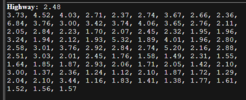
My times during that video yesterday were quite bad, but just now I did 200 ZBLL case solves with a mean time of 6.37, including recog + execution! Definitely getting better and more confident with these algs. Ideally I'd like to get my average down to sub-5, but I might just have to settle for sub-6 before I start learning another set.
 
ZBLL Progress update:

I don't know how, but my recognition time today is MUCH better than yesterday—execution time seems better as well! I just did 230 cases with an average solve time of 5.50. Maybe a sub-5 average for ZBLL recog+execution isn't too far off after all 😄
 
Back
Top