10! is just 10x9x8..x2. Leave the biggest prime, 7, as a factorial because that way you no longer need to think about replicating primes.
Now you're left with 10x9x8x7!
Prime factorize 10, 9 and 8.. and then have fun?
10 = 5 2
9 = 3 3
8 = 2 2 2
5x2x2x3 x 3x2
5x4x3 x 3x2
---
I think you're trying to say \( "a_{k+1}=a_{k}^2+1" \)
a_0 = 2012
a_1 = a_0 ^2 + 1 = 2012 ^ 2 + 1 = .....4 + 1 = ...5
a_2 = a_1^2 + 1 = ....5^2 + 1 = ....25+1 = .....6
So on and so forth. It loops back at a_6 = .....2
Which leads me to believe that the last digit of a_2012 is 6. I'm sure I've done something/everything wrong, I'm so tired it's not even funny >_>
Yay it's Jon! Unfortunately those two questions you just did are the ones I already know how to do lolol. Yep I got 6 as well, you're not wrong in any way.
Does no one else know how to do the other questions?
So here's a proof that there are \( 2^{n} \) subsets in a set of n elements that I just randomly thought of when I was eating some pizza (it was delicious).
The amount of subsets is the amount of subsets containing 0 elements + subsets containing 1 element + ... + subsets containing n elements (the original set). The amount of subsets containing X elements is the amount of ways of choosing X elements from n elements, which is \( {^nC_X} \). The total amount of subsets is therefore \( \sum_{X=0}^{n}{^nC_X}=2^{n} \) (proof that this adds to \( 2^{n} \) here).
Could someone explain how to use this? I know how to find the number (cycle length with quickie K) I'm just confused on how to use it. How to use it = what to do after finding the cycle length to get a solution to the goal.
I didn't finish taking Algebra 2 yet so I don't think a lot of people here would know this including college students maybe. I got confused because it kept using mod stuff instead of K. I only get about 1 minute to figure out the solution.
I don't really want my opponents to find this and use it against me so if you want an explanation of the game I'll PM you. I'm pretty sure not a lot of people in Academic Games are cubers.
So here's a proof that there are \( 2^{n} \) subsets in a set of n elements that I just randomly thought of when I was eating some pizza (it was delicious).
The amount of subsets is the amount of subsets containing 0 elements + subsets containing 1 element + ... + subsets containing n elements (the original set). The amount of subsets containing X elements is the amount of ways of choosing X elements from n elements, which is \( {^nC_X} \). The total amount of subsets is therefore \( \sum_{X=0}^{n}{^nC_X}=2^{n} \) (proof that this adds to \( 2^{n} \) here).
\( \text{Bernoulli}\left[ R \right]=1-\int\limits_{0}^{1}{\left[ R\sum\limits_{i=1}^{n}{i^{R-1}} \right]dn}\text{ for }R\ge 2. \)
(We can get the Bernoulli Numbers this way).
Just in case you've never heard of the Bernoulli Numbers, you can see as many as you like at wolframalpha.com
Copy and paste this into the input bar: BernoulliB[{0,Range[25]}]
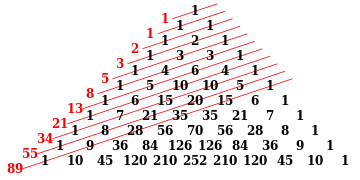
In fact, this means we can have an "Adjusted Pascal's Triangle" to compute the Bernoulli Number sequence too!
Recall the "Adjusted Pascal's Triangle" I constructed for power sums:
All we do is adjust my triangle for the Power Sum formulas by:
[1] Integrate all terms in the triangle and multiply each row by the denominator of the fractions on the far left (to cancel them):
[2]
a) Substitute 1 as n in all terms (this converts all terms into fractions)
b) multiply each fraction (only where the summations used to be) by \( \left( 1-B_{m+1} \right) \) where the summation \( \sum\limits_{i=1}^{n}{i^{m}} \) used to be.
c) Subtract all rows (except for the first one) by 1.
(Note that \( B_{2} \) = BernoulliB[2] = 1/6 and so forth.)
(Right click on the picture and select "view image" to be able to see it better.)
I then wrote the following recursion formula from the triangle:
This means that we can choose m=n if we only one one Bernoulli number in terms of all previous Bernoulli numbers (except for the first two which are 1 and -1/2 or B0 and B1), or m=a and n>a to get a range of Bernoulli Number values (that's why I have multiplied the inner summation by B so that we could get a sum of the compositions of each of the Bernoulli numbers (you just can replace the plus sign with a comma and delete the B multiplied by each term).
For those who have Mathematica, just so you don't have to type all of that out, here is the formula in plaintext:
Sum[Subscript[B, i]*(1-1/i-1/(1+i)-Sum[((-1)^k*Binomial[-1+i,k]*(1-Subscript[B,1+i-k]))/(1+i-k),{k,2,-1+i}]),{i,m,n}]
So, for example, to if you calculate B[8], you let m = n = 8 to get:
And to calculate B[2] to B[8], we let m = 2 and n = 8 to get:
I also programmed this algorithm in my Ti-83 Plus Calculator (in Basic), and I found that in that language, it requires \( 1+\sum\limits_{i=2}^{m}{\left( 1+1+\sum\limits_{k=2}^{i-1}{\left( k \right)}+1 \right)}=\frac{m^{3}}{6}+\frac{11m}{6}-1 \) assignment lines of code.
Since this thread is also about calculators, here's the code (note that it can be shortened to be less bytes).
(I downloaded a program from ticalc.org that does Bernoulli numbers, but it digresses from the answers after a certain Bernoulli Number, whereas mine is as accurate as possible).
I've read on Wikipedia that David Harvey developed a very efficient algorithm for computing the Bernoulli numbers.
I wonder how my algorithm's efficiency level compares with that (is the number of assignments counted as arithmetic operations? Maybe someone could explain what is meant by "arithmetic operations" in coding).
I also simplified the results from the formula above to write Bernoulli[3] through Bernoulli [20] in terms of Bernoulli[2] = 1/6 to see if there was a pattern (with the intention of possibly coming up with a simpler recursion relation), but no luck. Here are the results: (Note that I had to set all odd Bernoulli numbers to zero to get the even Bernoulli numbers).
I was wondering if either the sequence of numbers multiplied by \( B_{2} \) or the number sequence just added exist already. I first thought to look here (link needed: http://oeis.org/), but then I realized that they only have integer sequences!
I use it as a similar reference to the Fibonacci Sequence. Anyone disagree?
Fibonacci-1+1=2 2+1=3 3+2=5 5+3=8 8+5=13 13+8=21 21+13=34, and so on.
Pascal-1+1=2 2+1=3, then a branch to 3+1=4 and 3+2=5. Like a family tree. I think a similar method can be applied to Fibonacci Sequence, eh?
Not exactly. I mean it's even more simple to apply Pascal's Triangle to calculate the Fibonacci numbers: you don't have to adjust the pascal's triangle at all. Just look at Wikipedia. They show that
I got some errors that look like this:
Warning: touch() [function.touch]: Utime failed: Permission denied in [path]/includes/class.latex-vb.php on line 167
Warning: touch() [function.touch]: Utime failed: Permission denied in [path]/includes/class.latex-vb.php on line 167
Warning: touch() [function.touch]: Utime failed: Permission denied in [path]/includes/class.latex-vb.php on line 167
anyway, that's not the problem I have for you guise.
Backstory: So there's this game my friend Shiaohan showed me in middle school involving a shuffled deck of cards. It was a pretty stupid game, looking back, but the gameplay was simple--draw the top card off the deck, turn it over on the table, and say "Ace."
If the card is an Ace, you get zero points, your game is over, and you must shuffle the cards and start over from zero points.
If the card isn't an Ace, you get one point, and you repeat the process of drawing cards, each successive time proclaiming the next value ("Two", "Three",... "King", and wrap around to "Ace" again), racking up as many points as you can before you have to start over.
The goal is to get 52 points, aka going through the entire deck without fail.
It quickly occurred to me that you can troll this game by having a sorted deck of cards and then placing one card from the top to the bottom. In this way, the result obviously comes out to 52 points, even if the deck wasn't completely shuffled. Problem: What is the probability of playing this game and receiving a result of 52 points?
So over lunch I thought of this problem, and instead of solving it with just, the volormula of a sphere I decided to have a crack at integration. Of course, being me, I accidentally did it for a cylinder, not a sphere. So I chatted to ben about rotating it about the x axis, because I forgot how to do it and didn't think of doing it, and yeah here's the solutions.
He brought up another interesting point about chopping the sphere into n segments. Anyway enough build up:
Ok so, if you have a perfectly spherical meatball and want to chop it into four equal volumed pieces with only 3 vertical, parallel cuts, where would the cuts need to be?
So I tried writing without my tablet. I integrated the equation \( y=\sqrt{1-x^{2}} \)which is a semicircle because implicits annoy me.
--
this is where I made a boo boo and assumed it was a cylinder.
I said okay so let's set this to -pi/8 and solve for x to get like -0.404
silly me.
--
So anyway I chatted to ben about it and he reminded me of revolving around the x axis and finished it
[18:17:28] Bacon: or you could use the volume of a sphere formula
[18:17:32] fivebldcubing: but thats boring
[18:17:35] Bacon: kso
[18:17:44] Bacon: you have y=√1-x²
[18:18:02] Bacon: imagine that curve rotated τ radians around the x axis to form a sphere
[18:18:05] Bacon: k?
[18:18:24] fivebldcubing: yeah
[18:18:32] Bacon: to get the volume of that
[18:18:38] Bacon: integrate pi y² dx
[18:18:56] Bacon: so pi*integral 1-x²dx from -1 to 1 = volume
[18:19:13] Bacon: =pi[x-x³/3] from -1 to 1
[18:19:19] Bacon: =4pi/3
so whole volume = 4pi/3
[18:21:09] Bacon: so each piece volume = pi/3
[18:21:36] Bacon: so integrate pi y² dx from -1 to n = pi/3
[18:21:49] Bacon: integrate y² dx from -1 to n = 1/3
[18:21:58] Bacon: etc
[18:22:06] Bacon: replace n with x because n is stupid
[18:22:18] Bacon: multiply by 3 to get rid of fractions n stuff
[18:22:27] Bacon: and you get x³-3x-1=0
[18:22:38] Bacon: and the solution is -0.347296etc.
the other cuts are at 0 and +0.347296 of course.
then we talked about chopping into more/fewer pieces. Weirdly it turns out than for -1<=x<=1 one of the cuts should be
Anyone care to help me figure these two problems out from Abstract Algebra I?
If a|(b + c) and gcd(b, c) = 1, prove that gcd(a, b) = 1 = gcd(a, c).
and
Show that if n lines are drawn on the plane so that none of them are parallel, and so that
no three lines intersect at a point, then the plane is divided by those lines into (n^2+n+2)/2 regions.
The second one, I simply have no idea how to approach it. We've done nothing similar to this that I can recall.
The first one, we've done stuff similar, but I'm not sure how to start it. Help me just start this one?
Thanks
If gcd(x,y) = 1, then you can find M and N with xM + yN = 1. Apply that fact to your three statements about gcd's. Now think about factoring something to show that you've got a contradiction.
On the second, consider the difference between n lines and n-1 lines. This is the number of new regions created by that last line. It should be pretty simple and then recursion.


 Unfortunately those two questions you just did are the ones I already know how to do lolol. Yep I got 6 as well, you're not wrong in any way.