

Hello everyone!
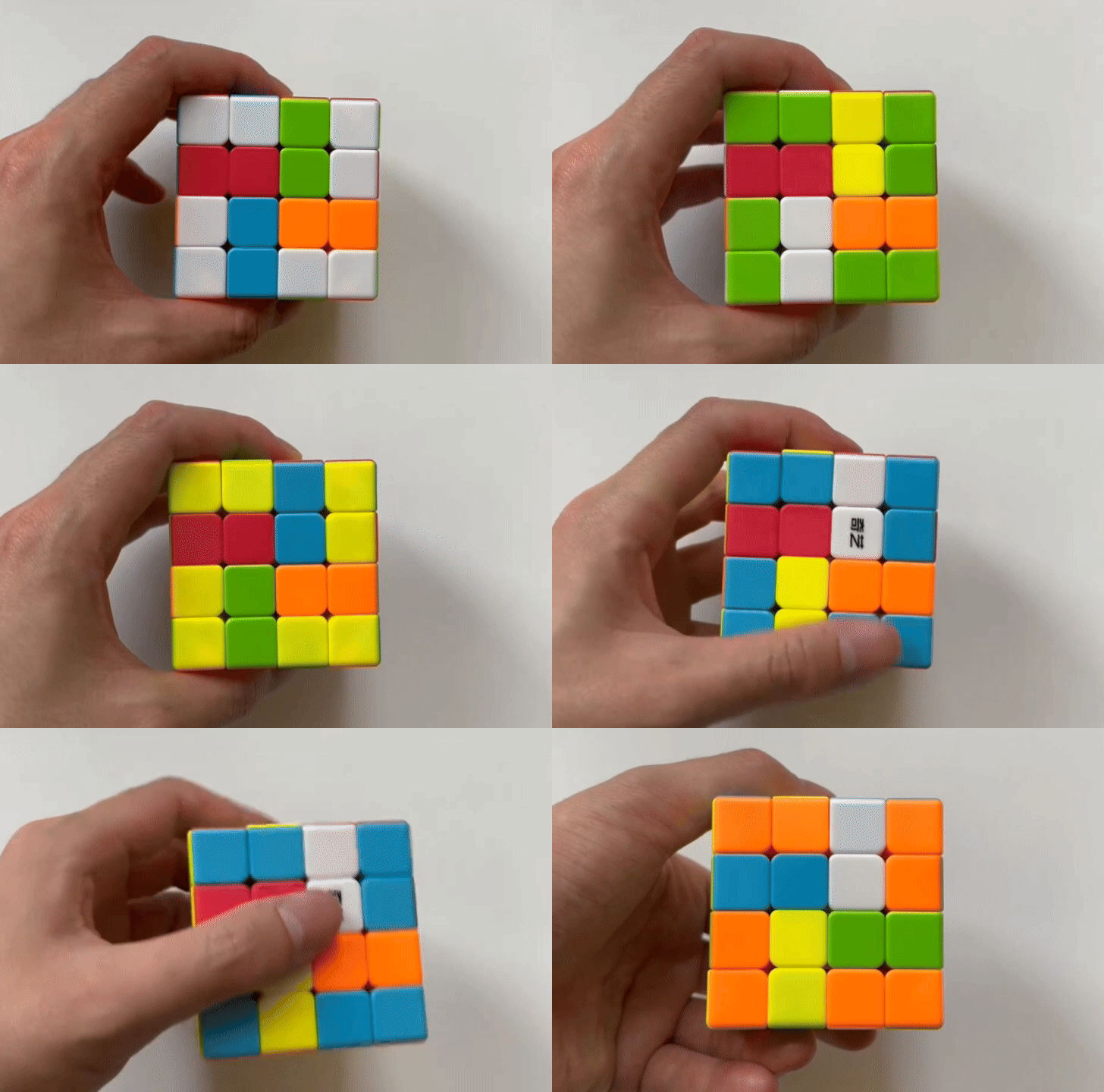
Over the past few years, I’ve been exploring a class of patterns on the 4×4×4 Rubik’s Cube that I call "uniform windmill patterns".
By a uniform windmill pattern, I mean a pattern on the 4×4×4 Rubik’s Cube in which:
Here is one example of such a pattern that I managed to achieve on my cube:
These patterns naturally led me to think about some underlying structural and mathematical questions, such as how many of them are realisable on a 4×4×4 cube, and when do the generating algorithms for such a pattern depend on the initial orientation of the solved cube.
I have written an article collecting these observations and ideas, along with some algorithms for achieving those patterns; it is available on Zenodo. I’m sharing the link here in case anyone is interested in a more detailed discussion:
I’d be very happy to hear your thoughts, and I’d love to learn if others have explored similar patterns or related questions.
Thanks for reading!
FMLJohn
Over the past few years, I’ve been exploring a class of patterns on the 4×4×4 Rubik’s Cube that I call "uniform windmill patterns".
By a uniform windmill pattern, I mean a pattern on the 4×4×4 Rubik’s Cube in which:
- each face of the cube displays a windmill figure with the same orientation, and
- the four branches of any windmill are all different in colour, and
- identical or visually similar colours are kept non-adjacent, so that no red-orange, blue-green, or white-yellow pair appears as a windmill branch and its background on the same face.
Here is one example of such a pattern that I managed to achieve on my cube:
These patterns naturally led me to think about some underlying structural and mathematical questions, such as how many of them are realisable on a 4×4×4 cube, and when do the generating algorithms for such a pattern depend on the initial orientation of the solved cube.
I have written an article collecting these observations and ideas, along with some algorithms for achieving those patterns; it is available on Zenodo. I’m sharing the link here in case anyone is interested in a more detailed discussion:
I’d be very happy to hear your thoughts, and I’d love to learn if others have explored similar patterns or related questions.
Thanks for reading!
FMLJohn


