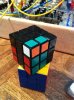
I'm new to Roux, and I have a few questions. I'm having trouble with a certain situation when I start to solve the top edges.

Here's a scramble that looks similar to my situations: (White on top and Green on Front) L' B' L D2 L2 D U2 F D R U' R U' (Here is is on alg.garron.us)

Now when solving with blue on top and orange on the front, what do I do when the white-blue and yel-blue are on the bottom face, but not facing the same way?

As for my other question, is there a PDF (or something printable) for Roux, similar to these ones: http://www.kungfoomanchu.com/#333

Daniel, your EO is wrong as Renslay said. From that scrambled position, you can do:

(M2 M' U M' U' M' U M' U M' U M')

This should solve your EO then you can continue to the next step of solving UL and UR edges:

1. U to get the UL and UR edges diagonally across from each other
2. (M'/M U2 M'/M) to get the edges on the D face
3. U to have opposite color headlights (the color of the stickers of the two corners facing you should be yellow, while the DF edge sticker should be white)
4. M2 U to solve (Step 4c skip)

If you're still having trouble with EO or any other of the Step 4 substeps, I highly recommend Waffle's website and his tutorials online. It shouldn't take you long to get EO down. Once you become more familiar with the cases and the patterns, you can easily sub-10 step 4.

Waffle's Website page for EO: http://wafflelikescubes.webs.com/orientation.htm
Waffle's Video Tutorial for EO: http://www.youtube.com/watch?v=bltwWaHOhJs
Good Luck!!

-CheescakeCuber

P.S. If I understand correctly, you orient ALL edges, then you solve UL and UR edges? If that is true, then you're doing the steps correctly.
 
Huh. I always orient the edges before I start to go try to solve them. Maybe that wasn't a good example. Is there a possibility I could end up in that same situation with the edges oriented correctly?

No. If your last six edges are all well oriented, then situations like the example above never could happen. If your UL/UR edges are on the DF/DB places, then the L and R stickers (in the previous example: white and yellow, in the new exaple: red and orange) always on front and back, therefore, the insertion in step 4b) is easy. That is because your all 6 edges are well oriented - including the UL and UR edges! If it's not the case (again, like the example above), that means your orientation is wrong, therefore, you didn't finish step 4a) yet.

From this tutorial:

General Rules for UL and UR Permutation.

1) To preserve the EO, you can do M2 moves and U moves to permute stuff into place

2) It's okay to just use an M' or M move as long as you follow up with a U2 and another M' or M

I think I may be doing that part wrong. Would M2 U2 M2, or M2 U2 M' follow those rules?

That means if your edges are all well oriented (hence, finished step 4a), moves loke M2, U and their combinations don't mess up the orientation - each 6 edges remain well oriented. Only M and M' moves changes edge-orientation, except it follows U2 and another M or M'. In long, the following moves do not change orientation:
M U2 M
M U2 M'
M' U2 M
M' U2 M'
Therefore, after finished step 4a), you can use all of these (and many similar more) to solve Step 4b), and you don't need to worry about missing up the edge orientation in Step 4a).
Your example M2 U2 M2 is good here, but M2 U2 M' does not - unless you continue it with U2 M or U2 M' (if not, it messes up orientation, if it was good, and bring you back to an unsolved Step 4a).


The way I get into that bad situation is usually when the edges I need to be across from each other, are right next to each other like this:

U2 B2 L2 D' F2 L2 B2 U' R2 U2

After fiddling with it a little, I think I figured it out, but I still don't completely understand.

In this example, I assume that your blocks are orange-yellow and red-yellow, and your UL/UR edges will be white-orange and white-red. Here, every edges are oriented, Step 4a) is finished.

Step 4b)
M2 U M' U2 M // Place UL/UR edges (here: white-orange and white-red) to DF/DB places for easy insertion
M2 U // Place UL/UR edges to their final place

Note that here the orientation does not change, every edges remained well oriented, since a singe M or M' was never used, except where U2 M or U2 M' followed. This is exactly what I said above. We don't want to mess up orientation done is Step 4a (which is skipped here, since we already had well oriented edges).

Step 4c)
M' U2 M' U2 M2 // Solve the remaining permutation on the M slice. Note that again the orientation does not chage.

Solution on alg.garron.us
 
Last edited:
Just for clarifying:

Here's a scramble that looks similar to my situations: (White on top and Green on Front) L' B' L D2 L2 D U2 F D R U' R U'

(M2 M' U M' U' M' U M' U M' U M')
M' U M' U M U M'

If you hold your cube after the scrable above with x' y, then your misoriented edges are on FU and BD, and a solution for Step 4a) is Kirjava's M' U M' U M U M'.

If you hold your cube with x' y', then your misoriented edges are on BU and FD, and a possible solution could be M' U M U M' U M', what I mentioned earlier. Or you can use the mirror version of Kirjava's examle: M U' M U' M' U' M, but generally M' is preferred over M because of its faster execution through fingertricks.
 
Hiya!
Quick introduction since this is my first post. Picked cubing back up a few months ago after a 30 year hiatus, father of 2 awesome kids and husband of super wonderful lady in Dallas.
So I got going with fridrich and am averaging 45 secondsish with it and started learning roux about a month ago, and am averaging a little over a minute with it - I kind of like it more because it feels less 'by the numbers' or something, I dunno . Anyway, here's a specific case I wanted to ask you about, as in the picture below.
Now, to insert that right back pair without rotation I do B U' B' - but ugh it feels yucky. I could also rotate and do the same move and it feels better, but then I'm rotating. And yet another approach is to sledgehammer.
Is there another cool move anyone can recommend to elegantly insert that pair in the back right? Or is just practice practice practice that B U' B until it feels good the ticket?
IMG_0095.jpg
 
Now, to insert that right back pair without rotation I do B U' B' - but ugh it feels yucky. I could also rotate and do the same move and it feels better, but then I'm rotating. And yet another approach is to sledgehammer.
Is there another cool move anyone can recommend to elegantly insert that pair in the back right? Or is just practice practice practice that B U' B until it feels good the ticket?
View attachment 2778
U' r' U' r
 
Hiya!
Quick introduction since this is my first post. Picked cubing back up a few months ago after a 30 year hiatus, father of 2 awesome kids and husband of super wonderful lady in Dallas.
So I got going with fridrich and am averaging 45 secondsish with it and started learning roux about a month ago, and am averaging a little over a minute with it - I kind of like it more because it feels less 'by the numbers' or something, I dunno . Anyway, here's a specific case I wanted to ask you about, as in the picture below.
Now, to insert that right back pair without rotation I do B U' B' - but ugh it feels yucky. I could also rotate and do the same move and it feels better, but then I'm rotating. And yet another approach is to sledgehammer.
Is there another cool move anyone can recommend to elegantly insert that pair in the back right? Or is just practice practice practice that B U' B until it feels good the ticket?
View attachment 2778

U' r' U' r

To elaborate a bit more in terms of CFOP (Fridrich), you can think of this as reorienting the edge while doing the first move of the R' U' R insertion. The thing to keep in mind with the first two blocks in Roux is that you can reorient an edge with a simple quarter turn, either r/r' or M/M'.

Set up this scramble: U2 B U2 F U2 B2 D' F2 D R' B U' F L' R' U2 x'

Notice that the left block and right square are done, and that you have a simple R' U' R insertion for the back right pair. The reason you can insert this using only R and U turns is because the edge is correctly oriented to allow for that. Now, do just an M' move, leaving you with a combined F2L pair at the back right, which is the case you asked about. The problem that would occur here in CFOP is that you cannot insert this pair without either using B moves, a rotation, or displacing the back cross piece during the r' U' R, and then having to put it back with U M' after the pair is in place. An advantage with Roux is that your M layer is free to move, so you can simply orient the edge correctly with M, then insert with R' U' R. Of course the M R' can be done with just r', so you end up with r' U' r or r' U' R.

The point is to remember that the reason you only ever need to rotate in CFOP when an F2L edge is not oriented, but in Roux you don't need to do rotations at all because you can reorient edges on the fly with quarter turns on the M layer.

Have your two blocks solved and do this setup: R' U' r U M2. See the edge at UF and the corner at UBL. In CFOP some typical ways of solving this would be d' R U R' U R U R', or R U R' y R U R' if the FR slot is empty. In Roux you can make use of the free M layer and do M2 U' r' U R or M2 U' r' U r.

One last, less verbose, example. Setup with: R' U M U' r. First look at the case as if it were CFOP, and think about it. Then see the advantages of a free M layer in Roux by solving with r' U M' U' R.
 
Last edited:
wow Dominate, those were some great illustrations, thanks so much - that further solution you showed at first where the joined f2l pair is broken apart and then joined while inserting was elegant, and the further setups you show to consider are showing me how roux is even cooler than i had thought.

edit: playing around with that some more, holy moly block solving just got a lot less challenging, thanks again.
 
Last edited:
this might be a tad bit faster I use it a lot

m' u m' u m' u m' u2 m' u m' u m' u m'

nothing against the above posted alg, I just have the hardest time doing m slices im way faster at m' slices

well M' U M' U M' U2 M U M U M U2 is used more because the M turns are easy to do. you don't have to alternate M/M', you can just move your index finger to the top and keep pushing downwards. 12 STM to 15 STM is also quite a difference considering M' isn't even faster than M in this alg.

your alg is okay, and i actually used it until i realized there's the shorter one.
 
Help on memorizing CMLL?

Hi, I just started using roux (my main is cfop) and I'm trying to start learning CMLL. I know 2 look CMLL, but I don't know what order to start learning it. Also, are there any ways like mnemonic devices to memorize them?
 
Nah, just use muscle memory. And the order doesn't really matter, but I learned the H/double headlight cases first b/c there's only 4 of them, and then I learned the B/antisunes, the F/chameleon, and the E/headlights, I'm still learning the G/bruno, D/bowtie and C/sune

Also, I might have the letters on chameleon/headlights and/or sune/antisune swapped.
 
Back
Top