| My personal progress thread | Coming back after a long time |

I believe he uses Mehta-CDRLL 2H, and I know he was talking about using a CP first variant of Mehta-CDRLL for 1H. But I'm curious as well. :)
Yeah you're right. For 2H it's just plain Mehta-CDRLL-JTLE OS and for OH, I do CPLine>extend to Mehta FB>continue the rest of the solve normally.
 
Why not just do YruRU?
Personally, I believe that CP line > belt > EOdM (thereby transposing into Mehta by creating CP+EO ledge) is a stronger continuation than the one proposed in YruRU.

Even without seeing DB, EO recognition after belt is one-lookable because-- for each cubelet-- you only care about which sticker has the U/D color. With the belt solved, case count is drastically reduced, allowing you to make EOdM 95% algorithmic if you so choose.

Once you've transposed in this way, the only continuations that do not destroy CP are:
  • <RU> DCAL... <RU> CDRLL... L5EP
  • <RU> TDR... 2GLL
 
Once you've transposed in this way, the only continuations that do not destroy CP are:
  • <RU> DCAL... <RU> CDRLL... L5EP
  • <RU> TDR... 2GLL
but you also have RU 6CO> RU 6CP> RU L5EP, RU 6CO> RU APDR> RU EPLL and RU DCAL> RU JTLE> RU EPLL
(every OS path is possible. The only difference is, 6CO and CDRLL are just 9 and 7 algs respectively and 2GLL is 84 algs)
 
but you also have RU 6CO> RU 6CP> RU L5EP, RU 6CO> RU APDR> RU EPLL and RU DCAL> RU JTLE> RU EPLL
(every OS path is possible. The only difference is, 6CO and CDRLL are just 9 and 7 algs respectively and 2GLL is 84 algs)
I didn't know this. Specifically that 6CO could be done <RU>. This makes an even stronger argument for Mehta-CP.

Also, I shouldn't have said CDRLL - OCLL is more accurate.

Also, my initial impression would be that the EPLL continuations seem weaker. They do not seem as appealing as they do in Mehta-OS.
 
Last edited:
Specifically that 6CO could be done <RU>
oh yeah, speaking of this, fully RU 6CO algs can be found here(along with a lot of other stuff that I intend to finish soon)

btw I figured out how to use OBS with youtube:
I'm gonna start streaming soon.
(no twitch because my OBS is being funny with twitch)
(note: If I start streaming I won't be talking much but I'll be using the chat to interact)
 
How do you feel about the execution speed of triple sune vs. F U' R D' R U' R' D R' U F'? Also, how do you feel about execution speed of CDRLL algs for U2 case vs. any of the COLL algs.
 
How do you feel about the execution speed of triple sune vs. F U' R D' R U' R' D R' U F'? Also, how do you feel about execution speed of CDRLL algs for U2 case vs. any of the COLL algs.
1)Triple sune is always better than that.
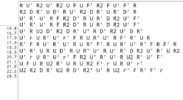
2)Can you specify a bit more? Is it U2 as in R U D' R U R' U2 D R'?
 
Like these... That first alg is wrong.
 

Attachments

  • Screenshot_20211021-072756-407.png
    Screenshot_20211021-072756-407.png
    80 KB · Views: 7
Mehta EO while preserving CP seems a lot worse to me. How do you do it?
Personally, I solve only 3QB (tracking the last belt edge while I do), and the YruRU triggers usually preserve one of the Redges. I want to say "always" here, but I cannot say for certain that a Redge is always preserved.

Another approach is to influence DR to be a good edge during the belt (i.e., pEO extension), and then you simply have Roux style EO (if dM is not solved) or EOLL (if dM is solved).

However, the simplest way to accomplish this is to use the same triggers you would with L5EO-DF (using S moves instead of M moves). Yes, I realize this is not the most OH-friendly solution, but S/S' moves shouldn't be too bad. (There are no S2 moves.)
I think my opinion is that if you're going to be doing M moves, just do Roux. If you want good ergonomics while excluding M move steps, use YruRU.
 
I think my opinion is that if you're going to be doing M moves, just do Roux. If you want good ergonomics while excluding M move steps, use YruRU.
Then there is the 3QB approach. Put the 3rd belt edge in UR and preserving it is easy using existing YruRU algs.

I personally don't mind M moves in 2H or OH, yet prefer the solving approach of (CP)line > 3QB/belt > (EO)dM > SB to that of Roux.
 
Then there is the 3QB approach. Put the 3rd belt edge in UR and preserving it is easy using existing YruRU algs.

I personally don't mind M moves in 2H or OH, yet prefer the solving approach of (CP)line > 3QB/belt > (EO)dM > SB to that of Roux.
I just don't see the benefit of solving the belt edges first. It maybe slightly improves recognition, but it seems like your movecount and ergonomics both get a lot worse.
 
I just don't see the benefit of solving the belt edges first. It maybe slightly improves recognition, but it seems like your movecount and ergonomics both get a lot worse.

We are getting off topic here, but I am of the opinion that it hugely improves recognition.

There's no way you are going to instantly 1-look EO if you follow YruRU: there's 8 total edges (including 2 belt edges which can be ambiguous when viewed from only one side), and only 3 edges are entirely visible without rotating; pEO extension does provide a very slight improvement over LEOR EO, but EO is still (by far) the weakest step in each of these methods. In each of these methods, a great deal of lookahead and prediction are required to perform EO at such an early stage.

Solving the belt edges (and influencing DR) sets up a cube state identical to Roux LSE, and I don't think there is a valid argument to be made about the movecount or ergonomics of Roux in 2H or OH.

Even so, this is only 1 of 3 possible routes for EO that I suggested. (It also happens to be the one I prefer.) Solving a half belt or 3QB are also perfectly viable approaches that avoid <MS> and still allow for different transpositional possibilities.
 
Back
Top