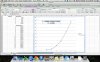
The curve is less steep than reality, I think. Even if a 20x20 could be created that functioned well, less than 40 minutes is pushing it. I guess it could make a small difference that your numbers aren't that exact (2x2 average is actually 1.69, less than 2 seconds, while 3x3 is 6.54, greater than 6 seconds. In this case, rounding them steepened the curve slightly) and are in some cases wrong. 4x4 is 28 seconds; 5x5 is 55 seconds; 6x6 is 1:51, and 7x7 is 2:52.
The number of pieces to solve increases pretty fast. I don't have the numbers, but it's not even close to linear and it's more than your numbers would suggest, I think. The difference between the number of pieces in the 19x19 and the 20x20 is 222, if I counted right.
Another reason these numbers would be skewed is that the puzzles get harder to hold at an increasing rate. The difference between turning a 3x3 and a 4x4 is much less than the difference between a 7x7 and an 8x8, in my opinion. 7x7 is the size that is just approaching the capacity of two normal sized human hands. A physical 20x20 would have a ridiculously slow turn speed. This makes me wonder how much more realistic the theoretical average would be on computer cubes instead of physical puzzles. EDIT: I'd be interested to hear qqwref's opinion on that last idea, since he's done a lot of virtual cubes.
So, the number of pieces increases at an increasing rate, and the turn speed decreases at an increasing rate. That accounts for some of the graph's inaccuracy when compared to actual UWRs up to 11x11, but that's exactly why you called it "theoretical." It's not directly comparable.

I'm sure a more complex graph could be made. It could take into account the number of pieces in the puzzle (and also note the solving time of each subcategory, since the solving of centers, edges, and corners is very different) as well as the rate that turn speed decreases.
This post was sloppier than it could've been. This is a thought provoking topic, and I may decide later that I have more to say, but I don't have the energy to articulate these ideas more at the moment. Lol.
Nice first post, and welcome to the forum.


 ) turning specific layers on bigger cubes does get harder, but probably not as much as it does for keyboard cubes.