
Discomantis
Veteran
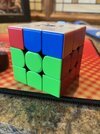
What are the odds of getting a J perm in that one angle that looks like a PLL skip? Pictures are shown below of what that would look like.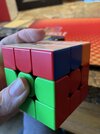

Follow along with the video below to see how to install our site as a web app on your home screen.
Note: This feature may not be available in some browsers.

Well on odd cubes it is 1 in 43 quintillion, on even cubes it is 1 in (4 x 43 quintillion).Not sure if this was already discussed, but what is the probability of a 3x3 stage (or centers; edges) skip on big cubes?
2 possible cases where it looks like a skip, and 4 x 12 = 72 pll cases, so 2 in 72, so 1 in 36.What are the odds of getting a J perm in that one angle that looks like a PLL skip? Pictures are shown below of what that would look like.View attachment 22275View attachment 22276

How do you mean that? You always see 3 Colors on 2 sides...What are the odds of getting a J perm in that one angle that looks like a PLL skip? Pictures are shown below of what that would look like.

I often think that I got a PLL skip when I get a J perm from that angle and DNF because of that. Also I found out that the odds of DNFing an average of 5 because of that occuring is approximately 1/137.How do you mean that? You always see 3 Colors on 2 sides...

I think it would take 72 solves for there to be a 50% chance of having gotten them all, which basically means it's "supposed" to take 72 solves to get them all.How many solves on average would it take to get all PLL's at least once? (Including a PLL skip.) I'm wondering this because I'm close to having gotten all PLL's officially. In case anyone doesn't know, here are the odds of each PLL:
H perm, Nb perm, Na perm, PLL skip: 1/72 chance each
Z perm and E perm: 1/36 chance each
All other PLL's: 1/18 chance each
That's definitely wrong. Why do you think there's a 50% chance of getting every case after 72 solves?I think it would take 72 solves for there to be a 50% chance of having gotten them all, which basically means it's "supposed" to take 72 solves to get them all.


I don't know if this is the correct way to do this, there are definitely much smarter people than me on the forum who can correct me if I'm wrong:How many solves on average would it take to get all PLL's at least once? (Including a PLL skip.) I'm wondering this because I'm close to having gotten all PLL's officially. In case anyone doesn't know, here are the odds of each PLL:
H perm, Nb perm, Na perm, PLL skip: 1/72 chance each
Z perm and E perm: 1/36 chance each
All other PLL's: 1/18 chance each
My logic was that since all of the solves are independent, it would take 72 solves to get an H perm (or any others like it), and by the time that was accomplished you should have gotten 1 of each N perm, a skip, 2 Z perms, etc. But it seems like there are smarter people that know what they're talking about, lol.That's definitely wrong. Why do you think there's a 50% chance of getting every case after 72 solves?
I don't know how you derived this. The PLLs are not independent in terms of how likely it is to see a new one. That's why I linked the coupon collector's problemLet's start by asking how many solves it would take to get the 4 1/72 PLLs (H, Na, Nb, Skip). Using the binomial distribution, we can see that for the probability of 4 successes (p=1/72) to be >0.5, we need 265 solves.
For the 5 1/18 PLLs, we need 264 solves for P>0.5;
For the 2 1/36 PLLs, we need 61 solves for P>0.5

1 in 373248 chance. (1/72 chance raised to the third power.)Does anyone here know the probability of getting a PLL skip 3 solves in a row?... Happened to me multiple times.

1/4^5=1/1024whats the probability of getting double parity on each solve in a 4x4 average of 5?
For me it's around 100% o_Owhats the probability of getting double parity on each solve in a 4x4 average of 5?


This might be wrong but I'm just going to give it my all:while I was doing 2x2, my scramble had one side done already
i accidentally deleted that solve
what are the odds of me getting a scramble with a side solvedd again?


