• Welcome to SpeedSolving.com — the world’s largest puzzle community!

    You’re currently browsing as a guest, which means you have limited access to discussions, resources, member profiles, and community features.

    Join 50,000+ cubers and puzzle enthusiasts from around the world to ask questions, share solves, improve faster, and be part of the community.

    Registration is free, fast, and easy — create your account today.

    Already a member? Log in here to hide this message and start participating.

Probability Thread

I came up with:

States on 2x2: 7! 3^6 = 3,674,160

Approximate positions:

Base: 4*4 Top: 4! 3^3 and multiply by 6 for 6 faces (need to remove intersection)

Multiply Base x Top x 6 = 62,208

Calculating intersection:

1 case on opposite face R2 away.

The other possibility lies on the left or right faces (presuming bars are on DL and DR):

2 sides * 3 orientations * 2 permutations = 12

Total cases = 62,195

Probability of starting with a face from this algset solved = 62,195/3,674,160 = 1.69%

Wish I knew the chance of being one move away from this base now.

My quick guess would be approximately 1.69%*6 = 10.2%
Also worth mentioning that I calculated positions of a premade EG layer is approximately 3! 4! 3^3 this excludes intersections.

Works out to be roughly 6/16 * the chance of this bars method which means ~0.63% vs 1.69%
 
I found this because I built the second block and then realized It was two moves from solved. I didn’t try to do this it just happened. So CMLl and LSE skips with and AUF. Also sadly didn't time or have a scramble because I was practicing slow solving.

So 42*23040 = 967,680 then taking the 967,680 and multiplying by 1/4 to account for the AUF, which gives a 1/241,920 chance.
 
Not really probability, but how many permutation are there when you exclude symmetries?
For example, a scramble done white top green front (usually) gives a different permutation of pieces than done red top blue front. Usually these are counted differently, but how many permutations are there if you count them as the same?
 
I'm not a maths expert, but I would probably say that's the number of possible permutations divided by the number of orientations, because if you want the number of scrambles for that, all permutations for the same scramble on different sides would be the same.

Technically if you do a scramble on different orientations, the pieces would be in different places, but the solution is still the same, but hey.

So that would be 43 quintillion (or 43252003274489856000) divided by four orientations on every side of the cube (or 24), which is 1802166803103744000, roughly about 1.8 quintillion.

Correct me if I'm wrong, because again I'm not a math expert.
Not like I am qualified but 24 was the number used for symmetry at the God's Number Project.
 
Not really probability, but how many permutation are there when you exclude symmetries?
For example, a scramble done white top green front (usually) gives a different permutation of pieces than done red top blue front. Usually these are counted differently, but how many permutations are there if you count them as the same?
If you mean symmetries from cube rotations (and not say mirroring along an axis or diagonally), then the cube orientation (including starting orientation) is uniquely defined by color on top and color on front, so 6 * 4 = 24.
 
Probability of all centers solved on 4x4
1. count the number of possible centre arrangements (and convince yourself that they're all equally likely)
2. count the number of possible centre arrangements where the centres are all solved
3. divide

All fairly straightforward computations; you can try working it out yourself. (Slightly less straightforward if you take 4b3 into account, which forbids the solved state and 1-move states from being WCA-legal scrambles.)
 
If you mean symmetries from cube rotations (and not say mirroring along an axis or diagonally), then the cube orientation (including starting orientation) is uniquely defined by color on top and color on front, so 6 * 4 = 24.
You are correct. There are 24 rotational symmetries and the number of cube positions may be reduced nearly 24 fold by these symmetries. It is "nearly" 24 fold since some positions have rotational symmetry. Superflip for example has full cubic rotational symmetry. It doesn't matter how one orients the cube when applying a superflip maneuver, you get the same permutation. Kociemba has a good discussion of symmetry on his site.
 
  • Like
Reactions: qwr
Not really probability, but how many permutation are there when you exclude symmetries?
For example, a scramble done white top green front (usually) gives a different permutation of pieces than done red top blue front. Usually these are counted differently, but how many permutations are there if you count them as the same?
On Kociemba's site there is a table giving the number of cube patterns with various symmetries. He gives the symmetry reduced number of cubes with each symmetry in the More Information link. The number he gives is reduced by the full 48 element cubic symmetry group which includes mirrored symmetries. I took his reduced numbers and back calculated the total number of cubes with each symmetry and the number reduced by only the rotational symmetries:

Symmetry​
Mirrored (1 YES, 2 NO)​
Symmetries​
Count​
Oh Sym Eq Classes​
O Sym Eq Classes​
Oh​
1​
48​
4​
4​
4​
Th​
1​
24​
20​
10​
10​
T​
2​
12​
48​
12​
24​
D3d​
1​
12​
48​
12​
12​
C3v​
1​
6​
128​
16​
16​
D3​
2​
6​
1,664​
208​
416​
S6​
1​
6​
30,960​
3,870​
3,870​
C3​
2​
3​
15,083,456​
942,716​
1,885,432​
D4h​
1​
16​
372​
124​
124​
D4​
2​
8​
1,152​
192​
384​
C4v​
1​
8​
2,688​
448​
448​
C4h​
1​
8​
4,224​
704​
704​
C4​
2​
4​
433,920​
36,160​
72,320​
S4​
1​
4​
1,312,512​
109,376​
109,376​
D2d (edge)​
1​
8​
8,832​
1,472​
1,472​
D2d (face)​
1​
8​
1,152​
192​
192​
D2h (edge)​
1​
8​
5,760​
960​
960​
D2h(face)​
1​
8​
11,892​
1,982​
1,982​
D2 (edge)​
2​
4​
278,784​
23,232​
46,464​
D2 (face)​
2​
4​
560,544​
23,356​
46,712​
C2v (a1)​
1​
4​
186,624​
15,552​
15,552​
C2v (a2)​
1​
4​
3,490,560​
290,880​
290,880​
C2v (b)​
1​
4​
577,536​
48,128​
48,128​
C2h (a)​
1​
4​
1,722,624​
143,552​
143,552​
C2h (b)​
1​
4​
577,392​
48,116​
48,116​
C2 (a)​
2​
2​
45,856,382,976​
1,910,682,624​
3,821,365,248​
C2 (b)​
2​
2​
15,286,488,192​
636,937,008​
1,273,874,016​
Cs (a)​
1​
2​
55,028,305,920​
2,292,846,080​
2,292,846,080​
Cs (b)​
1​
2​
2,546,491,008​
106,103,792​
106,103,792​
Ci​
1​
2​
45,862,360,944​
1,910,931,706​
1,910,931,706​
TOTALS​
​
​
164,604,321,936​
4,948,260,778​
9,407,837,992​
So the number of cubes with no symmetry is

43,252,003,274,489,856,000 - 164,604,321,936 = 43,252,003,109,885,534,064 This number may be reduced 24 fold by the rotation symmetries:

= 1,802,166,796,245,230,586

Add in the 9,407,837,992 rotational reduced symmetric cubes gives:

= 1,802,166,805,653,068,578

(Elsewhere, Kociemba says that the number of symmetric cubes is 164,604,041,664 not 164,604,321,936. So the numbers he gives don't jive. There is an error somewhere but I don't know where.)
 
Last edited:
Probability of all centers solved on 4x4
(Taking only centre piece positions as other piece types are inconsquential)

Positions where centres are solved:
4!^6*24

Total centre positions:
24!

Probability:
4!^6*24/24! = 1.35*10^14

~1 in 135 Trillion.
 
A question not so related to probability:
How many megaminx LL cases are there? And (probability question) what are the chances of a megaminx LL skip (with auf)?
So I was curious about how to mathematically answer the megaminx LL skip:

Using a mathematical derivation for probabilities by solving EO-CO-CP-EP:

Edge orientation:

2^4 - each edge has 2 possible orientations, when you know the orientation of 4, the last is predetermined, hence 2*2*2*2 = 2^4, so chance of EO skip = 1/16

Corner orientation:

3^4 - same logic as edge orientation, except 3 orientations possible for each corner. Chance of CO skip = 1/81

Chance of OLL skip: 1/81*1/16 = 1/1296

As permutation of corners and edges are dependent on each other, I will use a 4LLL approach calculating skip chance of first CP (ignoring EP) then EP (dependent on knowing CP)

Corner permutation:

4*3 - taking the first corner as fixed and then permuting the remaining 4 corners around this. The first corner has 4 to choose from, the next has 3 to choose from. Once you know these corners the remaining two are fixed (this also means you can determine megaminx cp from 3 corners) Chance of CP skip = 1/12

Edge permutation:

5*4*3 - once corner permutation is known, the 5 edges need to be permuted around this. First edge position has 5 to choose from, next has 4, third position has 3. Knowing all corner positions and first 3 edges means the position of remaining 2 edges is fixed. Chance of EP skip = 1/60

Chance of PLL skip = CPskip*EPskip = 1/12*1/60 = 1/720

Chance of LL skip = OLL skip* PLL skip = 1/1296*1/720 = 1/933120

A little wordy but this gives a few extra probabilities and info.
 
What are the chances of getting the same EG-1 case?
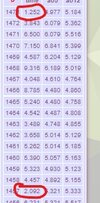
I got this scramble, F R' U F2 R' F R U2 F', I saw it was an EG-1 case, I learnt it and continued solving. Then some 15 solves later, I get this scramble, U' F U' F' R F' U2 F' U' and it's the exact same case that I just learnt some minutes ago. What are the chances of this happening, I don't know if it's rare of quite common. If it helps, I only have like 1470 solves.
 

Attachments

  • chance.jpg
    chance.jpg
    25.2 KB · Views: 5
What are the chances of getting the same EG-1 case?
I got this scramble, F R' U F2 R' F R U2 F', I saw it was an EG-1 case, I learnt it and continued solving. Then some 15 solves later, I get this scramble, U' F U' F' R F' U2 F' U' and it's the exact same case that I just learnt some minutes ago. What are the chances of this happening, I don't know if it's rare of quite common. If it helps, I only have like 1470 solves.
The first solve doesn't really matter, but since none(since we are talking only about EG-1) cases have symmetry, every one of the 42 cases is as likely to happen.
So, if you do a solve, remember the EG Case, then do another, the Case you just had has a 1 in 42 chance of appearing(assuming you can force EG-1, you certainly can, I din't think you did but this is the way you asked the question. If you ask it differently, we can talk about full EG)
 
Back
Top