• Welcome to SpeedSolving.com — the world’s largest puzzle community!

    You’re currently browsing as a guest, which means you have limited access to discussions, resources, member profiles, and community features.

    Join 50,000+ cubers and puzzle enthusiasts from around the world to ask questions, share solves, improve faster, and be part of the community.

    Registration is free, fast, and easy — create your account today.

    Already a member? Log in here to hide this message and start participating.

Human limit in speedcubing?

Lord_Oscar

Veteran
Joined
May 17, 2023
Messages
637
Location
Wellington, NZ
WCA
2023WELT02
YouTube
Visit Channel
This is a debate in many sports, very notably Freediving.

My question is this:
Will we, as a speedcubing community get to a point where it is physically impossible to beat any world records (due to both hardware, solutions, TPS, and lookahead)?

Will this ever happen and if so, how soon and in what events?
YES!!!! It will happen! It will happen on 4/15/28. the event will be FTO. the time will be 4.15 seconds!!!! QUESTION ANSWERED. DONE!!!!!!!

okay jkjkjk.

I've also wondered this. about cubing and many other things especially time trial road biking, MC speedrunning, and the NFL Rookie Combine 40 yard dash time, and honestly, I think that it will never happen. I am a relatively strong believer in "nothing is impossible" and I believe that records were made to be broken. the harder a time gets to beat, the more the other people are going to want to do it. unless something crazy happens like some idiot recognizes a 7 move 6x6 reduction to 2x2 stage and then executes sun CLL then maybe, but there can be no absolute answer.
 
I'm not sure about this. i dont know much about how tnoodle scrambles work but we've had some really low movecount cfop solves recently, but tell me if im wrong and tnoodle cant generate scrambles like that.
TNoodle is random-state, so doesn't purposefully try to generate hard scrambles. A scramble solvable with just one slice move is technically possible by TNoodle.
 
I'm not sure about this. i dont know much about how tnoodle scrambles work but we've had some really low movecount cfop solves recently, but tell me if im wrong and tnoodle cant generate scrambles like that.
There HAVE been some cases of really short scrambles in comps
Sofia Autumn 2018
1716129822076.pngwhat the actual
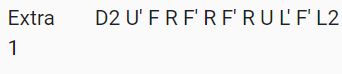
And 15 move optimal scrambles in FMC
This one's from Thailand Championships 2015
1716129977021.png

so MAYBEE in the future not any time soon we can see a 15 move solution
 
I'm not sure about this. i dont know much about how tnoodle scrambles work but we've had some really low movecount cfop solves recently, but tell me if im wrong and tnoodle cant generate scrambles like that.
WCA regs allow for scrams as low as 2 move optimal. 12 movers have already been genned in competitions.
 
I think that 3x3 will be capped in comp at 2-3 seconds. Might be a decade or two, but I think it can happen. 2x2 I think is already pretty close. 4-7 is debatable. FMC is, like @precompsubwr said, pretty close to the limit. It can get better with some luck, but It is already pretty crazy. Mega is probably sub-20, Skewb/Pyra are pretty close, but probably sub-1ish. Clock is stupid, no need to talk about that, squan is probably 2.5-3.5, we've had some crazy unoficall times. Blind is probably at the limit, except absolultey insane luck. Big blind/Multi blind might get faster, but they have stood untouched for a while. OH probably caps out at around 5-6 seconds, WR single might be sub 5. All of these are possible in the next decade or two.
 
WCA regs allow for scrams as low as 2 move optimal. 12 movers have already been genned in competitions.
Surely any scramble that isn't randomly generated - without human input .....

is fixed! 😡

And therefore wrong.

What if the scramble is 20 moves. First 10 scramble to random position, second 10 restore it i.e. reverse it - so you end up with a solved cube to solve. 🙂
 
The weird thing is that a random state of a cube is a random state. By stating that you randomly scramble the cube via a PC, but then reject scrambles that can be solved in less the 'K' moves means the scrambles are no longer random.
By this logic, the WCA is the one that decides the human limit, by deciding how easy a scramble can be. It could be applied to 3x3. You could scramble then have the PC find all possible CFOP/FreeFOP/Roux solutions and any scramble that has a sub-27 move solution is rejected. In that sense, times at home with truly random scrambles would no longer match competition times.
I have often commented that for corners first 3x3 solving, the time to solve the corners is LESS than the time to solve the corners on a 2x2. This is because a 3x3 scramble is allowed, where the corners are pre-solved or can be solved in 1, 2 or 3 moves. Whereas all those scrambles are rejected in 2x2 competitions because 4 moves is the lowest allowable solve. This means that for 3x3 corners first the corners (for an expert) are actually much faster to solve. This is just the first sign of the weirdness of non-random scrambles which are now the standard for WCA.
 
I am curious to know what are the human limits in freediving?
There is no concrete answer to this, and there are many conflicting opinions on this.

To understand this, we need to talk about freediving. As you probably know, competitors compete on a single breath, however there are many disciplines, just like cubing.
However, I will talk about the Constant Weight with fins (CWT) discipline to keep this message short and easily digestible. If you want to learn more about freediving check the freediving Wikipedia Article and this article on PADI.
In CWT, competitors are allowed bi or monofins and cannot remove any weights or touch the guideline during the dive.
Currently, the world records in CWT are 133m (men's) and 123m (women's), as ratified by AIDA, the international governing body of freediving.

I do not have a clearly defined human limit, as people thought 100m would be impossible at times. However, I believe that anything over 300m will be next to impossible.
As far as I am aware, there is no widely agreed-upon limit on freediving.
When I set the world constant weight record at 82m in 2001 in Vancouver, I predicted constant weight records would rapidly advance to 125m and then progress would slow to a crawl. Incredibly, that is what happened. Eventually, I wrote a document on a new method that could allow 150m in constant weight, but, it required so drastic a change in approach that no top divers were willing to get worse for 3 years before they got better. Unfortunately, doping has become too common in freediving and the records don't really match the 'clean' human limit anymore.

The current record for static breath-holding is 11'35" by Stephane Mifsud but he cheated with oxygen (well known). I coached Branko Petrovic from Croatia to a clean Serbian record of 12'18", but he did 13'30" in practice without oxygen or drugs. However, yoga masters in India can hold their breath for more than half an hour without losing consciousness.

The sad thing with so many sports is how widespread doping is. Road cycling has been synonymous with doping since its inception basically, and the Tour de France is often referred to as the “Tour de Doping”.
I don’t admire anyone in the pro cycling scene, just because I have no faith in anyone performing at a high level.
 
When I set the world constant weight record at 82m in 2001 in Vancouver, I predicted constant weight records would rapidly advance to 125m and then progress would slow to a crawl. Incredibly, that is what happened. Eventually, I wrote a document on a new method that could allow 150m in constant weight, but, it required so drastic a change in approach that no top divers were willing to get worse for 3 years before they got better. Unfortunately, doping has become too common in freediving and the records don't really match the 'clean' human limit anymore.

The current record for static breath-holding is 11'35" by Stephane Mifsud but he cheated with oxygen (well known). I coached Branko Petrovic from Croatia to a clean Serbian record of 12'18", but he did 13'30" in practice without oxygen or drugs. However, yoga masters in India can hold their breath for more than half an hour without losing consciousness.
Wow, first of all, huge congratulations on having the constant weight record in the past. I remember you from the LMCF solves that you posted 7 years back. They were super fast yo!

I agree yogic practice helps people maintain breaths for longer. I practice yoga myself and have spent 27 years in India.
 
Doping in sports creates a different kind of sport. In sports like cycling, it is basically impossible to win without doping. When people get mad at Lance Armstrong for doping in cycling, they make the stupid comment that 'he only won because he doped.' Wrong. Everyone doped. And he still won. And that makes him pretty incredible, even if it is not the type of incredible that I wish for.
 
This is a debate in many sports, very notably Freediving.

My question is this:
Will we, as a speedcubing community get to a point where it is physically impossible to beat any world records (due to both hardware, solutions, TPS, and lookahead)?

Will this ever happen and if so, how soon and in what events?
I don’t think there will ever be a point like that. People a decade ago thought it was impossible to get a sub-6 or sub-5 average, and yet, here we are. It is exciting to think of what the future could bring in terms of times.
 
Back
Top