
Hi everyone!
In this thread I'll present CEOR-Zero, a new variant of CEOR I came up with which achieves the following:
- Better ergonomics, it's possible to do at most only 1 S-move and 1 u-move, the rest is using U, r and R-moves.
- Fewer moves. The exact difference hasn't been calculated but it's certain to be lower. This is when comparing to CEOR using CPLine+extension to build CPFB.
- Fewer algorithms. No more algorithms needed for CPLine.
- Easier CPFB planning.
For the cost of having to do a z' rotation, slightly more advanced tracing and a more intuitive FB building step.
How is this achieved? The trick lies in replacing the CPLine+extension step with a new corner permutation step at the start called "0-move CP", together with intuitive FB. This works by reducing the corners into a state that can be solved by first doing <U, L> moves followed by <U, R>. Now here's the kicker: it's been shown to always be possible to find an orientation where this reduction is already solved (given that you are x2y color neutral or better), thus requiring 0 moves. If not found, only 1 move is needed at most. After this orientation is found, you solve FB using <L, l, U, u, S> moves, except you hold the cube so that these moves become <U, u, R, r, S> and build your FB in the U layer. After it's been built, you do a z'-rotation which places the FB in its usual position. The rest of the corners will now be correctly permuted due to our previous tracing step and you can continue the solve as with standard CEOR.
Yash Mehta has managed to find a tracing system for the 0-move CP step! It's a bit complicated, but works, it's included in the guide linked towards the end of this post. I've also made a small optional extension that one can use to further increase the likelihood of finding a 0-move solution.
In the first step during inspection, the corners are "solved" in what can be described as a "2-phase reduction", this image might help to show what it means.
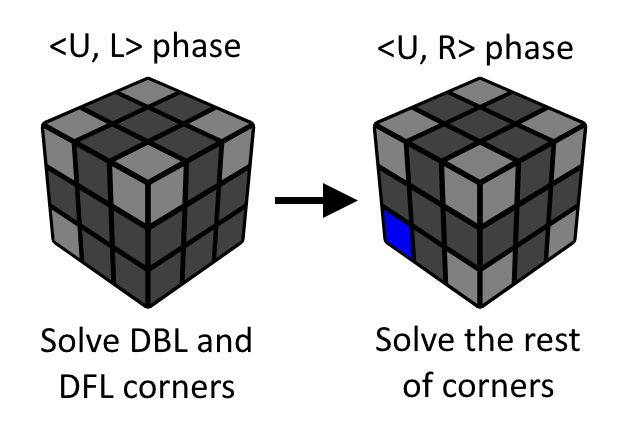
Now as we can see, if we do a z rotation in the first phase, the <U, L> moves become <U, R>. So we can solve all the corners through doing <U, R> moves, a z' rotation, then <U, R> moves again. This therefor improves ergonomics a bit, avoiding F moves in particular.
Please check out this guide, it has some pictures to further explain how this variant works as well as a tutorial for the tracing system. Edit: and it has some example solves! There are more in the discord server as well.
The variant isn't fully developed, we now have to work on finding algs and techniques for solving the FB as optimally as possible during solves. For now, you'll have to do it intuitively, although there is a suspicion that solving square+pair is more efficient than line+extension (which would be similar to standard CEOR). Hopefully, more applications can be found for 0-move CP as this is possible to adapt for many methods and all N x N puzzles.
Feel free to ask any questions, I hope I explained things well enough. If you want to, you can contact me on discord: "edde_" and/or join the CEOR method discord server.
In this thread I'll present CEOR-Zero, a new variant of CEOR I came up with which achieves the following:
- Better ergonomics, it's possible to do at most only 1 S-move and 1 u-move, the rest is using U, r and R-moves.
- Fewer moves. The exact difference hasn't been calculated but it's certain to be lower. This is when comparing to CEOR using CPLine+extension to build CPFB.
- Fewer algorithms. No more algorithms needed for CPLine.
- Easier CPFB planning.
For the cost of having to do a z' rotation, slightly more advanced tracing and a more intuitive FB building step.
How is this achieved? The trick lies in replacing the CPLine+extension step with a new corner permutation step at the start called "0-move CP", together with intuitive FB. This works by reducing the corners into a state that can be solved by first doing <U, L> moves followed by <U, R>. Now here's the kicker: it's been shown to always be possible to find an orientation where this reduction is already solved (given that you are x2y color neutral or better), thus requiring 0 moves. If not found, only 1 move is needed at most. After this orientation is found, you solve FB using <L, l, U, u, S> moves, except you hold the cube so that these moves become <U, u, R, r, S> and build your FB in the U layer. After it's been built, you do a z'-rotation which places the FB in its usual position. The rest of the corners will now be correctly permuted due to our previous tracing step and you can continue the solve as with standard CEOR.
Yash Mehta has managed to find a tracing system for the 0-move CP step! It's a bit complicated, but works, it's included in the guide linked towards the end of this post. I've also made a small optional extension that one can use to further increase the likelihood of finding a 0-move solution.
In the first step during inspection, the corners are "solved" in what can be described as a "2-phase reduction", this image might help to show what it means.
Now as we can see, if we do a z rotation in the first phase, the <U, L> moves become <U, R>. So we can solve all the corners through doing <U, R> moves, a z' rotation, then <U, R> moves again. This therefor improves ergonomics a bit, avoiding F moves in particular.
Please check out this guide, it has some pictures to further explain how this variant works as well as a tutorial for the tracing system. Edit: and it has some example solves! There are more in the discord server as well.
The variant isn't fully developed, we now have to work on finding algs and techniques for solving the FB as optimally as possible during solves. For now, you'll have to do it intuitively, although there is a suspicion that solving square+pair is more efficient than line+extension (which would be similar to standard CEOR). Hopefully, more applications can be found for 0-move CP as this is possible to adapt for many methods and all N x N puzzles.
Feel free to ask any questions, I hope I explained things well enough. If you want to, you can contact me on discord: "edde_" and/or join the CEOR method discord server.
Last edited:


 I've updated the original post and the link in the tutorial.
 I hope people gives it a chance now that there's a much smaller "gap" between standard CP solving and 0-move CP. Before these new tracing methods, there were a strong argument that the complexity of the tracing would make it not worth it, as you'll need to not only do the tracing but at least have some time left. But now it's possible to do it much faster and, for those who already knows CEOR, you can start out with standard tracing then have the choice of solving CPline as usual or do 0-move. It should also be noted that mine and Mehta's tracing methods complement each other rather than "compete" as they handle two different kind of cases (his doesn't work when the choice of CPline corners are adjacent, which mine works the best for).


