
As you said, it's hard to know where to draw the line. JPerm has a couple of really good videos on look ahead, and if you haven't already seen it, I would recommend watching this:I think I'll choose one of the 2-gen algs for that case and stick with that for now; I can always upgrade or add more later, but there are more urgent things to fix first before learning more ways to do the same thing. And as you say, choosing which one is best is too advanced at this point anyway.
Your point about look ahead is interesting, though. When I time solves, it feels like I spend half the time looking for the right pieces, so my intuitive conclusion was that improving look ahead even moderately would make the whole solve much more fluid. Maybe I'm using the word incorrectly here, I simply mean that it feels like a priority to learn to at least spot one piece I want in the next step while performing the current step.
Then again, it could also be the case that building better F2L habits is even more important. If that's the case, I should probably not do any timed solves at all until I have a better understanding of F2L, which will take much longer than a few weeks. What I'm not sure about is where to draw the line? I mean, in theory, I could not do any time solves for a year and only focus on understanding and learning all common F2L cases, which might yield better long-term results than what I'm doing now.
My goal here isn't to win competitions (I'm 39, so it's a bit late for that), so what I enjoy obviously plays into what strategy to use, but I do think that trying to improve is in itself interesting and enjoyable. I think I'll stick to doing timed solves one day a week or something like that, then spend the rest of the time improving F2L. If you (or anyone else) has any suggestions for how to build good habits for F2L, that would be more than welcome!

Navigation
Install the app
How to install the app on iOS
Follow along with the video below to see how to install our site as a web app on your home screen.
Note: This feature may not be available in some browsers.
More options
Style variation
You are using an out of date browser. It may not display this or other websites correctly.
You should upgrade or use an alternative browser.
You should upgrade or use an alternative browser.
Snigel's progression thread (dabbling in bigger cubes)
- Thread starter Snigel
- Start date
I guess "building good F2L habits" might not have been the best choice of words, when I think about it. What I meant to say is that I think you think you should at least learn all of the basic F2L cases first, since using inefficient and bad solutions will make look ahead a lot harder.

Snigel
Regular
- Joined
- Jun 20, 2010
- Messages
- 122
I guess "building good F2L habits" might not have been the best choice of words, when I think about it. What I meant to say is that I think you think you should at least learn all of the basic F2L cases first, since using inefficient and bad solutions will make look ahead a lot harder.
Yeah, I see what you mean. If I need to think about where pieces are going and where they are supposed to go as I solve a pair, that makes it impossible to look ahead. All my deliberate practice right now is focused on F2L, so I'll keep doing that while also occasionally actually solving the cube. I'll also do weekly updates and film solves to track progression, but learning to do basic F2L cases in non-horrible ways seems more important than trying to go faster with inefficient solutions. Thank you for the input so far!

Snigel
Regular
- Joined
- Jun 20, 2010
- Messages
- 122
I did my weekly batch of timed solves, but no filming this time (I don't think there's too much difference between now and last week, to be honest). I've made progress on recognition and execution of the tricky F2L cases I've been focusing on, and the cross is better than before as well. I had a rather good streak and broke all records except for single solve. PBs as of today:
2023-006-07: Single 21.63, ao5 26.13, ao12 28.42, ao100 31.61, ao500 33.80
2023-006-07: Single 21.63, ao5 26.13, ao12 28.42, ao100 31.61, ao500 33.80
Snigel
Regular
- Joined
- Jun 20, 2010
- Messages
- 122
This is a very basic question, but I feel I have to ask. When I have two pieces paired up in the top layer during F2L like this:
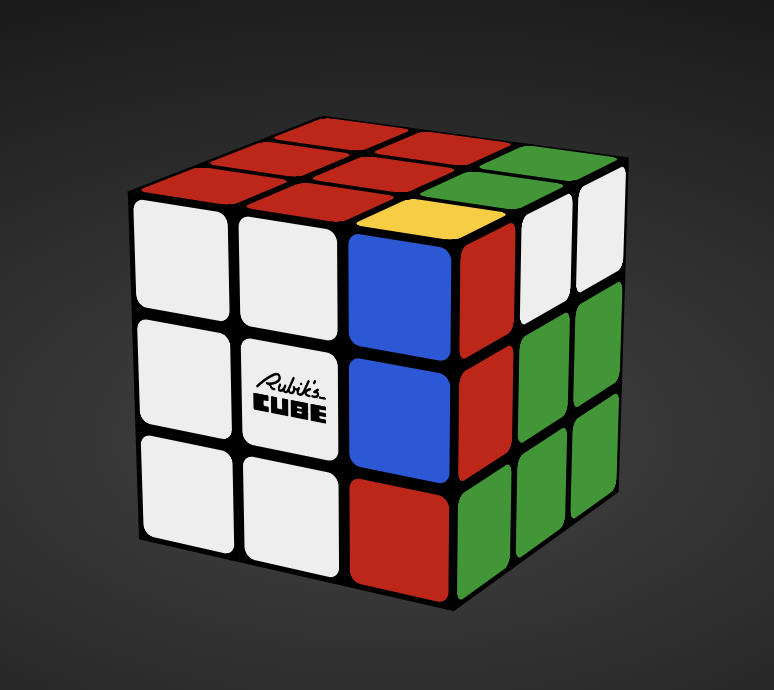
Should I insert this with F' U' F or y L' U L' or maybe something else? I understand that it might be better to rotate if that makes other cases easier or I will have to rotate anyway, but assuming that I can't predict that during a solve, should my default insert here be with a rotation or some other way? If without rotations, how do I finger trick it? I really, really suck at doing things like F' U' F.
Should I insert this with F' U' F or y L' U L' or maybe something else? I understand that it might be better to rotate if that makes other cases easier or I will have to rotate anyway, but assuming that I can't predict that during a solve, should my default insert here be with a rotation or some other way? If without rotations, how do I finger trick it? I really, really suck at doing things like F' U' F.

An Animating Cuber
Veteran
- Joined
- Dec 22, 2022
- Messages
- 2,336
- Location
- Georgia, USA
- WCA ID
- 2023COTT01
- YouTube
- Visit Channel
Depends on the case, I'll sometimes rotate sometimes I'll do F R' F' R.This is a very basic question, but I feel I have to ask. When I have two pieces paired up in the top layer during F2L like this:
View attachment 24668
Should I insert this with F' U' F or y L' U L' or maybe something else? I understand that it might be better to rotate if that makes other cases easier or I will have to rotate anyway, but assuming that I can't predict that during a solve, should my default insert here be with a rotation or some other way? If without rotations, how do I finger trick it? I really, really suck at doing things like F' U' F.

artless1der
Veteran
A s a ROUX solver, I don't know any WINTER VARIATIONS for last slot...
but that looks like one of the cases...
also,
you could do R U' R' U2 R U2 R'
but that looks like one of the cases...
also,
you could do R U' R' U2 R U2 R'
Last edited:

ruffleduck
Veteran
RotateThis is a very basic question, but I feel I have to ask. When I have two pieces paired up in the top layer during F2L like this:
View attachment 24668
Should I insert this with F' U' F or y L' U L' or maybe something else? I understand that it might be better to rotate if that makes other cases easier or I will have to rotate anyway, but assuming that I can't predict that during a solve, should my default insert here be with a rotation or some other way? If without rotations, how do I finger trick it? I really, really suck at doing things like F' U' F.
If you don't want to make it complicated, I would recommend just rotating. Eventually, it's useful to choose between y L' U L and y' R' U R depending on what's faster to execute or what's better for look ahead etc. (U) F R' F' R is a very nice option as well, and can sometimes be better than rotating. F' U F can also be good sometimes, but it doesn't always flow well together with other F2L pairs. There are several ways to fingertrick it, and I'll try my best to explain the ones I prefer.This is a very basic question, but I feel I have to ask. When I have two pieces paired up in the top layer during F2L like this:
View attachment 24668
Should I insert this with F' U' F or y L' U L' or maybe something else? I understand that it might be better to rotate if that makes other cases easier or I will have to rotate anyway, but assuming that I can't predict that during a solve, should my default insert here be with a rotation or some other way? If without rotations, how do I finger trick it? I really, really suck at doing things like F' U' F.
- F' with left index, U with right middle finger, and F with right index.
- Both F moves with right thumb and U with left index push.
- F' with left thumb, U with right middle finger or left index push, F with right index.
Edit: If you want to see some of these fingertricks in a video, you can check out OLL 10, 14 and 37 in:
Last edited:
Snigel
Regular
- Joined
- Jun 20, 2010
- Messages
- 122
If you don't want to make it complicated, I would recommend just rotating. Eventually, it's useful to choose between y L' U L and y' R' U R depending on what's faster to execute or what's better for look ahead etc. (U) F R' F' R is a very nice option as well, and can sometimes be better than rotating. F' U F can also be good sometimes, but it doesn't always flow well together with other F2L pairs. There are several ways to fingertrick it, and I'll try my best to explain the ones I prefer.
Note that all of these are done from homegrip without any regrips, and the cube can be stabilized by putting both pinkys under the cube on the S slice.
- F' with left index, U with right middle finger, and F with right index.
- Both F moves with right thumb and U with left index push.
- F' with left thumb, U with right middle finger or left index push, F with right index.
Edit: If you want to see some of these fingertricks in a video, you can check out OLL 10, 14 and 37 in:
Thank you, that's very helpful! I think the second one with both F with the thumb comes most naturally to me, but it's still awkward.
I'll rotate for now, I think.
Snigel
Regular
- Joined
- Jun 20, 2010
- Messages
- 122
It feels like I've become worse at F2L in the past week. I still managed to get a new single PB, but it was a lucky solve and not a result of better solves on average. I also lowered the ao500 a bit, but that's because the earlier solves in such a large sample were quite bad. I tried to film a bit today, but it was all horrible so I gave up.
2023-06-07: Single 21.63, ao5 26.13, ao12 28.42, ao100 31.61, ao500 33.80
2023-06-14: Single 20.68, ao5 26.13, ao12 28.42, ao100 31.61, ao500 33.06
2023-06-07: Single 21.63, ao5 26.13, ao12 28.42, ao100 31.61, ao500 33.80
2023-06-14: Single 20.68, ao5 26.13, ao12 28.42, ao100 31.61, ao500 33.06
Snigel
Regular
- Joined
- Jun 20, 2010
- Messages
- 122
I didn't cube much last week, but I did manage to record an ao5 today with representative times:
2023-06-19 (ao5: 28.51)
1. (26.15) U' L2 F' R2 U2 B R2 F' D2 B2 R2 F R' F2 R D U2 R' U L'
2. 29.66 R' B' R U' B R L2 F L2 U F2 U2 B2 R2 B2 D B2 D F2 U'
3. 27.59 B' D2 R2 B' F2 U2 B2 D2 L2 F L U' F R' U2 L' F' D2 L'
4. (34.61) R2 U' L2 U' R2 B2 U L2 F2 U' R2 D' F R' U' L B R D' F2 D2
5. 28.28 L2 B U2 B2 D2 B2 R' B2 L' F2 L F2 R' D' B2 R F2 R2 D B'
Many obvious mistakes here, of course, such as messing up the cross on the first solve. I also often mess up OLL 46 a lot, mixing up the order of the moves in the middle, which means that the second half of the alg reverses the first half. Very annoying. I also cube rotate for no good reason quite a lot.
I also beat some records:
2023-06-14: Single 20.68, ao5 26.13, ao12 28.42, ao100 31.61, ao500 33.06
2023-06-19: Single 20.35, ao5 26.13, ao12 28.42, ao100 31.57, ao500 32.45
Snigel
Regular
- Joined
- Jun 20, 2010
- Messages
- 122
Timed ~50 solves today and made a breakthrough, both quantitatively and qualitatively. Quantitatively, I broke every single PB, single with more than 1.5 seconds (my first sub-20 solve with CFOP) and ao5 with more than one second.
2023-06-19: Single 20.35, ao5 26.13, ao12 28.42, ao100 31.57, ao500 32.45
2023-06-20: Single 18.79, ao5 24.96, ao12 27.99, ao100 30.51, ao500 32.16
Qualitatively, the difference is that I'm starting to be able to find the next F2L pair while solving the current pair. Not always, but often enough that I can get started on it immediately, or at least avoid spending a few seconds looking for the pieces. The 18.79 solve had an accidental x-cross, though, but no PLL/OLL skip (the previous PB did)!
Yesterday, I felt that sub-20 average was far, far away, but this makes it seem possible soon. Woho!
Snigel
Regular
- Joined
- Jun 20, 2010
- Messages
- 122
Just did the luckiest solve I think I've ever done. Unfortunately, I messed up the OLL and got 17.99 seconds, which still a PB, but this could have been sub-15 easily. I must also have messed up the scramble, because when I try to reconstruct the solve, it doesn't match what I actually had, but since the cross was nothing out of the ordinary, this doesn't really matter.
So, normal cross (think it was 4-5 moves, good but nothing exceptional), then normal first F2L pair, but then when solving the second pair, I accidentally solved the remaining two pairs as well. The chance of this happening must be astronomically small, although hard to quantify. I mean, getting one free F2L pair does happen, but two? I probably lost 1-2 seconds just by verifying that all pairs were actually solved because I assumed I must have messed something up.
Fun, but not very representative!
Update: I did some more solves and feel that I can consistently get sub-30 now, which is great! The ao100 crept just below 30 and I also broke the other PBs, but the single PB mentioned above wasn't part of the new best ao5 or new best ao12. Here are the stats as of today:
2023-06-20: Single 18.79, ao5 24.96, ao12 27.99, ao100 30.51, ao500 32.16
2023-06-22: Single 17.99, ao5 23.99, ao12 26.90, ao100 29.95, ao500 31.58
Last edited:
Snigel
Regular
- Joined
- Jun 20, 2010
- Messages
- 122
I have done a ton of timed solves today, encouraged by the fact that times seem to be coming down quite fast. This is not really visible in the PBs because yesterday was so good, but I get sub-30 more often than not now, which certainly wasn't the case earlier this week.
However, I feel like I really should slow down and spend more time on optimising F2L instead of just spamming timed solves. Anyway, here's a PB update for today:
2023-06-22: Single 17.99, ao5 23.99, ao12 26.90, ao100 29.95, ao500 31.58
2023-06-23: Single 17.99, ao5 23.88, ao12 26.90, ao100 29.95, ao500 31.39
Snigel
Regular
- Joined
- Jun 20, 2010
- Messages
- 122
I haven't cubed much recently but had a really nice streak this morning and broke most PBs again. The only new thing I've been trying out is when I see great 2x2x2 potential in inspection, I sometimes plan out a 2x2x2 and see if I can find two extra pieces for a cross. I think this is backwards from what CFOP solvers normally do, but I've been able to do this fairly consistently as long as the 2x2x2 is just a few moves. The single PB shown below was with one of these starts, for example. The block needs to be obvious, though, because inspecting both for a cross and a good 2x2x2 is not possible for me right now.
2023-06-23: Single 17.99, ao5 23.88, ao12 26.90, ao100 29.95, ao500 31.39
2023-06-27: Single 17.75, ao5 23.88, ao12 25.28, ao100 29.67, ao500 30.51
2023-06-23: Single 17.99, ao5 23.88, ao12 26.90, ao100 29.95, ao500 31.39
2023-06-27: Single 17.75, ao5 23.88, ao12 25.28, ao100 29.67, ao500 30.51
Snigel
Regular
- Joined
- Jun 20, 2010
- Messages
- 122
I've been spending too much time on timed solves recently, so I'll take at least a week's break and focus on slow F2L instead. Times are still improving even if I'm just doing the same things but faster, but I don't think this is good in the long term. Here are my stats as of today:
2023-06-27: Single 17.75, ao5 23.88, ao12 25.28, ao100 29.67, ao500 30.51
2023-06-30: Single 17.75, ao5 23.88, ao12 25.16, ao100 28.66, ao500 30.10
2023-06-27: Single 17.75, ao5 23.88, ao12 25.28, ao100 29.67, ao500 30.51
2023-06-30: Single 17.75, ao5 23.88, ao12 25.16, ao100 28.66, ao500 30.10
Snigel
Regular
- Joined
- Jun 20, 2010
- Messages
- 122
I've been trying to practise more cross and F2L recently, and one thing I've been doing is trying to count moves and find effective solutions. My question is what would a reasonable move count be for cross + F2L?
This is not FMC, of course, so I use only algs and solutions I would use in a normal solve. I don't try the same scramble multiple times to compare, pick the pair that I see first without spending a minute finding a better one. Some solutions, such as when the two pieces are connected on the top layer with cross colour on top, where I now do R' U' R2 U' R' U R' U R2 U' R' thanks to @OreKehStrah's earlier advice, take up a lot of moves, but are quite fast.
I counted moves to completed F2L for 30 solves and I have an average of 41.6 moves. I saw somewhere that CFOP has an average move count of 56, which obviously includes LL as well. Of course, averaging just under 30 seconds won't allow me to solve F2L as efficiently as pros, so how bad is 41.6?

OreKehStrah
Veteran
For that avg, 41.6 is good! Very good in my opinionI've been trying to practise more cross and F2L recently, and one thing I've been doing is trying to count moves and find effective solutions. My question is what would a reasonable move count be for cross + F2L?
This is not FMC, of course, so I use only algs and solutions I would use in a normal solve. I don't try the same scramble multiple times to compare, pick the pair that I see first without spending a minute finding a better one. Some solutions, such as when the two pieces are connected on the top layer with cross colour on top, where I now do R' U' R2 U' R' U R' U R2 U' R' thanks to @OreKehStrah's earlier advice, take up a lot of moves, but are quite fast.
I counted moves to completed F2L for 30 solves and I have an average of 41.6 moves. I saw somewhere that CFOP has an average move count of 56, which obviously includes LL as well. Of course, averaging just under 30 seconds won't allow me to solve F2L as efficiently as pros, so how bad is 41.6?
Snigel
Regular
- Joined
- Jun 20, 2010
- Messages
- 122
For that avg, 41.6 is good! Very good in my opinion
Thank you! That matters for my approach moving forward, I think, because it means that my focus should be on transferring this efficiency to real solves (rather than increasing efficiency itself). I think I know what my weaknesses are, so I'll work on the following then:
- Try to reduce cube rotations. I often rotate for no good reason and sometimes even end up rotating back because I realise that the original rotation was what I needed.
- Insert into the back whenever appropriate. I have known all along that inserting into the back is better, all things else being equal, but I postponed thinking about this until now. When rotating, I'm now trying to rotate so I insert into the back slots.
- Avoid favouring the right side. I've mentioned this before, but I'm so much better at intuitively solving the pairs on the right compared to the left (because Petrus). I tried doing 2-gen UL and UR scrambles to see how big this difference is, and I solve UR 2.5 times faster than UL. I don't think they will ever be the same, but I should stop automatically rotating so I have free slots on the right even when this is inefficient.
- Learn remaining special F2L cases. I have a few cases with connected pieces I need to think a lot before I know how to solve intuitively, mostly those where both pieces are in the slot already.
Similar threads


- Replies
- 22
- Views
- 1,148


- Replies
- 10
- Views
- 467

