Anyone here interested in philosophy?

Status
Not open for further replies.
I didn't say that they weren't connected, I just said that they aren't intrinsically connected. It's kind of like the 2D political grid thing.
images

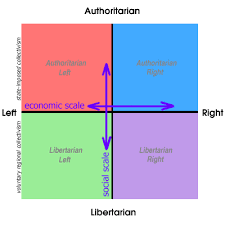
A lot of people, myself included, fall roughly on the line from lower left to upper right on the grid. However, although they are connected, the scales don't have to be. That's why the 3rd biggest party in the US is the Libertarian Party, which is decidedly NOT on that line, falling closer to the lower right.
I think there's a relatively semantic distinction between things being connected and intrinsically connected. In a vacuum it could still be argued that capitalism has a social or political dimension to it, otherwise it would not be capitalism. Just like how a tree would not be a tree without soil and nutrients, saying capitalism is purely an economic system would be like saying a tree is just a bunch of wood: it's overly reductive.

Also, as a side note, have you taken the political compass test? It doesn't take that long and I think it's pretty interesting, here's a link: https://www.politicalcompass.org/test It basically says where exactly you are on that chart, and although it may not be super accurate (it said I sided with a soft form of anarchism) I think it's still a decent insight into your political/economic views. I was about where the L in Left is for Libertarian Left, if not slightly more to the left and down.
 
What is really at play here is the manipulation of people's perceptions of communism and marx to think that Mao, Pol Pot, etc were perfect examples of Marx's ideals, when in reality it's completely false. Just because people do it wrong doesn't mean it's not a good philosophy.

What I'm actually talking about here is the idea of democratic socialism or a capitalist economy which is regulated by the government in such a way that huge corporations are not allowed to oppress the masses. If you want to talk about how the proof is in the pudding, look at places like the US vs Scandinavian countries. The US is heralded for being one of the most economically free nations yet it has enormous rates of poverty, mass incarceration, and use of fossil fuels, and income inequality is ridiculous. All of these are a direct result of unregulated capitalism. Poverty and income inequality are made possible by keeping the poor in their place with an absence of a higher minimum wage among lots of other things, while corporations get tax breaks from politicians. Mass incarceration is fueled by the massive waste of time and money called the War on Drugs as well as for-profit prisons, giving an incentive for the government to incarcerate people and basically make them do slave labor for extremely low pay. The use of fossil fuels is symptomatic of capitalism's inherent drive to produce, and insofar as renewable energy is not the most cost effective at the moment, big oil companies would much rather produce as much energy as cheaply as possible without caring what happens to the environment.

Capitalism isn't perfect, and I haven't seen anyone on here advocating a pure libertarian economic system, which is what you are describing as capitalism. There is an idea called The Tragedy of the Commons that says where there is a shared resource (in the original example a pasture) but an individual benefit from using it (originally grazing individually owned animals on it) it will tend to be overused to the point that it is useless to everyone. This concept can and has been expanded to consider all of earth's natural resources as a Commons, the idea being that if I dump pollution into the air I benefit more from getting rid of waste cheaply than I am hurt, because the benefit is concentrated but everyone on earth suffers, so the negative effect is spread out. The proper role of government in economics, in my opinion, is to prevent this kind of thing. It will be a never-ending debate as to what exactly that looks like, but that's ok. There are limits to capitalism, and a good government will regulate to some extent, but it is true that when people are acting in their own best interest they work harder and more effectively than they do if they are just working because that's what you do. We're selfish that way.

Plus, you also talk about how capitalism allows for the most acceptance, but what about the image of the black male thug that has been produced by society as a result of continuing cycles of poverty and mass incarceration? Or what about the fact that slavery was inherently tied to the capitalist drive for unregulated labor? Or the commodification of various identity politics movements by capitalism? Or the production of the ideal body image of women by clothing companies? There are many example of how a purely capitalist society does not create acceptance. However, it's not even a question of acceptance anymore as the way oppression is manifested nowadays is in societal structures, which capitalism alters in such a way that people experience lots of hard times, most of which are linked to poverty. Now, let's look at Scandinavian countries. They have what most would consider to be a socialist economy, yet they do not have high tensions with other countries, they don't have a lot of corruption, and they have one of the highest happiness rates in the world. There's your proof in the pudding. It also disproves your tribalism hypothesis since Scandinavia was pretty much the origin of tribalist conquest, with the Vikings a long time ago.

The very fact that you recognize these as problems is an indicator of how far we've come. I'm not going to argue that these things are good by any means, but through gradual change things have improved a lot.

As to the Vikings and Scandinavian countries: first, I think that saying that the Vikings originated tribalism is just simply not true. The Vikings were active around 1300-1000 years ago, roughly the time that Mohammed and early Muslims were conquering the Middle East, and long after the Romans, Greeks, Babylonians, Persians, Egyptians, Israelites, and early Chinese dynasties, to name a few, were doing the same thing. Scandinavia now is unique. You are correct that they have very stable, prosperous, and socialist culture. My brother and sister spent last fall in Denmark, and their observation was that "the only thing not homogenized in Denmark is the milk," by which they meant that people in a given country by and large come from very similar backgrounds, socially, economically, and genetically, and everyone understands that they are part of a larger whole. They mentioned specifically the health care system, which has functioned just fine for quite a while now, but that recent immigrants are putting a strain on the system. Not because there are more people, but because immigrants don't have the same sense that "if I go to the doctor for a stubbed toe, my friend across the street will pay for it." There is a sense of communal responsibility that is lacking in the United States, and probably in most places, that is necessary for socialism to function.

E: Also, the communist countries today that people often reference (China, NoKo) are not communist. China is "communist" because it is technically led by the communist party, but they trade freely with other nations and have a booming capitalist economy. The reason why living conditions are bad in some areas of China is because of the huge amounts of production and capitalist exploitation that takes place, which is actually a result of capitalism, not communism. See, just another example of the subtle ways our perception is tainted by capitalist structures. And North Korea is really just fascism, I doubt there's a single thing in the Communist Manifesto that Kim Jong-un actually abides by.

I believe you are correct in estimating just how technically "communist" China and North Korea are, however the fact of the matter is that they still use Marxist rhetoric to justify their policies, and China at least did start out explicitly trying to implement a Marxist system. The system that is in place in China is corrupt, whatever it is, and it is certainly not properly regulated capitalism. Even with the problems, though, and there are many, there are not millions of people being killed, so I count that as better than when they were really trying to implement Marxism.

Yes, communism in its pure form is simply an economic system. Neither communism nor capitalism has anything to do with gun ownership or gay rights.

You really can't separate things this cleanly. When the United States was fighting the Soviet Union during the Cold War, Whitaker Chambers wrote of communism in his autobiography Witness:

"It is not new. It is, in fact, man's second oldest faith. . . . Like all great faiths, its force derives from a simple vision. Other ages have had great visions. They have always been different versions of the same vision: the vision of God and man's relationship to God. The Communist vision is the vision of man without God. . . . it has taken the logical next step which three hundred years of rationalism hesitated to take, and said what millions of modern minds think, but do not dare or care to say: If man's mind is the decisive force in the world, what need is there for God? Henceforth man's mind is man's fate."

You might dismiss him, as a fundamentalist nut, but I would point out that in the years after that it was well enough understood that we were a Christian nation fighting the godless communists that in 1954 the words "under God" were added to the pledge of allegiance.
 
I believe that, in philosophical discussion especially, talking semantics is a good thing. We sometimes have different models in our minds of the meaning behind certain concepts, so it's worth taking the time to outline what we mean when we say things.
 
You might dismiss him, as a fundamentalist nut, but I would point out that in the years after that it was well enough understood that we were a Christian nation fighting the godless communists that in 1954 the words "under God" were added to the pledge of allegiance.
We were never a "Christian nation". Under God needs to go. It's obviously unconstitutional.
I think there's a relatively semantic distinction between things being connected and intrinsically connected. In a vacuum it could still be argued that capitalism has a social or political dimension to it, otherwise it would not be capitalism. Just like how a tree would not be a tree without soil and nutrients, saying capitalism is purely an economic system would be like saying a tree is just a bunch of wood: it's overly reductive.
But that is what capitalism is - it is an economic system. It doesn't come with anything else built in. A tree without soil and nutrients is still a tree. It's a soon-to-be dead tree, but still a tree. Likewise, capitalism works best with certain sociopolitical systems behind it, but without them, it still is capitalism, because the word in its purest sense just applies to economics.
Also, as a side note, have you taken the political compass test? It doesn't take that long and I think it's pretty interesting, here's a link: https://www.politicalcompass.org/test It basically says where exactly you are on that chart, and although it may not be super accurate (it said I sided with a soft form of anarchism) I think it's still a decent insight into your political/economic views. I was about where the L in Left is for Libertarian Left, if not slightly more to the left and down.
Just did. I got -4.88 on the economic scale and -7.28 on the social scale. https://www.politicalcompass.org/analysis2?ec=-4.88&soc=-7.28
 
We were never a "Christian nation". Under God needs to go. It's obviously unconstitutional.

We never were a Christian country in the sense that Saudi Arabia is a Muslim country, but we have a strong tradition of Christianity and Judeo-Christian moral principles. Because "under God" is non sectarian I don't believe that it is obviously unconstitutional. If you want to get specific Marxism is unconstitutional too, so there's that.
 
We never were a Christian country in the sense that Saudi Arabia is a Muslim country, but we have a strong tradition of Christianity and Judeo-Christian moral principles. Because "under God" is non sectarian I don't believe that it is obviously unconstitutional. If you want to get specific Marxism is unconstitutional too, so there's that.
Let's put "Under no God" on our coins then and see how quickly the conservatives "change their mind" on whether or not that's unconstitutional...

The government isn't supposed to establish a religion. Seems clear enough. Saying that we are a nation "under God" seems like establishing a religion, albeit not a more specific religion. That would be like writing a law saying that we are a Christian nation, but since there are more specific religions in Christianity (Methodism, Catholicism, etc.) then it doesn't count. Yes, it counts.
 
Let's put "Under no God" on our coins then and see how quickly the conservatives "change their mind" on whether or not that's unconstitutional...

There are lots of conceptions of God, and "under God" is generic, and contrary to none of them. "Under no God" is specific, like putting "under Allah" on a coin.
 
There are lots of conceptions of God, and "under God" is generic, and contrary to none of them. "Under no God" is specific, like putting "under Allah" on a coin.
Doesn't matter, because there is supposed to be a separation of church and state, no matter how generic the language.
Instead of theocracy we can have theocracy-lite. Sounds better?
 
Doesn't matter, because there is supposed to be a separation of church and state, no matter how generic the language.
Instead of theocracy we can have theocracy-lite. Sounds better?

Separation of church and state is not quite that. We don't have a creed or a state sanctioned religious organization, but there's nothing wrong with recognizing something that is believed with salutary effects by a large number of people as a valid belief.
 
Separation of church and state is not quite that. We don't have a creed or a state sanctioned religious organization, but there's nothing wrong with recognizing something that is believed with salutary effects by a large number of people as a valid belief.
Our nation is not under God. We were formed, among other reasons, because our founding fathers believed in the idea of secularism. What if the government made a law saying that everyone has to go to a place of worship once a week. It doesn't say "Church", "Mosque", "Temple" or anything specific, but just a "place of worship". In your mind, would that not be unconstitutional? We the irreligious believe so.
 
Our nation is not under God. We were formed, among other reasons, because our founding fathers believed in the idea of secularism. What if the government made a law saying that everyone has to go to a place of worship once a week. It doesn't say "Church", "Mosque", "Temple" or anything specific, but just a "place of worship". In your mind, would that not be unconstitutional? We the irreligious believe so.

There is a huge difference between secularism and atheism. Secularism means that we don't specify what religion you do or don't subscribe to. Political Atheism means that we can't recognize religion as a political force. I would not support a law requiring religious observance. One way in which we are a Christian nation is that the separation of church and state are built into Christianity. Not to say that Christianity has not been used for political purposes, but if you read the gospels everyone expected Jesus to be a political figure but he refused on multiple occasions, unlike for example, Mohammed who was an explicitly political character.
 
Capitalism isn't perfect, and I haven't seen anyone on here advocating a pure libertarian economic system, which is what you are describing as capitalism. There is an idea called The Tragedy of the Commons that says where there is a shared resource (in the original example a pasture) but an individual benefit from using it (originally grazing individually owned animals on it) it will tend to be overused to the point that it is useless to everyone. This concept can and has been expanded to consider all of earth's natural resources as a Commons, the idea being that if I dump pollution into the air I benefit more from getting rid of waste cheaply than I am hurt, because the benefit is concentrated but everyone on earth suffers, so the negative effect is spread out. The proper role of government in economics, in my opinion, is to prevent this kind of thing. It will be a never-ending debate as to what exactly that looks like, but that's ok. There are limits to capitalism, and a good government will regulate to some extent, but it is true that when people are acting in their own best interest they work harder and more effectively than they do if they are just working because that's what you do. We're selfish that way.
Look I understand everything you're saying about communistic style economies being bad, but that's simply not what I'm advocating. I say that capitalism needs to be regulated (not that everything should be shared) so it cannot oppress people, and the fact that capitalism is imperfect doesn't mean there's not a better alternative. As for your argument regarding selfishness, there's two problems: First, it begs the question of why more productivity is necessarily good, and second, your argument is true on an individual level but when corporations (which have much more power that individuals) are more productive, that directly contributes to poverty and oppression. Plus, regulation is not some inherently bad thing that restricts one's ability to work harder, rather, it simply restricts people or corporations' abilities to go too far and oppress people.
The very fact that you recognize these as problems is an indicator of how far we've come. I'm not going to argue that these things are good by any means, but through gradual change things have improved a lot.

As to the Vikings and Scandinavian countries: first, I think that saying that the Vikings originated tribalism is just simply not true. The Vikings were active around 1300-1000 years ago, roughly the time that Mohammed and early Muslims were conquering the Middle East, and long after the Romans, Greeks, Babylonians, Persians, Egyptians, Israelites, and early Chinese dynasties, to name a few, were doing the same thing. Scandinavia now is unique. You are correct that they have very stable, prosperous, and socialist culture. My brother and sister spent last fall in Denmark, and their observation was that "the only thing not homogenized in Denmark is the milk," by which they meant that people in a given country by and large come from very similar backgrounds, socially, economically, and genetically, and everyone understands that they are part of a larger whole. They mentioned specifically the health care system, which has functioned just fine for quite a while now, but that recent immigrants are putting a strain on the system. Not because there are more people, but because immigrants don't have the same sense that "if I go to the doctor for a stubbed toe, my friend across the street will pay for it." There is a sense of communal responsibility that is lacking in the United States, and probably in most places, that is necessary for socialism to function.
I'll agree that they weren't the origin of tribalism. Now regarding the state of affairs in Scandinavian countries, I want to distinguish between two types of oppressions that capitalism creates: one relates to identity (race, sex, gender identity, sexuality, disability, etc) and the other relates to class. The way I see it, capitalism indirectly causes the first form of oppression, and it directly causes the second. The reason why capitalism can create the first form of oppression is not because it's a literal product of it, but rather, capitalist structures facilitate that type of oppression. In a homogenized nation, we don't see this problem all that often, but in capitalist countries that are diverse we do, such as the UK or the US. The way this is distinct from directly causing classist oppression is that white people aren't suddenly discriminated against in a mostly white society because they're white, but society does become stratified by class and the lower classes experience oppression. Most of the examples I gave for why capitalism causes oppression related to identity make sense under this conceptualization, since things related to class are usually how people are able to form prejudicial attitudes, such as the example I gave regarding black male stereotypes and also the fear that immigrants are taking our jobs. Now the reason why I only mentioned race is because Scandinavian countries are homogenized in terms of race and culture, but not other forms of identity. This is perhaps the main reason why I disagree with you on your idea that homogenization is the reason they have no problems. I've already explained how racial oppression is facilitated by capitalism (although remember I never said it's the only cause), but if your argument is true, then why does Scandinavia consistently have lower rates of discrimination based on sex, gender identity, sexuality, or disability? It's because capitalism a) causes class oppression which is responsible for oppression/negative views towards other minorities (especially race) and b) facilitates those other forms of oppression through things like commodification of social movements. That's one thing socialism doesn't do and is perhaps the best explanation of why capitalist countries have more discrimination based on those things. Capitalism takes identity politics and turns it into something profitable (or excludes/rallies against it, such as with the media deciding not to listen to social movements or rallying against it, such as with Fox New's blue lives matter stuff), and in order to be profitable those things need to appeal to the masses. If a problem exists among the masses, making it appeal to them is not the way to go. For example, Caitlyn Jenner, while admirable, has definitely commodified trans identity and used hers as a way to make money.
I believe you are correct in estimating just how technically "communist" China and North Korea are, however the fact of the matter is that they still use Marxist rhetoric to justify their policies, and China at least did start out explicitly trying to implement a Marxist system. The system that is in place in China is corrupt, whatever it is, and it is certainly not properly regulated capitalism. Even with the problems, though, and there are many, there are not millions of people being killed, so I count that as better than when they were really trying to implement Marxism.
This is less of a problem with Marxism and more of a problem with power and most likely never reading Marx himself. I've made my point clear enough, and I'm not sure whether you're just trying to say marxism is bad or that china is bad, but I think what I've said is sufficient to prove that marxism is not like you or those dictators say it is.
You really can't separate things this cleanly. When the United States was fighting the Soviet Union during the Cold War, Whitaker Chambers wrote of communism in his autobiography Witness:

"It is not new. It is, in fact, man's second oldest faith. . . . Like all great faiths, its force derives from a simple vision. Other ages have had great visions. They have always been different versions of the same vision: the vision of God and man's relationship to God. The Communist vision is the vision of man without God. . . . it has taken the logical next step which three hundred years of rationalism hesitated to take, and said what millions of modern minds think, but do not dare or care to say: If man's mind is the decisive force in the world, what need is there for God? Henceforth man's mind is man's fate."

You might dismiss him, as a fundamentalist nut, but I would point out that in the years after that it was well enough understood that we were a Christian nation fighting the godless communists that in 1954 the words "under God" were added to the pledge of allegiance.
Do you know where the idea of the "godless communists" came from? It came from people such as Joe Mccarthy who helped add to the Red Scare. This is a perfect example of America twisting people's perceptions of things so as to further their own political interests. In fact, communists are probably more in tune with god than capitalists, since it's all about being one as part of a social collective where everything is shared and there is no stealing or exploitation, and I'm pretty sure god supports a society that's similar to that. Either way, I think there are better models of society than communism anyway, so this doesnt matter in the end.

Also, can I just ask (for the purposes of a more informed debate) what your exact argument/stance is? I'm confused because I'm not sure whether you're simply trying to prove communism is bad, or capitalism is good, or democratic socialism is bad, or what.
 
The government is supposed to have nothing to do with religion. God was mentioned 0 times in the Constitution. Putting "In God we trust" on my money is discrimination. In God you trust, but making me carry something that says we trust in God is wrong. I don't care if it isn't specific, it infringes on my first amendment right to not practice religion. It says I believe in God whether I like it or not. That is not OK.
 
The government is supposed to have nothing to do with religion. God was mentioned 0 times in the Constitution. Putting "In God we trust" on my money is discrimination. In God you trust, but making me carry something that says we trust in God is wrong. I don't care if it isn't specific, it infringes on my first amendment right to not practice religion. It says I believe in God whether I like it or not. That is not OK.
Define "God", "discrimination" and how is it actually harming you?

Feel free to rub off all the coins you find but I think that the fact you still have pennies is a bigger problem for the US.
 
Last edited:
Not real
OHHHHHHHHHHHHHHHHHHHHHHHHHHHHHHHHHHHHHHHHHH SNAP
So does it matter?

Perhaps you could interpret your coinage as "we trust that there is no God".

Plus as mentioned before how about you deal with sone slightly larger issues that the US has such as how you have more houses than homeless and still use pennies rather than whining about point which really don't matter as I don't think anyone actually bothers reading coinage.
 
@goodatthis That's a lot of ink, and for the moment I'm not going to go through each point. On your last question, though, with regard to communism and capitalism I am convinced that Marxism, in particular, is bad, and democratic socialism can work in certain cases (Scandinavia) but I don't believe that it could ever be even close to a sustainable system in the United States.

@JustinTimeCuber Carrying money that says "In God we trust" is not practicing religion. Objecting to that could be construed as practicing religion. It is saying that we, as a country, trust in God. I am a farmer, and farmers grow soybeans. Therefore when I talk about myself as a member of the group of people known as farmers, I can say "we grow soybeans" even though I never have grown soybeans and never intend to do so. If someone were to tell me that I grow soybeans, I could correct them, and it wouldn't be a problem. And finally, if "God" is defined as "not real" then what do you care? Would it bother you if, say, this happened?
 
Define "God", "discrimination" and how is it actually harming you?

Feel free to rub off all the coins you find but I think that the fact you still have pennies is a bigger problem for the US.
First, and this is just a pet peeve of mine, but when people ask for definitions of words and concepts they clearly understand solely as a (bad) debate tactic it's annoying. You know what God is, and you know what discrimination is. A better question might be "how does that create discrimination"

Second, I think the point Justin is trying to make is that putting things like "in god we trust" on money is an example of inscribing Christianity into public life, which should not be done considering there are many other religions. However, I do agree that it probably doesn't personally harm him, but it definitely has implications for groups that are negatively affected by what people interpret to be Christian values, such as LGBTQ people or people of other religions. The whole point is that glorifying Christianity as the religion of America by putting it on currency or in other places is the problem, as it certainly negatively affects people. (for example most arguments against gay marriage or abortion rights are religious in origin, and those arguments no doubt have harmful impacts on groups affected by those things, as well as the fact that the KKK, while being incorrect and not actually being good christians, ties american identity to the religious ideals that influence their white supremacy)
 
Status
Not open for further replies.
Back
Top