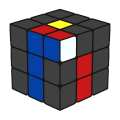
F2L cube state
From Speedsolving.com Wiki
|

Previous Steps
 * A previous state of this one is the Cross cube state. Use the F2L step to have the F2L cube state, as in the CFOP method.
- A previous state of this one is the F2L-1 cube state. Use the Last F2L Slot step to have the F2L cube state, as in the CFOP method.
- A previous state of this one is the F2L-1 cube state. Use the 2GLS step to have the F2L cube state.
- A previous state of this one is the F2L-1 cube state. Use the 2GLS step to have the F2L cube state.
- A previous state of this one is the 1st Layer-1C cube state. Use the 4E c keyhole step to have the F2L cube state.
- A previous state of this one is the 1st Layer-1C cube state. Use the Multi keyhole step to have the F2L cube state.
* A previous state of this one is the Cross cube state. Use the multislotting step to have the F2L cube state.
* A previous state of this one is the Cross cube state. Use the Freeslice F2L step to have the F2L cube state.
- A previous state of this one is the F2L-1E(E) cube state. Use the +1E(E) from F2L-1E(E) step to have the F2L cube state, as in the LBL std method.
- A previous state of this one is the F2L-1C cube state. Use the F2L keyhole alg to have the F2L cube state.
- A previous state of this one is the F2L-1E(D) cube state. Use the L5EOP step to have the F2L cube state, as in the pcms-var2 method.
- A previous state of this one is the 1st Layer cube state. Use the 8355 algs to have the F2L cube state.
- A previous state of this one is the 1st Layer cube state. Use the Niklas w/M to have the F2L cube state.
- A previous state of this one is the 1st Layer cube state. Use the Edges XG to have the F2L cube state.
- A previous state of this one is the 1st Layer cube state. Use the std LBL edges to have the F2L cube state.
- A previous state of this one is the Pair No Cross cube state. Use the D-Edg to have the F2L cube state, as in the pcms var method.
- A previous state of this one is the Pair No Cross cube state. Use the Salvia edg to have the F2L cube state, as in the Salvia method.
- A previous state of this one is the Pair No Cross cube state. Use the Ins Cross to have the F2L cube state, as in the [[CA<P]] method.
Next Steps
- Beginner BLL (Any Layer By Layer method)
- 4LLL BLL (Any Layer By Layer method)
- 3LLL BLL (Any Layer By Layer method)
- 2LLL BLL (Any Layer By Layer method)
- SuneOLL
- 2look OLL
- Compound OLL
- SVOLL
- 22LL (x2)
- 1LLL (full)
- 2LL Tempus 18algs
- 2LL Kirjava 30algs
- F2L:EO (Ignore C)
- EOLL
- OELL (OLL-E)
- ELL
- LLEF
- PLLEF
- F2L:Niklas w/M
- F2L:EP (Randelshofer)
- CLLEF
- OLLCP
- CPEOLL
- F2L:CP+EO
- F2L:CO(OLL subset)
- F2L:CO(CxLL subset)
- OCLL
- F2L:CO Only
- 2LCMLL 1st look (M free subs)
- COLL
- CLL (3x3x3)
- CxLL
- 2look CLL
- CP (CxLL subset)
- Dedmore Helm
- F2L:CP only Niklas*
- Intuit COMM (by Roux)
|



