Waffle's Roux Tutorial

Similar Question to the CFOP case:

After CLL when there is any "line" (any two oriented and placed edges) at DF /DB , is thies worth to treat as a special case ?

Personaly when I only react on this case if the Line consists of UL/UR, and use a CFOP OLL.
 
This is my breakdown.
F2B-11.33
12.03 11.91 11.66 10.86 (12.99) 10.70 8.75 12.10 11.55 11.04 (6.98) 12.66


Cmll=LSE with no inspection time.
8.43, 8.40, 8.08, 9.18, 8.89,9.51, 8.90, (9.57), 6.52, 8.15,7.05, (5.89)[Cmll skipp!]
avg12: 8.31 (σ = 0.93)

I realllyyyy want sub 20. Oh so badly.

Some old question. What doo i dooo?
 
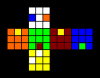
I'm having trouble with a specific scramble. Unfortunately, I don't have the written scramble, and I have no clue how to generate a scramble from a cube position. (Is there a way?) So I attached an image.

I don't understand the bad edges on this one, no matter how many times I count them, I always end up with 3, which can't be right...

I made a blue block and a green block, with white on bottom.

white/red : bad, red is next to green --> aren't opposites
yellow/green : good, green is next to bluue --> opposites (plus, blocks colors [g & b] must be on L/R/F/B)
white/orange : good, white is next to yellow --> opposites
yellow/red : good
yellow/blue : bad, block color (blue) can't be on D
yellow orange : bad, orange is next to white --> aren't opposites

What am I missing?


badedges.png
 
I'm having trouble with a specific scramble. Unfortunately, I don't have the written scramble, and I have no clue how to generate a scramble from a cube position. (Is there a way?) So I attached an image.

I don't understand the bad edges on this one, no matter how many times I count them, I always end up with 3, which can't be right...

I made a blue block and a green block, with white on bottom.

white/red : bad, red is next to green --> aren't opposites
yellow/green : good, green is next to bluue --> opposites (plus, blocks colors [g & b] must be on L/R/F/B)
white/orange : good, white is next to yellow --> opposites
yellow/red : good
yellow/blue : bad, block color (blue) can't be on D
yellow orange : bad, orange is next to white --> aren't opposites

What am I missing?


View attachment 1860
Scramble (White U / Green F): B F' R D2 R B F' U' B2 F2 L2 D'

The two edges on the bottom (BY/OY) are 'bad'.

 
As long as a U/D color sticker is on U/D face, that edge is oriented. Don't focus on the red sticker. When you look at the edge, you see it has two stickers: a white and a red one. You know white is a D color and since it's the U sticker, it's oriented.

That's all you need to do for all edges. Focus on the U/D colors and if you see one not on U/D, that means you need to orient it.

So I only check U/D during EO. Got it.

Thanks to both of you!
 
So I only check U/D during EO. Got it.

Thanks to both of you!
actually, you only need to check the U/F faces to know EO.

You can tell if the DF edge is bad by seeing if the sticker on the F side is either a U/D color. If thats the case then the edge is bad.

You can tell if the DB edge is bad by knowing the state of the other 5 edges you can see.
 
Thanks for that. Also, recognition of the 3 edge shuffles on M is kind of hell for a beginner. Is it possible to permute all 6 edges in one step after orienting them? How many algs would that require?
I guess recognition will get easier with more practice though, so this is kind of a question more out of curiosity than actually wanting to learn it.
 
Just learn it the proper way. Recognise it as 3-cycles; commutators, where you bring one piece to its position through the M slice and using the side effect of the U2 to cancel. Sorry I can't explain this simply... maybe someone else can.

But yeah, imagine that you're doing a 2-cycle of edges (U2 swaps 2 edges) then adjusting the M slice and doing another 2 cycle, making the U2s cancel each other out. Hope that made sense.

Yeah, that part is quite simple. i can recognise which of the two cases it is. I take too long finding the solved edge, placing it and performing the cycle. Too much inspection of B/D faces or adjusting M layer. Both the cases look same from a certain position when there seems to be one misplaced edge in UF and the U colour on UB and F colour on DF match with the centres on those faces. Kinda like a Y perm. can the case be recognised looking at only up and front faces? Like all PLLs can be recognised from 2 faces right?
 
I look for the edge that's 'on it\'s own'.

I guess I do the same (If that meant the edge in its right position relative to centres). If so, I'm glad to know that some of the best rouxers do the same thing. One thing about roux I noticed, there aren't many variants as such because the original method is the best way to go about the solve. Now that's pretty cool.
 
Back
Top