Pattern thread

Do you have a pattern and you want it to be implemented but after the cube has been scrambled? Just put a picture up of a pattern and tell people to try and get it (Note: Cannot be patterns such as checkerboard, center-switching, etc.)

So basically MTS (as in the weekly comp) but starting from a scrambled cube instead of a solved one?
I had already considered this as an modified MTS approach where you would actually have two scrambles per "solve".
Makes the start of the solve a bit harder...
 
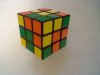
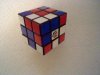
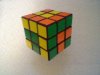
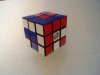
Checkerboard with opposite sides is simple, but checkerboard on a rotation about one of the corners is (in my mind) fairly complex. And if you combine both checkerboards, it's kind of neat, too!

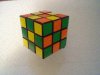
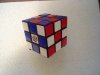
HNI_0018.JPG HNI_0019.JPG
Checkerboard rotated about a corner.

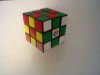
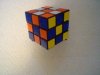
HNI_0022.JPG HNI_0023.JPG
Checkerboard rotated about a corner followed by checkerboard opposites.

More interesting by far, though, are these patterns. I can't tell you a cut-and-dry algorithm for any of them, because...well...I don't know notation, but I can tell you essentially how they are attained if you're interested. Enjoy!

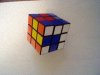
HNI_0012.JPG HNI_0024.JPG
Don't know what you'd call this one.

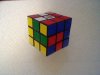
HNI_0013.JPG HNI_0014.JPG
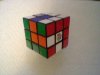
I like to call this one the chain, because the displaced colors wrap around the cube:
HNI_0015.JPG HNI_0016.JPG HNI_0017.JPG

Hope you all have fun with these!
 
Learning notation would be awesome; I could learn an official method of solving the cube so that my times improved, as well. Is Cube Explorer computer software, and if so, is it free?

I prefer playing with larger cubes where patterns are concerned, especially the 6x6x6. So many possibilities!
 
Learning notation would be awesome;
http://www.speedsolving.com/wiki/index.php/Notation and http://mzrg.com/rubik/nota.shtml. (The URFLDB, MES, and xyz turns are most common.)

I could learn an official method of solving the cube so that my times improved, as well.
There isn't an "official" method but there are several you can learn that provide varying tradeoffs between amount memorized, thinking time, and turning efficiency. The Roux method is one that can be very fast with almost no memorization (it can be sub-15'd with only 2 algorithms).

Is Cube Explorer computer software, and if so, is it free?
Yes and yes. In the future, try Google first.

I prefer playing with larger cubes where patterns are concerned, especially the 6x6x6. So many possibilities!
I agree. The Randelshofer patterns page has a lot of interesting ones for cubes of all sizes; I've contributed a few myself.

R' F r F2 u M' u' F2 r' F' R
Ooh, very nice.
 
I usually just solve the megaminx into the pattern,because most patterns take a large number of moves to make on the megaminx. many are over a hundred...
 
Just a tip, whenever you discover a pattern in such a way it's best to just plug the patter into a solver. That way you get an algorithm that will achieve the same pattern, and be about 20 moves long.
 
Back
Top