A new FMC theory?

Status
Not open for further replies.
Cuz maths has proven that no one can get a solution worser that 20 moves and maths never lies. So its impossible to best the gods number but instead its possible to be the gods number
Well math must be broken then, because I find it quite easy to get a solution that is 'worser' than 20 moves. May I ask what you mean with besting a number and with being a number?
 
Well math must be broken then, because I find it quite easy to get a solution that is 'worser' than 20 moves. May I ask what you mean with besting a number and with being a number?
Besting a number as what I beleive is where you get a sub 20 mean. And being a number is getting a flat 20 mean.

In other terms since math never lies even a computer would sometimes be the gods number because its just luck that gives a person to get a sub 20 move mean.
 
Im terribly sorry for creating this chaotic confusion but after thinking for a while I figured out that both are the same. But I would preferably call it as "being the gods number" as it makes more sense to me as ive explained above

anyway does Anyone of you guyz think whether Any of my impractical theories might work?
 

Attachments

  • Screenshot_20240624-231206.png
    Screenshot_20240624-231206.png
    105.3 KB · Views: 40
Come on dude, Im trying to give my fullest respect to that gentleman. Imagine that youve been cubing for 10years and you are capable of acheiving many NRs but the fact being that youre unable to travel abroad for a Comp or no comps being held in your country. So, SriLanka was that kind of a country. And this gentleman made a dream to Come real. He helped us when I was in need and now its my turn to do it.

I agree that held totally did something terribly dirty, but guys imagine of the above situtation please.
I wasn't really referring to Kalindu stuff here.

It was your 8 move EOs and 600 DRs in an hour that I found hilarious about this

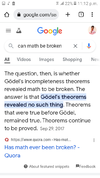
EDIT: Oh and now Gödel's incompleteness theory is also related here! Absolutely hilarious as I said.
 
Just some advice. You've had an idea, sure, and that's great. However, you haven't managed to respod to criticism of it, nor have you put it in the right thread (should be in new subset/method/concept thread) and you've been talking about Kalindu a lot, which isn't a great idea now. If you want your idea to be judged purely on its own merits (which I think it has been from what you've told us), don't mention anything beyond it. For example, asking people who use your idea to promote freeing Kalindu (who hasn't been put into prison, and also has been shown beyond reasonable doubt to have cheated so hasn't faced any injustice anyway) is a bad idea and will bring ridicule and won't help us with your idea.

I also have no idea what your idea is apart from "check more EOs guys". Yes, people would check more EOs, but it's hard to know which EOs will lead to a good solution without trying. You claim in your first post that as computers often will use longer EOs (no idea if that's even true or not), then we should as that will lead to shorter solutions. The new WR singles show that you can have short EOs (2 moves in these cases) that lead to good solutions.

Let's think clearly with a different example. Do the scramble R2 U' L2 B2 U2 F2 R' D2 F2 U' R2 U' L.
From here, I could do many solutions to solve F2L. Here are 2.
  1. U2 R U2 R' U' R U R'
  2. R U R' U' R U R' U2 R U' R'
Which solution will give me a better last layer? You have no idea unless you do the solution (either mentally or physically). In this case, almost everyone should do 1. It is shorter and the last layer isn't determined.

The whole point of this is that you are going to optimise for that step in the given context. In FMC, you don't care how fast something is. However, you will always try for the shorter thing because that's what you're optimising for. In Speedsolving, you go for the faster. In FMC, you only check longer EOs because the continuation from the shorter may be worse. Ideally you would have a good DR from the best EO. So the only thing checking longer EOs gives you are more continuations. You're obviously gonna find more good DRs from checking 200 EOs than 10 EOs, but you'd rather check the 10 shortest EOs than 10 long EOs. You don't have infinite time.

Hopefully this has dispelled what I think you were suggesting. Hopefully you can think about it and move on. Hopefully you understand that the punishment Kalindu got was because of what he did and that reversing his punishment would be unjust and unfair on the community. Please let me know if you have any questions on this. I hope the rest of the thread is cordial (and that there are no more posts because it's unnecessary and low quality), but this is the internet and this forum is just spiraling down.
 
I wasn't really referring to Kalindu stuff here.

It was your 8 move EOs and 600 DRs in an hour that I found hilarious about this

EDIT: Oh and now Gödel's incompleteness theory is also related here! Absolutely hilarious as I said.
Yo, when it comes to finding a new theory, an individual is required to scan through 100s of stuff to atleast end up getting 10 or even less which will actually work
 
Just some advice. You've had an idea, sure, and that's great. However, you haven't managed to respod to criticism of it, nor have you put it in the right thread (should be in new subset/method/concept thread) and you've been talking about Kalindu a lot, which isn't a great idea now. If you want your idea to be judged purely on its own merits (which I think it has been from what you've told us), don't mention anything beyond it. For example, asking people who use your idea to promote freeing Kalindu (who hasn't been put into prison, and also has been shown beyond reasonable doubt to have cheated so hasn't faced any injustice anyway) is a bad idea and will bring ridicule and won't help us with your idea.

I also have no idea what your idea is apart from "check more EOs guys". Yes, people would check more EOs, but it's hard to know which EOs will lead to a good solution without trying. You claim in your first post that as computers often will use longer EOs (no idea if that's even true or not), then we should as that will lead to shorter solutions. The new WR singles show that you can have short EOs (2 moves in these cases) that lead to good solutions.

Let's think clearly with a different example. Do the scramble R2 U' L2 B2 U2 F2 R' D2 F2 U' R2 U' L.
From here, I could do many solutions to solve F2L. Here are 2.
  1. U2 R U2 R' U' R U R'
  2. R U R' U' R U R' U2 R U' R'
Which solution will give me a better last layer? You have no idea unless you do the solution (either mentally or physically). In this case, almost everyone should do 1. It is shorter and the last layer isn't determined.

The whole point of this is that you are going to optimise for that step in the given context. In FMC, you don't care how fast something is. However, you will always try for the shorter thing because that's what you're optimising for. In Speedsolving, you go for the faster. In FMC, you only check longer EOs because the continuation from the shorter may be worse. Ideally you would have a good DR from the best EO. So the only thing checking longer EOs gives you are more continuations. You're obviously gonna find more good DRs from checking 200 EOs than 10 EOs, but you'd rather check the 10 shortest EOs than 10 long EOs. You don't have infinite time.

Hopefully this has dispelled what I think you were suggesting. Hopefully you can think about it and move on. Hopefully you understand that the punishment Kalindu got was because of what he did and that reversing his punishment would be unjust and unfair on the community. Please let me know if you have any questions on this. I hope the rest of the thread is cordial (and that there are no more posts because it's unnecessary and low quality), but this is the internet and this forum is just spiraling down.
I totally agree with the matter of brother kalindu.

And as youve mentioned above, there are certain times when human beings get lucky and find the exact solution of a computer cuz in that case the computers have preferred to use a short EO like how a human would.
And this impossible and impractical thing is what im working on. Let's see if it works, but surely god should will for it work
 
Sub 20 mean is possible with luck
Eg Wong chong wen avg between 20-23.If he get 20,18,21 moves it is possible to get a sub 20 mean. He have got 18 and 20 moves in one round. And only 21 moves is needed to get a sub 20 mean( he has got 21 moves more than 15 times).
This is what im working on. Rather than just being lucky sometimes, im trying to be lucky all the time by doing something impossible and impractical
 
Is this a thread about FMC or is it about your friend...? You haven't replied to a single comment about your actual idea. If you want to be taken seriously you have to take other people seriously too - address their criticisms and put some actual effort into *proving* your theory instead of repeating that you're going to do the impossible. What do you average in FMC? Can you do some example solves to test your idea and compare them to regular solves? It shouldn't take more than a few hours.
 
Is this a thread about FMC or is it about your friend...? You haven't replied to a single comment about your actual idea. If you want to be taken seriously you have to take other people seriously too - address their criticisms and put some actual effort into *proving* your theory instead of repeating that you're going to do the impossible. What do you average in FMC? Can you do some example solves to test your idea and compare them to regular solves? It shouldn't take more than a few hours.
My actual idea is to best the gods number, and even if i dont if someone does I wanted to be honoured as the father of modern FMC. I also want to honour My friend too as competitions in SL wouldnt be possible without him.

The point being that i dont want to fall into the same hole of averaging 20 to 23 moves in FMC, im trying a different line to catch it all up. I just fijished leaejng EO, now im in DR triggers, ill be eventinf a list of them on My journey
Please ignore the part at the bottom
 

Attachments

  • 20240625_080145.jpg
    20240625_080145.jpg
    152.5 KB · Views: 41
Going to reproduce some messages from the FMC Discord that I wrote when the 19.67 first came out (names redacted):

<O> i dont think this is true, the earlier low 20 singles were probably to make this seem somewhat believable and he thought he might get away with a small wr
<N> It’s also like not a small wr
<N> It’s the first sub20
<A> world's first sub 20 mean isnt a small wr
<me> 20.00 isn't some kind of magical barrier
<K> literally is
<K> 20 = gods number
<K> not many scrambles are 20 optimal but it's still a pretty big barrier
<me> going from 20.33 to 20.00 and going from 20.00 to 19.67 are roughly comparable (except of course the latter is harder)
[…]
<me> my point is that there's no discontinuous jump in skill/luck/whatever between 20.33, 20.00, and 19.67
<me> the mean was improved by 0.33, which is literally the smallest possible improvement

There's nothing inherently special about 20.00 as the current WR mean or the 19.67 that Kalindu cheated to get. Yeah, GN is 20 and Kalindu's "result" was better than that; so what? No bearing whatsoever on actual FMC results.

If Wen / Jay / another legit FMCer (could even be you in the future!) gets a 19.67 mean officially (note: there are already people with sub-20 means unofficially), that would be impressive for being a world record, not because it's under GN.

If you want to be the "father of modern FMC", you'd better come up with something that's actually revolutionary and not just "do the same thing, but more". A great starting point would be practising FMC with the currently existing techniques so you can at least know where the points of improvement are, instead of fantasising about being a trendsetter in FMC techniques.
Thank you very much for your valuable piece of advice bro, and as youve mentioned above that there are guyz who have acheived sub 20 means unofficially, what Im trying to do is to be sub 20 all the time which is challenging. And this is the reason why I invented a few non-sense theories which im researching on.

anyway I would like you guyz to keep giving me your valuable concerns and ideas. But also keep this is mind. Whether its Wen/Jay or even me, only god knows it, so god would give it to me only if I actually deserve it.

As I must practice a lot more, this thing should probably take months or most likely even years. So I want you dudes to keep motivating me.
 
I was wondering if A computer solves FMC by using long EOs and short DRs and gets sub 20 all the time while we use short EOs which unnawaringly leads to long DRs and rarely get sub 20's. Is this something we can reserach and improve on to be the gods number?
First, I think it's important to understand how a computer solves the cube. You can think of the cube states as points that are all connected by paths, forming a maze. For any given scramble, you're dropped at a random point on the maze, and you have to find your way to the exit. There's the old strategy for finding the exit of a maze which involves putting your left hand on the wall and always turning left. As long as the maze doesn't have circular paths, this will always work. Unfortunately for us, the cube does have circular paths, so we have to have a way to mark everywhere we've been so that we can avoid them. The resulting algorithm is called a "depth-first search" because it explores the maze by going down one branch as deep as you can, then backtracking up to the next branch.

We can be a little smarter with the cube because we can use heuristics to avoid going to far. For example, we can say we're already 20 moves deep and haven't found the exit, so there's no point in going any further down this particular path.

One challenge is the 43 quintillion states will just take far too long to explore. So what computers do is they split these into two phases, the first being a domino reduction phase, and then the rest. It's important to recognize that these sets are not small - they consist of about 2 billion and 20 billion states respectively.

But we haven't really covered how many paths we have to explore yet. Let's consider the first phase - we have a scrambled cube and we want to get to a DR state. We have 6 faces and can do 3 types of moves on each face (clockwise, counterclockwise, and double turns). So that's 18 choices of move for the first face. For the second face, we don't want to turn the same face twice, so we have 3 fewer choices, and we also don't need to check for example L R if we're already checking R L, because they do the same thing. So we can reduce it down to an average of 13.5 turns we need to check for each move after the first. That means the first step we check 18 states, the second step we check 243 states, and for the third move we have to check 3,240 states. It explodes really quickly. By the time we're looking at 12 moves, there are trillions move sequences to check (the vast majority of which lead to duplicate states).

But we don't have to check all of these sequences. A computer can store a pruning table, so it can know for any state how far it is from domino reduction state. using some smart symmetry tricks and smart bitpacking, a computer can store the number of moves any state is from the DR in tens of megabytes. These are calculated and stored in advance. So the computer can look at any of the 2 billion cases and say that particular case is X moves away from the DR state. That's powerful because it means we can prune (cut away unwanted branches) of the search tree.

It's also worth considering that the computer can iterate through millions of states per second, finding thousands of sequences that lead to DR states.

Then comes the additional magic of pruning tables. It can look up the resulting state in the phase 2 pruning table, and know exactly how many moves away from being solved it is. After DR, the majority of states are still 13 or 14 moves away from being solved. But the computer can throw away those states immediately. The chances of a finish after DR being 6 moves or less are about 1 in 15,000. So if the computer wants to solve the cube in 20 moves, it can find tens of thousands of 14 move DRs and have a good chance of finding one with a 6 move finish. For the computer, checking solutions is as simple as doing a single memory lookup.

Now, a human can't possibly check through tens of thousands of 14 move DR in the hour, so they need to be smarter. They need to be much smarter. It takes at most 12 moves to get to DR, but the majority of scrambles can reach DR in 10 moves. Human's won't blindly explore every move sequence. They'll carefully construct them by solving sub-goals, maybe EO first, then RZP, then look for patterns. They'll throw away any solutions that take too many moves to RZP, and they'll throw away patterns that look hard. So using this technique, they can maybe find 10-15 or so DR solutions that are within a move or two of optimal. We use heuristics like the number of qt to HTR to be able to throw away some solutions that are likely to have long HTR solutions, but we can't look at a DR state and know immediately with certainty whether it is good or not.

And if we look at the distribution the number of moves needed to solve from DR, while most need 13-14, or up to 18 moves to solve, about 1 in 10 can be solved in 11 moves or less, and about 1 in 40 can be solved in 10 moves or less. So out of the 10-15 DR states averaging about 10 moves that a top performing human could reasonably find in an attempt, that may be as short as 10 moves on average, they should be able to find a 10 or 11 move finish if they could be perfectly optimal.

That's why the limit for human FMC in an hour is probably a global average of about 21 moves. We'll see some better means if there are lucky scrambles, but overall, we'll probably never see a human with a global average sub God's number.

So what would it take for a human to us a method closer to a computer? We'd need to be able to come up with tens of thousands of 14 move DRs. This is actually easier than it seems, and the only real challenge here is time. We just aren't fast enough to do it in an hour. But if someone could devote a week of their life to listing all fo the 14 move DRs they can find? It's not goign to be fun, but it becomes marginally more feasible. The next thing they need is to be able to look at every DR state and know accurately whether or not it can be solved in 6 moves or less. This is the hard part. We'd need to allow the person to have an absurdely long alg sheet (even with symmetry, it would need to list about a billion cases), and they'd need an extremely efficient way to find a specific case on that sheet.

This is the barrier that you need to find a way to overcome. I'm not convinced that it's possible.
 
I totally agree with the matter of brother kalindu.

And as youve mentioned above, there are certain times when human beings get lucky and find the exact solution of a computer cuz in that case the computers have preferred to use a short EO like how a human would.
And this impossible and impractical thing is what im working on. Let's see if it works, but surely god should will for it work
So this impossible and impractical thing you're working on isn't new then, or if it is, you haven't told us. AlphaSheep's recent post taught me a lot on how computers do it and also shows that whatever you're working on must be revolutionary. I admire your motivation, but people's criticism of your ideas have been based on what you've told us. If you think that's unfair, it's either because you don't understand the criticisms or you haven't told us everything about your idea. I'd recommend you do.

On you besting God's number, the best way to do it, from my knowledge, is to get really good with current techniques. We know that people can find optimal now with a bit of luck, so you also have to be lucky 3 times. Do that and you get sub 20.

Finally, please don't triple post (or double post) because it's considered bad forum etiquette. Thanks! :)
Thank you for your concerns. Ill put it into my play. And remember Im not just trying to be lucky once Im trying to be lucky all the time....
 
Cuz maths has proven that no one can get a solution worser that 20 moves and maths never lies. So its impossible to best the gods number but instead its possible to be the gods number
This is not neasecarily true. We found gods number was 20 by using brute force. Assuming there were to be a mistake in the code that was severe enough to affect the number, then the number could be wrong.

Again, not saying that this is likely in the slightest, (it is extremely unlikely) however I just want to point out that there is a possibility that the math is wrong. Humans are prone to error.
 
First, I think it's important to understand how a computer solves the cube. You can think of the cube states as points that are all connected by paths, forming a maze. For any given scramble, you're dropped at a random point on the maze, and you have to find your way to the exit. There's the old strategy for finding the exit of a maze which involves putting your left hand on the wall and always turning left. As long as the maze doesn't have circular paths, this will always work. Unfortunately for us, the cube does have circular paths, so we have to have a way to mark everywhere we've been so that we can avoid them. The resulting algorithm is called a "depth-first search" because it explores the maze by going down one branch as deep as you can, then backtracking up to the next branch.

We can be a little smarter with the cube because we can use heuristics to avoid going to far. For example, we can say we're already 20 moves deep and haven't found the exit, so there's no point in going any further down this particular path.

One challenge is the 43 quintillion states will just take far too long to explore. So what computers do is they split these into two phases, the first being a domino reduction phase, and then the rest. It's important to recognize that these sets are not small - they consist of about 2 billion and 20 billion states respectively.

But we haven't really covered how many paths we have to explore yet. Let's consider the first phase - we have a scrambled cube and we want to get to a DR state. We have 6 faces and can do 3 types of moves on each face (clockwise, counterclockwise, and double turns). So that's 18 choices of move for the first face. For the second face, we don't want to turn the same face twice, so we have 3 fewer choices, and we also don't need to check for example L R if we're already checking R L, because they do the same thing. So we can reduce it down to an average of 13.5 turns we need to check for each move after the first. That means the first step we check 18 states, the second step we check 243 states, and for the third move we have to check 3,240 states. It explodes really quickly. By the time we're looking at 12 moves, there are trillions move sequences to check (the vast majority of which lead to duplicate states).

But we don't have to check all of these sequences. A computer can store a pruning table, so it can know for any state how far it is from domino reduction state. using some smart symmetry tricks and smart bitpacking, a computer can store the number of moves any state is from the DR in tens of megabytes. These are calculated and stored in advance. So the computer can look at any of the 2 billion cases and say that particular case is X moves away from the DR state. That's powerful because it means we can prune (cut away unwanted branches) of the search tree.

It's also worth considering that the computer can iterate through millions of states per second, finding thousands of sequences that lead to DR states.

Then comes the additional magic of pruning tables. It can look up the resulting state in the phase 2 pruning table, and know exactly how many moves away from being solved it is. After DR, the majority of states are still 13 or 14 moves away from being solved. But the computer can throw away those states immediately. The chances of a finish after DR being 6 moves or less are about 1 in 15,000. So if the computer wants to solve the cube in 20 moves, it can find tens of thousands of 14 move DRs and have a good chance of finding one with a 6 move finish. For the computer, checking solutions is as simple as doing a single memory lookup.

Now, a human can't possibly check through tens of thousands of 14 move DR in the hour, so they need to be smarter. They need to be much smarter. It takes at most 12 moves to get to DR, but the majority of scrambles can reach DR in 10 moves. Human's won't blindly explore every move sequence. They'll carefully construct them by solving sub-goals, maybe EO first, then RZP, then look for patterns. They'll throw away any solutions that take too many moves to RZP, and they'll throw away patterns that look hard. So using this technique, they can maybe find 10-15 or so DR solutions that are within a move or two of optimal. We use heuristics like the number of qt to HTR to be able to throw away some solutions that are likely to have long HTR solutions, but we can't look at a DR state and know immediately with certainty whether it is good or not.

And if we look at the distribution the number of moves needed to solve from DR, while most need 13-14, or up to 18 moves to solve, about 1 in 10 can be solved in 11 moves or less, and about 1 in 40 can be solved in 10 moves or less. So out of the 10-15 DR states averaging about 10 moves that a top performing human could reasonably find in an attempt, that may be as short as 10 moves on average, they should be able to find a 10 or 11 move finish if they could be perfectly optimal.

That's why the limit for human FMC in an hour is probably a global average of about 21 moves. We'll see some better means if there are lucky scrambles, but overall, we'll probably never see a human with a global average sub God's number.

So what would it take for a human to us a method closer to a computer? We'd need to be able to come up with tens of thousands of 14 move DRs. This is actually easier than it seems, and the only real challenge here is time. We just aren't fast enough to do it in an hour. But if someone could devote a week of their life to listing all fo the 14 move DRs they can find? It's not goign to be fun, but it becomes marginally more feasible. The next thing they need is to be able to look at every DR state and know accurately whether or not it can be solved in 6 moves or less. This is the hard part. We'd need to allow the person to have an absurdely long alg sheet (even with symmetry, it would need to list about a billion cases), and they'd need an extremely efficient way to find a specific case on that sheet.

This is the barrier that you need to find a way to overcome. I'm not convinced that it's possible.
This the main reason why I call it the impractical And mostly IMPOSSIBLE.

But if god wills to share his number with me it will surely be possible
😂😂😂😂😂
 
Status
Not open for further replies.
Back
Top