

SenileGenXer
Regular
NOTE this post has be completely edited from it's original content. I am trying to present what I am thinking more clearly. I have also re-designed this whole thing. VIM! is vanquished and Excalibur substituted. I said something off-hand about how many F2L pairs Matz Valk could do on inspection and a whole lot of people wanted to argue about that.
This is my proposed Last Layer Skip. The Lewis-LS.
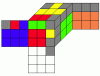
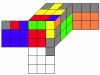
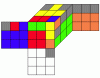
It starts like this. You solve the cross and the first three F2L cases. You make your last F2L pair so that it is's white face is pointing clockwise and you trap the oriented front color edge. Orient the rest of your edges if you need to. This forms a pattern I will call the Copperhead after a venomous Virginia snake. Visualize it as snake. The F2L pair and the front color edge form the head and mouth respectively. The pieces that would be scrambled by the sexy move are the serpent's body. The open corner positions have been labeled 1 2 3 and 4.
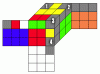
The next step is to permute and orient the RF color corner piece (primary piece) into position 4 with it's up side facing right while also just permuting the LB color corner piece (secondary) into position 3. If we wanted to make an alg for every case I think we would have 36 cases. We could label the cases like P2U1 where the primary piece is in position 2 with it's U face color up and the secondary piece is in position 1. For solving these cases everything along the Copperhead's body is swapable except edge orientation. Orienting the permuting the primary piece while permuting the secondary forms a case I will call Excalibur. We will call this step forging.
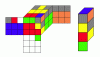
Behold the sword of power! Forged when the world was young and and man and beast were one and death was but a dream!
The picture is all there is to it. Picture it as a sword standing upright along the front right. The handle is solid and material, the blade is oriented but not permuted, the tip is permuted but not oriented. There can be nine concrete incarnations but we'll call them all Excalibur.
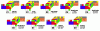
Once the we have forged excalibur inside the Copperhead serpent there are 9 corner orientations possible we can see them fairly easily looking at the up face colors.
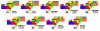
In addition we have only 6 crypto PLL's possible after forging excalibur (Solved, an N-Perm, V, Y, Ua, and a Ub). We could label them S, N, V,Y, A, and B. Reconition is probably awful. Nine corner orientations times 6 crypto PLLs gives us 54 cases. Solving from excalibur to a finished cube might be called wielding.
The algs to wield Excalibur can have a great overlap with the algs that forge Excalibur. That is I expect a great number of them could be executed by exactly the same alg. There is incredible alg reuse.
I may develop tables for forging and wielding and fill them in with optimal HTM solutions from cube explorer. I expect these algs to be very very short. A few sexy alternativs are possible as well.
If you would like to help maybe you could start a WIKI article for the Lewis-LS so we could all contribute? If you would like to calculate some algs I would suggest wielding cases first then note what they do for forging cases and add them there as well.
I am only human and I make a lot of mistakes. I am sure there are mistakes in this if you see some let me know. I have stumbled blind in the vast unknown. I groped for things in that I did not know and pulled out something true. It is a very strange feeling. Take this truth, this technique and make it yours.
This is my proposed Last Layer Skip. The Lewis-LS.
It starts like this. You solve the cross and the first three F2L cases. You make your last F2L pair so that it is's white face is pointing clockwise and you trap the oriented front color edge. Orient the rest of your edges if you need to. This forms a pattern I will call the Copperhead after a venomous Virginia snake. Visualize it as snake. The F2L pair and the front color edge form the head and mouth respectively. The pieces that would be scrambled by the sexy move are the serpent's body. The open corner positions have been labeled 1 2 3 and 4.
The next step is to permute and orient the RF color corner piece (primary piece) into position 4 with it's up side facing right while also just permuting the LB color corner piece (secondary) into position 3. If we wanted to make an alg for every case I think we would have 36 cases. We could label the cases like P2U1 where the primary piece is in position 2 with it's U face color up and the secondary piece is in position 1. For solving these cases everything along the Copperhead's body is swapable except edge orientation. Orienting the permuting the primary piece while permuting the secondary forms a case I will call Excalibur. We will call this step forging.
Behold the sword of power! Forged when the world was young and and man and beast were one and death was but a dream!
The picture is all there is to it. Picture it as a sword standing upright along the front right. The handle is solid and material, the blade is oriented but not permuted, the tip is permuted but not oriented. There can be nine concrete incarnations but we'll call them all Excalibur.
Once the we have forged excalibur inside the Copperhead serpent there are 9 corner orientations possible we can see them fairly easily looking at the up face colors.
In addition we have only 6 crypto PLL's possible after forging excalibur (Solved, an N-Perm, V, Y, Ua, and a Ub). We could label them S, N, V,Y, A, and B. Reconition is probably awful. Nine corner orientations times 6 crypto PLLs gives us 54 cases. Solving from excalibur to a finished cube might be called wielding.
The algs to wield Excalibur can have a great overlap with the algs that forge Excalibur. That is I expect a great number of them could be executed by exactly the same alg. There is incredible alg reuse.
I may develop tables for forging and wielding and fill them in with optimal HTM solutions from cube explorer. I expect these algs to be very very short. A few sexy alternativs are possible as well.
If you would like to help maybe you could start a WIKI article for the Lewis-LS so we could all contribute? If you would like to calculate some algs I would suggest wielding cases first then note what they do for forging cases and add them there as well.
I am only human and I make a lot of mistakes. I am sure there are mistakes in this if you see some let me know. I have stumbled blind in the vast unknown. I groped for things in that I did not know and pulled out something true. It is a very strange feeling. Take this truth, this technique and make it yours.
Attachments
Last edited:


