• Welcome to SpeedSolving.com — the world’s largest puzzle community!

    You’re currently browsing as a guest, which means you have limited access to discussions, resources, member profiles, and community features.

    Join 50,000+ cubers and puzzle enthusiasts from around the world to ask questions, share solves, improve faster, and be part of the community.

    Registration is free, fast, and easy — create your account today.

    Already a member? Log in here to hide this message and start participating.

Proposed ZZLS and VIM!

My math is not bad. The corner perm is tied directly to edge perm. When you have the following PLLs (Solved, Na, Ua, and Ub) how many corner cases do you have For each PLL -it's just one.

Your math is bad

You should actually try to work out the cases instead of counting them, because you forgot Y and V perm
 
There is a possible benefit to this sort of approach to LL: the algs might be more fingertrick-able. When you've already got the F2L+OLL solved you have less flexibility and so some PLLs are difficult. Perhaps this could be faster..but I am definitely not certain.
 
Your math is bad

You should actually try to work out the cases instead of counting them, because you forgot Y and V perm

Your right. I did. Sorry. If we redefined the sword to have the back right (Green-orange) corner permuted on top this would limit us to Solved, Jb, Ua, and Ub correct? Can't ever finish with it with just a simple R U' R' but... recognition is very important and needs to be easy. Limited cases also a big plus in my book.
 
Last edited:
You forgot J & J

Thank you.

Another entire alternative is to build a samurai sword raised along the back of the sexy move line. Have the red blue corner permuted and oriented up in the #1 position and have Blue-orange corner only permuted in #2. Recognition can be done a little easier as most of the un-moved parts and twisted corners are right frontish. I can only see Solved, F, Ua, and Ub here. What am I missing on this one? I guess R's

Edit made the secondary corner Blue-Orange.
 
Last edited:
What am I missing on this one?

More stuff. I'm getting bored of this game now, try thinking for yourself.

Do you want to collaborate and work out some CmLLish algs? It's three corners and three edges to move around I think you could do some fun moves.

Now that we've gone and fixed your logic, here's my main gripe with the actual method and why I will not be touching it;

Firstly, I'll explain the actual method to everyone that doesn't understand it.

This is a two look last layer method for when you have EO complete in your last layer already.

Step 1: Permute & orient a corner to the right of an edge and permute the opposite corner
Step 2: Solve everything else

This is all well and good, but for some reason the entire thing is conjugated by an LS insert so that the LL pieces you are solving have been moved around a bit. You can do this to any two look last layer method if you wish, but there is no reason to.

This adds literally nothing, except the chance to throw in the phrase 'last layer skip' as if it is some kind of holy grail. Doing it completely misses the point of what last slot methods are for in the first place.
 
More stuff. I'm getting bored of this game now, try thinking for yourself.

Says the man who asks people on IRC what they think of it? I do want to collaborate with someone but I don't need someone so insulting.

Anyway thank you for the insights you have given me but I don't think you get it entirely. Please don't presume to explain it for me.
 
Says the man who asks people on IRC what they think of it?

You just keep suggesting things that have the same problem I've already pointed out three times.

Yes, it's boring when people try to outsource their repetitive thinking onto you.

I do want to collaborate with someone but I don't need someone so insulting.

I have never written a single insult directed at you in this entire thread. I have only given constructive criticism of your method and method presentation which you now appear to be taking to heart.

You have now falsely accused me of insulting you and warned me against the trolling that I haven't been doing.

Anyway thank you for the insights you have given me but I don't think you get it entirely. Please don't presume to explain it for me.

I do indeed get it entirely. This is how I managed to point out its flaws.

You are free to point out anything that I missed, but I think that this is another thing you have just made up.

You're also free to reply to my actual criticism instead of just complaining about it.

It did take me longer than usual to understand this system, but I don't believe that's an issue on my end.
 
After the first step you have 2(number of CP cases remaining after first step) * 12 (number of EP cases) * 8 (i think, this is the number of CO cases with FR corner in the position where it would be solved with R U' R') = 192 cases for your "LL skip" + 36 for your first step and voila! your two look LL skip method has 228 cases assuming you don't need to learn anything to orient the edges prior to to starting. additionally, recognition for this last step would not be as easy as traditional LL methods with F2L already inserted

Alternatively, phasing (which permutes 2 edges rather than 2 corners and does not influence CO uses 58(permute 2 edges) + 167 (ZZLL) = 225 algs for something significantly closer to a 1LLL than what you propose.

This is assuming that I understand your method correctly, which I am not certain I do
 
Last edited:
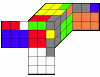
For better recognition I propose the first step is finding Parsifal.

Parsifal.gif

It's a little man lying down. His feet are firmly grounded at position 1. His body is hidden (and off limits according to the legend) under the oriented edge in the back. His head is permuted green orange corner not knowing where to look. Again nine incarnations are all Parsifal.

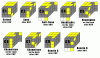
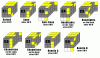
The next step would be guiding Parsifal. There would be nine corner orientations a little easier to recognize.

Corner-Orentation-Cases-correct.gif

In addition there would be six crypto PLL and they would be more towards the front.

If someone would confirm my corner cases are correct I will thing this over a little longer then get calculating on actual algs.
 

Attachments

  • Corner-Orentation-Cases.gif
    Corner-Orentation-Cases.gif
    28 KB · Views: 12
Last edited:
Alternatively, phasing (which permutes 2 edges rather than 2 corners and does not influence CO uses 58(permute 2 edges) + 167 (ZZLL) = 225 algs
Phasing can be done intuitively very easily. There are only 6 cases (or 8 if you include a LS skip) after the corner and edge are paired. I learned how to phase intuitively with a very quick look before turning after about 10 minutes, for all cases. The only algs you need are the 167 ZZLL algs.
 
Yeah basically this does not improve anything to normal CFOP... instead of: last pair, alg, alg you just do: setup a pair, alg, alg, last pair... not very worth it I'd say.

Btw. it would be nice if you could try to make a clear description on what you want including at least 1 example solve. Also the wielding sword, forging excalibur, unleashing dragons stuff, does not make your post very readable. I only had to laugh because of it (and not because it's funny).
Please continue posting your ideas though, it's always interesting to see what people are on to. Who knows, we might find a better way to do CFOP than we use at the moment :)

What I'm trying to do is setup a F2L pair while trapping a targeted edge - (EO and AUF as needed to copperhead) - alg - solve. The pair goes in at solve. There is no intermediary target between Parsifal and solved. I don't care if the last slot goes in with a U' R' or something different.

Easier said than done. It may be far away but it's a goal. I'm still gonna keep specific names for specific cases to avoid ambiguity because this is deep with it already. Not just the ambiguity of the the technique itself where your not exactly orienting or permuting during the Forge/Find alg and your not exactly permuting or orienting during the solve step. Not exactly stopping at any exact middle signpost. Ambiguity is natural and I'm trying to work with it not against it.

Recognition is new and images are needed as well as new metaphors. There are other ambiguities right now because it's still being architected. I know TDM just saw how easy it is to recognize phasing at copperhead and that the sexy move changes it. Do I want to select "forging/finding" algs that all preserve phase just for look-a head? Probably - that is way better than an idea I had on the back burner.

I'm lazy & bad at learning algs I'd just execute the sexy move at copper head if needed and skip half the solving/guiding cases for a very long time.
 
Last edited:
Phasing can be done intuitively very easily. There are only 6 cases (or 8 if you include a LS skip) after the corner and edge are paired. I learned how to phase intuitively with a very quick look before turning after about 10 minutes, for all cases. The only algs you need are the 167 ZZLL algs.

I pulled this from the wiki, i assume 58 is the number of phasing cases for all f2l cases and not just inserts, and yes, most of it is intuitive.

I wont completely disregard the potential here, but anything used in this method would have very close to no overlap with any existing LL method. also, until you learn all cases for the last step there is still the potential for a 3LLL.
With some improvement this could be used, but i think that the near zero overlap of existing methods will turn people off from wanting to bother with it, and the complexity of recognition will be too much for beginners.
 
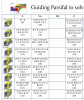
I calculated some cases and found some bitter disappointment with Parsifal as he stands composed.

Bitter-dissapointment.gif

It may seem unrealistic but I am actually unhappy with the numbers. Back in forging excalibur I had worked out half the cases where the primary and secondary corners were on the back (what I think would be the hardest cases) and eventually learned to get all of them down to between 8-12 moves.

In this solving from Parsifal I really don't like seeing 13/14f algs and was hoping for better. There may be tons of transcription errors in the algs because I can't copy and paste from cube explorer. The move counts are correct.

These are reasonably two-gen for what they do and that gives me a lot of hope but I am going to calculate solves for a different character before I return to Parsifal. Try a different idea and do some light multivariate testing.
 
Last edited:
As you're going with Mallorian Arthurian names and spellings, how's about Launcelot or Gwinever for the next set?

That said, the names are my favourite part of this method. I'd suggest that full edge control & COLL would be faster, and only leave 2 gen PLLs - U, H, Z, or PLL skip.
 
The way your saying everything really just is confusing. I understand that your not just solving parts of the last layer in terms of EO, EP, CO, and CP, but could you not just say something like "Set up a WV case and solve 2 corner and an edge of the top layer while placing the pair which requires X algorithms."? I know thats not what your method is, but I don't really know what it actually is because of the way your wording it, and even if it doesn't just solve a couple pieces at a time, there's got to be a better way to explain it than what your doing.
 
Back
Top