Mathematics Thread

What is the hardest math you learned?

  • Calculus (specify in comments)

    Votes: 69 35.0%
  • Trigonometry

    Votes: 27 13.7%
  • (Enriched) Geometry

    Votes: 18 9.1%
  • Equations (specify)

    Votes: 7 3.6%
  • Graphing Equations (specify)

    Votes: 5 2.5%
  • Basic Algebra (specify)

    Votes: 9 4.6%
  • I can do better!

    Votes: 49 24.9%
  • What kind of math is that?!

    Votes: 13 6.6%

  • Total voters
    197
Calculator/Math Thread

Zeta function is sigma k=1 to inf 1/k^x for Re(x)>1 and is analytically continued for the others
I dont think he'd found zeta 3 tho considering it's been unknown for a while.
 
Zeta function is sigma k=1 to inf 1/k^x for Re(x)>1 and is analytically continued for the others
I dont think he'd found zeta 3 tho considering it's been unknown for a while.

yeah im lying HAAA LOL

yeah i know infprod e^stuf = 4 is easy to pruf i just thought it seems kind of cool

infprod sqrt(e)^(1/(2n^2-n)) = sqrt(e)*sqrt(e)^(1/6)*sqrt(e)^(1/15)*sqrt(e)^(1/28)*blablabla
sqaar it and distribute the powár through each term = e*e^(1/6)*e^(1/15)*blablabla = infprod e^(1/(2n^2-n))
 
math.png

Compared to you guys, I suck at math.
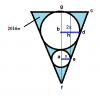
anyway, I have a math question. Use image as a reference.

NOTE: the triangle in the image is actually a cone, and the circles are actually spheres.
dark blue = radius
light blue = water left in the cone, its volume is 2016 pi.

A cone is filled with water. Two solid spheres are placed in the cone and water spills out. (The spheres are touching each other, each sphere touches the cone all of the way around, and the top of the top sphere is level with the top of the cone.) The larder sphere has radius twice that of the smaller sphere. If the volume of the water remaining in the cone is 2016π, what is the radius of the smaller sphere?

So i solved the whole thing, but I might have done something wrong cause the multiple choice answers don't match.

Anyway, here's my solution process:

volume of cone - volume of sphere1 - volume of sphere 2 = 2016π
(1/3)πr^2h - (4/3)πr^3 - (4/3)πr^3
(h = height, r = 3 different radii) bear with the laziness

finding h of cone
triangle EAF ~ triangle DHE (both are right triangles along CF)
DH/EA = x/x = 1
∴ triangle EAF = triangle DHE
HE = 3x = AF
h = GB + BA + AF = 2x + 3x + 3x = 8x = h

finding r of cone
r = CG
triangle CGF ~ triangle EAF
GF/AF = CG/EA
8x/3x = r/x
8x^2 = 3x(r)
8x/3 = r

subbing into old equation
(1/3)πr^2h - (4/3)πr^3 - (4/3)πr^3 = 2016π
(1/3)π(8x/3)^2(8x) - (4/3)π(2x)^3 - (4/3)πx^3 = 2016π

π(8x/3)^2(8x/3) - (4/3)π(2x)^3 - (4/3)πx^3 = 2016π

π(8x/3)^3 - π(4/3)((2x)^3 - x^3) = 2016π

π(512/27)x^3 - π(4/3)(8x^3 + x^3) = 2016π

π(512/27)x^3 - π(4/3)(9x^3) = 2016π

(512/27)x^3 - 12x^3 = 2016

512x^3 - 324x^3 = 54432

188x^3 = 54432

x^3 = 13608/47

x = (13608/47)^(1/3) or cube root of it

x ≈ 6.6


edit: i'm asking if there are any errors in my solution.
if you did the solution without looking at mine, did you get the same answer?
 
Last edited:
I got
x = (13608/65)^1/3
x =~ 23.87/4.02
x =~ 5.94

I'll see if I can find an error in a solution, either mine or yours, then I'll scan and post my solution (I did it on actual paper and I don't feel like typing it up)

EDIT: I found an error in your solution
subbing into old equation
(1/3)πr^2h - (4/3)πr^3 - (4/3)πr^3 = 2016π
(1/3)π(8x/3)^2(8x) - (4/3)π(2x)^3 - (4/3)πx^3 = 2016π

π(8x/3)^2(8x/3) - (4/3)π(2x)^3 - (4/3)πx^3 = 2016π

because (1/3)pi(8x/3)^2(8x) =/= pi(8x/3)^2(8x/3)
so I'll rearrange and stuffs to that equation to show that they aren't equal.
divide by (8x/3)^2 to get rid of that from both sides
(1/3)pi(8x) = pi(8x/3)
owait hold on... that's actually correct... I'll be back in a minute with an update.

mkay so I'm gonna type up my solution now and see if I can catch in error that way. I'll through in comments/explanations with {swirly tags}
cone - sphereB - sphereA = 2016pi
{thought process}
(1/3)(pi(r1)^2)(h) - (4/3)(pi)(r2)^3 - (4/3)(pi)(r3)^3 = 2016 pi
{generalized form}
((pi)((gc)^2)(gf))/3 - ((4)(pi)(8x^3))/3 - ((4)(pi)(x^3))/3 = 2016pi
{substitute in sides for lengths and rearrange with common denominator}
((gc^2)(gf)(pi) - (4pi(8x^3)) - (4pix^3))/3 = 2016pi
{subtract fractions}
(gc^2)(gf)(pi) - ((32)(pi)(x^3)) - ((4)(pi)(x^3)) = 6048pi
{multiply by 3}
(gc^2)(gf)(pi) - ((28)(pi)(x^3)) = 6048pi

Okay so there's an error in mine. Let me fix that and see what I get now.

Continuing where I last left off (before the error):
(gc^2)(gf)(pi) - ((32)(pi)(x^3)) - ((4)(pi)(x^3)) = 6048pi
(gc^2)(gf)(pi) - (((32)(pi)(x^3)) + ((4)(pi)(x^3))) = 6048pi
(gc^2)(gf)(pi) - (36)(pi)(x^3) = 6048pi
(gc^2)(gf) - (36)(x^3) = 6048
{divide by pi}

Now I can use this equation later once I find gc and gf, so I don't have to deal with the nasty stuff like you did.

FIND gf
gf = 2x + 2x + x + af = 5x + af
edh ~ fea, therefore:
he/af = x/x
he=af
edh =~ fea
he = 2x+x = 3x
af = 3x
gf = 5x+af
gf = 8x
{same method as you used}

FIND gc
gcf ~ aef
gc/ae = gf/af
gc/x = 8x/3x
gc = 8x/3

Okay, so now I can plug in my values for gc and gf into the equation I got a minute ago
(gc^2)(gf) - (36)(x^3) = 6048
((8x/3)^2)(8x) - 36x^3 = 6048
((64x^2)/9)(8x) - 36x^3 = 6048
(64x^2)(8x) - 324x^3 = 54 432
512x^3 - 324x^3 = 54 432
188x^3 = 54 432
x^3 = (54 432)/(188)
x =~ 6.62

that's the answer you got, isn't it? It should be correct. As far as I can tell, my solution is correct, and so is yours. Anyone else wanna post a solution?
 
Last edited:
So I was doing some of the old mandelbrot tests cuz I'm bored and I've got my final indiv round of the 2012-2013 season tomorrow:
Puzzle theory problem

The goal of this puzzle is to transform the left-hand position into the right hand position. On each move you may rotate any 2x2 subsquare (such as the set of four shaded squares) by 90, 180, or 270 degrees. What is the fewest number of moves needed?

FFF......FCT
CCC.->.FCT
TTT.....FCT

I haven't actually attempted it yet, but it seemed cool and like some people here might find it fun.

I read that and saw this straight away:

FFF.....FCC.....FCC....FCC.....FCT
CCC-->CFF-->CFT-->FTT-->FCT
TTT....TTT.....TFT....FCT.....FCT
 
I read that and saw this straight away:

FFF.....FCC.....FCC....FCC.....FCT
CCC-->CFF-->CFT-->FTT-->FCT
TTT....TTT.....TFT....FCT.....FCT

Nice. I got 1 more than that on my first attempt (which I thought was decent since that's what the guy who created the problem got on his first try). After I saw what the correct number of moves was I saw it almost immediately.
 
Nice. I got 1 more than that on my first attempt (which I thought was decent since that's what the guy who created the problem got on his first try). After I saw what the correct number of moves was I saw it almost immediately.

OH YEAH i forgot my mandelbrot was tomorrow also lol.
For some reason, I do better on the Mandelbrot relative to most people in my school than on other much easier contests. Same happened on the AMC.
 
Not sure if to post this, but co-ordinate geometry is my worst subject... Anyone else feel this hard?

vectors are hardest for me (well, mechanics actually but not puremaf so dunqaar)

when a function is divided by x-1 the remainder is 2, when the same function is divided by x+2 the remainder is -19, what is the remainder when the function is divided by (x-1)(x+2)

7/2
 
Last edited:
Back
Top