A method of CFOP speedcubing training that yields systematic progress

rickvu2: The idea of collecting data and continuous refinement of the "improvement curve" is very attractive. I can imagine some difficulties with filtering the data but fundamentally a great idea. From previous experience of training people, it is a roughly exponential decay of solve time vs how long you have been cubing for. A good example is the graph on BadMephistos site of his own improvement. One would expect a couple of blips (first learning f2l for example), but the issue I see coming up is confirming how much practice people are actually doing. Very few people do a set amount per day/week/month, and since the practice time (and quality of practice time) is a key variable, I think the data would be useful only from truly dedicated cubers, who it would be tricky to identify in advance.

What researchers often do in measuring the success of an intervention is conduct immediate pre/post testing. Perhaps you open a training session. In the analysis phase you are prompted to record your splits and learn your weakness. Training phase where you practice just that step. Then test phase where you do splits (or maybe just full solves) to be compared against the analysis phase. Not sure how much improvement to expect in say an hour long session. Even small increases (1/10 seconds) across a large sample size may be adequate to demonstrate effectiveness or trends. But then again, factors of warm up or fatigue may play even bigger roles than the training phase itself. So who knows.
 
This is a wonderful idea/trainer sppedpicker! can't wait to try it all out! and thank you all for your other comments/suggestions in response! sub30 here I come (even sub20!:) )
 
My results. I average high-9's to mid-10's.

Cross - 10.75 * 0.12 (Note, I raised my daily average by a bit) = 1.29 // Cross ao12 = 1.225 // Overall pretty close. Remember that I raised my average (10.75) up a little, so the cross average will have risen by a little as well.

Cross + 1 F2L - 10.75 * 0.245 = 2.63375 (About 2.63) // Cross + 1 F2L ao12 = 2.504 // Again, very close, with similar results.

F2L + Cross - 10.75 * 0.62 = 6.665 (About 6.67) // F2L + Cross ao12 = 6.781 // A little high, but I wasn't doing very well. So normally, it would be about right, maybe a little high.

OLL - 10.75 * 0.165 = 1.77375 (About 1.77) // OLL ao12 = 1.836 // High, but I still need to learn Full OLL. After that, I should be good.

PLL - 10.75 * 0.215 = 2.31125 (About 2.31) // PLL ao12 = 2.185 // About right. I got way too many G-Perms, so it may be a little lower usually.

I'm not doing LL, not now anyway. It's pretty much the same thing as OLL + PLL = about 4 seconds. And 4 + 6.781 (F2L) is roughly 10.75.
 
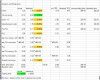
collinbxyz: Thank you for trying out my idea! Here is how the results look on the spreadsheet:

analysis.JPG

Exactly how do you get this to show the image instead of just linking it?

You will note the absence of results for recog vs execution for OLL/PLL. This is because I dont have your alg execution times for PLL (which allows estimation of OLL times), so there is no baseline to subtract from the total PLL to estimate your recognition time.

The green results are a particular strength of the solve, amber is on target OK, and red is cause for concern (more than 10% off the idealised pace).

Going through, cross is good (positive %age), close to 5 TPS, bpm given if you are interested in hearing it, cross + 1 is excellent. The sheet works out an estimate of the length of time to insert each f2l pair, and then adds that onto the cross time to get a baseline for cross+1, and you have exceeded this, hence the negative "1st pair recog".

Any X-cross there improving your average? I ask because the other f2l insertions were as you have pointed out, a little slower. However 5% off the idealised time is well within experimental variation, although if you were consistently negative here over a number of tests, its worth looking at algs/rotations/regrips etc.

Full F2L balances out overall because of the excellent cross and cross+1, but as you point out is a little off the pace. High TPS and BPM, high as in a BPM beyond the useful range that can be improved by metronome practice (after 180-200 its a bit pointless) so your look ahead is no concern.

OLL is a bit slow, as you have pointed out not knowing full OLL is a weakness, but the algs you do know are executed with high TPS. Ultimately I would be interested in the recog time calculation and the execution only time calc, as since you are semi-2 look, I would hope that this would show up as a extra recog time. Anyway...

PLL is a strength, notably faster than other cubers of the similar solve times.

For overall last layer, I just added your OLL + PLL, so all this represents is the sum of the splits you gave me. Doing LL as a separate average allows you to interpret how the last layer recog-AUF-OLL-recog-AUF-PLL-AUF flows together, by comparison with the individual averages and time trials.

In conclusion, your evaluation of your performance is right on the money, F2L a little off today, full OLL is definitely worth you learning. If you can get it as good as your PLLs, you will be easily half a second faster, if not more since its only a single look for recog. Could be the way to sub-10?

(By the way, I am a SIGNIFICANTLY slower cuber than you, I don't want any of this to sound cocky or patronising, I am simply going by the numbers.)
 
Last edited:
For anyone else who wishes their results interpreted, bring it on! How about some slower cubers too so we get a wide range? If anyone doesnt want their splits made public, feel free to PM me.

I would like (ideally, and this is the order I tend to do each phase),

1) Your average PLL execution time. I will accept PLL time attack/21. I do an average of 5 for each every now and again, and then work on the slowest, so I keep up to date records of all my PLL execution times. This is without any recognition of course. Just average the lot. If you are two look, average the corner alg executions, then average the edge ones separately, and submit the two figures. I will just add them together and call that your average PLL. OLL is automatically estimated from your PLL speeds.

2) An average of 5 or 12 solves done prior to the splits (in each case avg of 12 is better than 5, remain consistent throughout, ignore fastest and slowest, you know the drill). If you have multiple cubes that are decent, it expedites matters to use them all here, rather than just a single cube.

3) An average of 5 or 12 cross solves (with 15 sec inspection max obviously)

4) An average of cross + 1 (with 15 sec inspection max obviously)

At this point I tend once Ive recorded the times to finish the f2l on each of my cubes and place them U face down. I then go into timing my last layer, picking each cube up in a z2' kind of way. Since this way (multiple cubes, would be different with single) I can't remember what OLL case is on any of them, and my recog time more accurately reflects the truth than if I started with U visible.

5) An average of full Last layer including recog/AUF

At this point I usually scramble all the cubes again (competition computer generated scrambles only throughout please) and do

6) An average of full f2l including cross.

Place your cubes U down again (maybe mix them up "find the lady" style) so you can have truthful recog for:

7) an average of full OLL including recog and AUF (if you get a skip, disregard it in the average)

Place your cubes U down again (maybe mix them up "find the lady" style) so you can have truthful recog for:

8) an average of full PLL including recog (AUF included pre and post), if you get a skip, disregard it in the average.

Thats the lot, I'll pop it in the spreadsheet and feed back to you. Actually just doing an average of 12 of each of these phases this way is a good cubing exercise routine in itself, I should think it is of far more benefit than mindlessly solving for the same period of time.

Looking forward to testing this thing before release.

Let the analysis commence!
 
Last edited:
It seems like the cross is still my weakest point because I'm not good at doing it blind.

Cross: 3.06 (17%)
F2L (no cross): 10.24 (57%)

F2L (with cross): 13.30 (74%)

OLL: 2.37 (13%)
PLL: 2.41 (13%)

LL: 4.78 (26%)

Optimal solving time: 18.08
My non-lucky PB: 17.40
My best avg5: 22.50
 
So here's my data, look forward to seeing what you come up with:

Average PLL execution = 1.29
Solve = 14.07
Cross = 1.33
Cross+1 = 3.91
LL = 4.92
F2L = 9.76
OLL = 2.23
PLL = 2.87

Everything is avg12 except PLL exec, which is average of 21 Mo5s.
 
I'll be assuming that I average about 11.9 seconds seeing as I get lots of averages around that and my PB ao100 is around that. I'll also be doing no inspection for all things last layer related.

Cross - 11.9*0.12 = 1.43//Ao12 = 1.39
Cross+1 - 11.9*0.245 = 2.92//Ao12 = 2.65
F2L - 11.9*0.62 = 7.38//Ao12 = 7.36
LL - 11.9*0.38 = 4.52//Ao12 = 4.17
OLL - 11.9*0.165 = 1.96//Ao12 = 2.01 (Note: I use lots of OLLCP/AntiDiag so my average would have been faster had I only done speed optimised OLL's)
PLL - 11.9*0.215 = 2.56//Ao12 = 2.45
 
It seems like the cross is still my weakest point because I'm not good at doing it blind.

Cross: 3.06 (17%)
F2L (no cross): 10.24 (57%)

F2L (with cross): 13.30 (74%)

OLL: 2.37 (13%)
PLL: 2.41 (13%)

LL: 4.78 (26%)

Optimal solving time: 18.08
My non-lucky PB: 17.40
My best avg5: 22.50

OK, so here it seems that you didn't quite give me the right data I need, but I'll do my best with what you have given me. The problem is that you didnt give me all the right splits I need.
1) There is no baseline average from the same session,
2) There is no cross+1,
3) It appears that you have just added cross and f2l no cross to get full f2l instead of doing a separate average, this doesn't allow for any investigation of cross to f2l transition.
4) There is no pure execution of PLL time so I can't figure out recognition times,
5) Your full last layer appears to be the result of simply adding OLL and PLL, as opposed to being a separate average. This is important as its one of the metrics I use for validating the effectiveness of the test.
6) Also, are these average times? since 18.08 seems to be a lot faster than your best ever average of 5, so the test is invalid as the phases arent a reflection of you real solves. I am assuming that this time is doing steps with inspection and thus bypassing recognition times, finding pairs etc. If your best average is 22.5, (so globally about 25/27? pure guess) this means you are spending at least4.5, and probably more like 7 seconds on finding pairs and identifying last layer cases.

Anyway, let me breakdown what I reckon based on your best ever average of 5:

1) Your cross should be at least under 2.7 seconds. 3.06 is quite high for a low 20s solver, and corresponds to under 2 TPS (113 bpm if you want to hear it). You should be more like 130. I know cross doesn't tend to be metronomic in execution, but when you hear the speeds involved you will appreciate how its not that quick really.

Advice:

Cross: Ensure you are doing it on the D face,
Make sure you know your colour scheme cold so you can place pieces correctly relative to each other, but not necessarily matched with their centres.
Utilise your 15 seconds effectively, making sure to plan all four pieces in advance so you can solve eyes closed.
Practice solving cross eyes closed, if 15 seconds isnt long enough, take as long as you like to plan it (this time rapidly comes down with practice)
If you can't do it consistently in 8 moves or less, go on JARCS and compare your solutions to a given cross with its optimal solutions, if you still suck at crosses just spend an entire day figuring out cross solutions and executing them with your eyes closed,
Badmephistos has good cross vids.

F2L: A 13.3 F2L for a 22.5 second solve for f2l is about right, actually on the good side (sub 14 second f2l is a solid f2l for a 22.5 second solver) but I am concerned about your cross-f2l transition (since I have no data, and it could be a big part of the discrepancy between your actual solve speed and your 18.08 test total) Try some metronome work aiming for around 143 bpm, or if you don't like metronome solving, do some slow solves aiming to look ahead and not stop turning at any point. Your ideal practice zone is the speed where you can continuously turn without pause (or U,U,U,U) and complete the f2l. If you find you are doing lots of cube rotations, look into solving in the back slots, utilise empty slots as effectively as possible, and ensure that you can mirror things in your left hand to solve in FL as effectively as FR.

Last layer: I am assuming that your PLL and OLL are execution only, and if so they are fine, actually your pll is very good. Did you take an average here? Its important as there is a wide variation between execution times depending on which PLL crops up, hence the need for an average. Ensure all skips are disregarded for testing purposes. If your OLL and PLL are inclusive of recognition and AUF, then a last layer of 4.78 seconds is outstanding for a 22.5 second solver. Unfortunately that leaves you with a cross + f2l of 17 ish seconds, which is what needs the work.

In summary, sort that cross out, work on lookahead, optimisation and rotation reduction during f2l, with special attention to the cross-f2l transition.

If you would like to resubmit times with the appropriate averages and splits actually done, then I would be happy to reanalyse your solve.
 
So here's my data, look forward to seeing what you come up with:

Average PLL execution = 1.29
Solve = 14.07
Cross = 1.33
Cross+1 = 3.91
LL = 4.92
F2L = 9.76
OLL = 2.23
PLL = 2.87

Everything is avg12 except PLL exec, which is average of 21 Mo5s.

Now this one is very interesting, thank you so much for accurately breaking everything down.

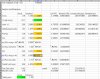
I include a jpg of your analysis:

jasonk.JPG

Cross: Excellent. This is the cross of someone who averages 11 seconds. Not a problem.

Cross+1: For such a quick cross, the cross + 1 is a little slower than one might expect. 0.63 seconds could be recovered here by finding the and tracking the first pair during execution of the cross, or even better during inspection time. You have obviously done the work to plan and solve the four cross pieces without much trouble, can you extend this to 6 pieces and not pause before the first pair?

F2L: First pair aside, your F2L is basically OK, perhaps a little slower than it could be, a full F2L of 9.76 seconds is just a little off the pace (9.2), which woudn't be a concern if it weren't for the fact that its supplemented by a lightning fast cross. If your f2l were at the standard of your cross, you would be looking at sub-7 seconds for the full f2l including cross. This would be awesome. See if you can squeeze that extra half second out of cross-f2l transition, and ensure you have a minimum of cube rotations and poor case algs. Personally, I made a chart of every possible f2l case from every possible angle, filled in what I do and then set about reviewing each case to see if there was a better way (anything longer than 8 moves without good reaspn, anything that involved more than 1 rotation, check those that have a single rotation to see if it can be avoided etc etc). Systematic gap plugging like this does add up, its no different to finding a better alg to a PLL you find awkward for example, just a bit more work. I can upload the blank if you like.

Last Layer: Very interesting indeed. Your PLL execution is really fast, a full second quicker than one would expect from a 14.86 cuber. If your PLL execution is 1.29s, I would infer an OLL of around a second, which are certainly heavy duty last layer artillery. Your last layer was in fact a good half second faster than would normally be expected (balancing the half second slower f2l), but given the execution only average quoted, you need to take a look at your recognition/AUFs.

Regarding OLL recognition, if you are keyed into identifying certain sticker to get the exact case, perhaps expand that a bit. For example, where are you looking to tell the difference between OLL 7 and 12 if the lightning bolt has the same orientation and UF is yellow? If you are looking for pairs of yellow stickers, you may have to AUF or move your head/cube, but if you can tell immediately from the which way the FUR yellow sticker is facing, then this is not required. As a practice technique, try getting to OLL and freezing with F, R and U visible. See if there are any cases that come up that require you to look around the cube further, and if so make a note and find other features which telegraph the precise case, so you don't need to look around. It is also worth looking into OLL prediction during last pair insertion. If its a regular R U' R' insertion, the block LU LBU and UB pieces dont change, they simply move anticlockwise around the centre, the pieces at FR and FUR move in behind them (to UBL and UB, thus glancing at the orientation of the yellow sticker on the UFR corner prior to insertion can give info about the forthcoming case, as this ends up at the BLU position, which may need you to look around to see which way the yellow sticker is pointing if you don't see it in advance.) and the pieces at URB and UR remain as they are. For completeness, RFD becomes UFR. Knowing this, you can often predict or partially predict which OLL case is likely to come up, or even if you can only tell the type of OLL that its going to be (say a small lightning bolt for example), you can then make sure your eyes are directed at the right spot to identify precisely which one of the family it is the instant the R U' R' is completed. Anyway even if this doesn't work for you, try to familiarise yourself with all the little details of all the similar cases, so you can identify quickly and confidently, no matter what the orientation of the U face.

If you really want to get hardcore, by knowing precisely which pieces are interchanged by your OLL, you can partially (often completely) anticipate PLL, but few do this. The easier version of this idea is with cases where a group of pieces remain unchanged. For example in the algs I use for cases 28 and 57, the entire L side of the U face remains unchanged throughout. If I notice if its headlights (centre opposite coloured or adjacent?), a continuous bar, a two block closest to me, two block furthest away, or no blocks at all I can partially identify the PLL. For example if its headlight with opposite colour in the centre, I know its a T, H, U or G (d or b) perm, so I am already looking at R side of the last layer when the OLL completes to tell which it is. This is the sort of thing you can get very good at, and I am sure accounts for the minimal recog time of top cubers, even if they don't realise they are doing it!

For PLL, I would look into working on and refining 2 sided PLL recognition which can drastically reduce recog time, and learn some PLLs from different angles so you can reduce AUFs. It seems like you are spending more time identifying and setting up the case than actually executing it! As a practice technique, when you reach PLL freeze looking at U F and R, then try to identify the case from opposite colours etc. It is true that many look very similar, but there are many details you can note (is it opposite colour in the centre of the headlights, or adjacent? adjacent clockwise or anticlockwise? is the block of two next to their opposite colour or an adjacent etc etc). At first this is a slow process, but similar with solving the cross with eyes closed, it really becomes easier over a fairly short time, after all there just aren't that many cases. Or just use the software, which partially removes the temptation to cheat.

Also make sure you know when you begin the alg what the AUF will be in the end. E.g. in a T perm, the colour of the block at FLU and FU will be the colour of the F side of the last layer once the alg is complete. If they are green (say), and the F centre is blue, you can infer that a U2 will be necessary at the end, then tag it on as part of the alg, rather than a separate AUF check.

In summary then, you have some serious technique in play here (cross, alg execution). You need to make sure you are utilising this as effectively as possible by ensuring your recognition skills are as good as your algs. There is some good 2-look PLL identification software that has been released recently, so check this out. Also try and work on that first f2l pair, and eliminate any other inefficiencies in your f2l to take full advantage of your lightning cross skills.

Hope this helps.

P.S. You know when people post sub-1 all PLL videos and someone (usually Escher) comes on and points out that the timing method is a little bit generous and they aren't really all sub-1? I wondered if you are perhaps skewing your PLL times a little bit from what they are in an actual solve with however you are timing them individually in the natural attempt to get the fastest execution times you can. If thats the case, then it would account for why your last layer is slower in practice than your average execution time would indicate, and thus mean that recog is not as much of an issue as the splits suggest. Just a thought.
 
Last edited:
Awesomely detailed analysis.

That was fantastically useful, great work.

You're obviously doing something right in your analysis - the gist is pretty much what I was expecting. I know that my Cross-F2L transition is pretty terrible, and that my LL in solves is a lot worse than when I'm just timing algs (not just recog, but the actual execution of the algs). It's good that the numbers match up with what I was feeling, gives me a push to actually work on those things. :p

I didn't realise how much slower my F2L is than it should be though. Although now that I think about it, I really barely do any F2L tricks or algs, pretty much my entire F2L is intuitive. I hadn't really considered how much that might be slowing me down, thanks!

What you're doing here is fantastic :tu
 
I'm really sorry for not giving all the data you would've liked to have but I'm surprised and thankful that you analysed my solve anyway. Here's a few things I'd like to point out:

1. I just had a 6-month break from cubing and my average solving time is around 24 seconds. I think I could do a better avg5 than 22.50 if I tried.
2. The times I provided (except for full F2L and LL) are avg5 as opposed to avg12.
3. The times are pure execution and I got no skips.
4. I know full PLL and about half of the OLL since I've forgotten some during my break.
5. My worst transition is probably cross-F2L or OLL-PLL.

Thanks for the advice!
 
I'll be assuming that I average about 11.9 seconds seeing as I get lots of averages around that and my PB ao100 is around that. I'll also be doing no inspection for all things last layer related.

Cross - 11.9*0.12 = 1.43//Ao12 = 1.39
Cross+1 - 11.9*0.245 = 2.92//Ao12 = 2.65
F2L - 11.9*0.62 = 7.38//Ao12 = 7.36
LL - 11.9*0.38 = 4.52//Ao12 = 4.17
OLL - 11.9*0.165 = 1.96//Ao12 = 2.01 (Note: I use lots of OLLCP/AntiDiag so my average would have been faster had I only done speed optimised OLL's)
PLL - 11.9*0.215 = 2.56//Ao12 = 2.45

ottozing, what is your average PLL execution time (without recog/AUF etc)? I need this to work out your PLL/OLL TPS and recognition time. Otherwise you appear to be right on the money with your solves, perhaps with a slightly slow OLL (but you have already mentioned that). Obviously Im familiar with OLLCP, but what is AntiDiag?

ottozing.JPG

Standard advice applies, if everything is fine, work on F2L as it is never time wasted.
 
Last edited:
I'm really sorry for not giving all the data you would've liked to have but I'm surprised and thankful that you analysed my solve anyway. Here's a few things I'd like to point out:

1. I just had a 6-month break from cubing and my average solving time is around 24 seconds. I think I could do a better avg5 than 22.50 if I tried.
2. The times I provided (except for full F2L and LL) are avg5 as opposed to avg12.
3. The times are pure execution and I got no skips.
4. I know full PLL and about half of the OLL since I've forgotten some during my break.
5. My worst transition is probably cross-F2L or OLL-PLL.

Thanks for the advice!

No problem, get back into it, and repost!
 
Can anyone help me with how to display these jpg files properly, so opening the spoiler just shows them rather than provides a link?
 
Can anyone help me with how to display these jpg files properly, so opening the spoiler just shows them rather than provides a link?

Just above the reply box there's a line of icons, one of which is a little picture of a tree. Click that and it should let you upload files from your computer or from the web.
 
I can just about manage sub 20 nowadays, maybe 20-21 seconds on others. On a bad day 21+

all of these are averages of 12, bear in mind for single stuff there is no recognition, particularly in LL, so it's probably a little faster than in an actual solve. Finally, I use two look OLL, knowing only a few easy cases for 1 look and full PLL:


cross: 2.38 - 11.9% of a solve (Pretty accurate :)
cross+1: 4.92 - 24.6%
F2L inc cross: 13.97 - 69.9% (This was a bad average of 12)
OLL: 3.39 - 17% (I had a 6 second single with a dot :/ the average was better but that time would have been well over 23 seconds)
PLL: 2.49 - 12.5%

this totals 19.85, so I'll round that to 20 or so considering it doesn't include OLL and PLL recognition, this is about my normal amount anyway.

Give or take.
 
Back
Top