Fridrich's F2L algorithms - missing alg. for switching edges on E axis

awiltz2

Member
Joined
Oct 16, 2009
Messages
10
I have just learned all of Fridrich's F2L algorithms, and I've noticed that there are a few situations that arent covered. Sadly, I've chosen to learn with first layer on U (I know its horrible). E in this case is the layer between U and D.*

To flip FR when the UFR corner is in the correct spot, I simply do:
R2D2F`R2FD2RD`R (I used to do FD2F`DFD2F`DR`D`R (awful))

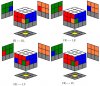
But what if edges need to be permutated on E? Such as switching FR↔LF or FR↔FL? Or FR↔BL and FR↔LB? Or even FR→BL→LF→FR edge rotation on E?
Here is a picture of four of the above situations:
http://i111.photobucket.com/albums/n157/wiltzandrew/Eedgealgorithms.jpg
I've also added the same image as an attachment.

There have been several times where all E edges were on E, but not in the right place, and I've lost a lot of time taking the edge out, putting it into its spot, pulling the other edge out, putting it into its spot, really annoying situation. There are several algorithms for rotating edges among their faces, but I havent found any for rotating among an axis.

This is my current algorithms for swapping FR↔BL (it is awful)
D`R`DRDFD`F`D2BD`B`D`L`DLD2R`DRDFD`F`
That is an awful way of taking out FR, putting it into BL, which takes out BL and puts it into FR. I cant think of an easier way. Is there? I really hope so :D
-Andrew Wiltz
 

Attachments

  • E edge algorithms.JPG
    E edge algorithms.JPG
    69 KB · Views: 39
Aye. Watching Badmephistos youtube videos for intutive F2L really helped me understand it. I would really work on learning intutive and with the F2L on bottom this time :P. But I suppose it is all preference. Either way maybe watching that video will help you.
 
Try using intuitive. Play around and try and work it out. Half of the fun is in the working out :D. I'm not one for algorithms for F2L.

I've tried intuition, I've found the best way to solve a certain situation from this point on with the exception of these situations :(. So frusterating :confused:
 
Aye. Watching Badmephistos youtube videos for intutive F2L really helped me understand it. I would really work on learning intutive and with the F2L on bottom this time :P. But I suppose it is all preference. Either way maybe watching that video will help you.

I'll watch the video this weekend.
 
stop!
i strongly recommend you learn f2l with cross on D face.
By doing this you'll go a lot faster for 2 main reasons:

1. Spot the pieces faster:
What's the point of looking at the pieces that are already solved?

2. finger tricks:
I'm not sure how your fingers are adapted to the cube, but you may find it is easier to turn.

AGREED. It's gonna take some time to get used to, but you should definitely do this.
 
stop!
i strongly recommend you learn f2l with cross on D face.
By doing this you'll go a lot faster for 2 main reasons:

1. Spot the pieces faster:
What's the point of looking at the pieces that are already solved?

2. finger tricks:
I'm not sure how your fingers are adapted to the cube, but you may find it is easier to turn.

True, but some people do F2L on the left. I always imagine I make the "tubes" of colour and ground them, never to move again...

I have an active imagination.
 
@ Teller, for the FR <-> LF case, R2 U2 R2 U2 R2 doesn't work. With blue on F and white on D, I would do:

R' U2 R2 U R' d' L' U' L U R U R' U R U R'

There's likely shorter algorithms, but then again, I'm doing this intuitively. Like other people have said, intuitive F2L is the way to go, with a couple of exceptions.

As for the other cases... I'm feeling too lazy to type up some solutions for them (believe it or not, it took me like 15 minutes to work it out and type up the algorithm above me because I kept messing it up :S)

~Rook
 
LF and RB swap for F2L on U:
F2 D (R2 D2 R2 D2 R2) D F2

You should really stop solving F2L on U (use D or L/R, so that you have mostly U and R moves, these are MUCH faster to execute) and start doing F2L more intuitively. It will slow you down now but pay off a lot in the long run.
 
R2 U u R2 U' u' R2 for the first

R2 u R2 u' R' U' R' F' U2 F for the second

F' U' R' F2 R U' R' F' R F for the third (which sucks)

R U2 R' F' U' R' F2 R F for the last, kind of bad as well.

Those truly are awful algorithms. Although the Intuitive method seems hard I'll get used to it eventually. Thanks so much for putting the time into finding these :D. I would love to know how you found them. Was it by trial and error or from an index of algorithms?
-Andrew
 
stop!
i strongly recommend you learn f2l with cross on D face.
By doing this you'll go a lot faster for 2 main reasons:

1. Spot the pieces faster:
What's the point of looking at the pieces that are already solved?

2. finger tricks:
I'm not sure how your fingers are adapted to the cube, but you may find it is easier to turn.

This might sound like an awful, awful thing to do, but for almost everything I learn (in general) I learn it the hard way and then the easy way. After I master Fridrich's method with F2L on U, I'll probably relearn them with F2L on D or another face. Eventually I plan on being able to do it on any such side.

An off project of mine is being able to solve the Rubik's cube from its reflection in a mirror. So far it is very interesting - to rotate the cube right to see B in the reflection, I have to rotate left, lots of fun. Future projects include blindfold, doing it behind my back, one-handed both left and right, solving two cubes at once with each hand simultaneously, and maybe even a blindfolded variation of the latter two. This will surely cover a few years - I'll be lucky if I finish the above projects before I get my M.D. in 2016 :p. If I didn't have school I'd be spending a larger portion of my time on developing my skill, but the only time I have to do this is on the bus/train to and from school, and weekends if I dont have too much work.

I planned on eventually learning F2L on D from the start, but for now I'll learn the awful F2L on U. Thanks for all the help guys, I'll be making more posts after I learn Fridrich's.
Sincerely,
-Andrew
 
Last edited:
After I master Fridrich's method with F2L on U, I'll probably relearn them with F2L on D or another face. Eventually I plan on being able to do it on any such side.

I don't recommend this approach at all. Fridrich is a speedsolving method and as far as speedsolving is concerned doing moves of arbitrary random faces is NOT the way to go, even if it does solve the cube. You want to have mostly R and U moves (or L and U if you're left-handed) and that is what Fridrich F2L on D or L (or R if you're left-handed) accomplishes and is designed for. Practicing F2L from all sides has about as much practical utility as practicing to be able to write cursive upside down and sideways.

You seem like someone who just wants to solve the cube and is not really very interested in speed, keeping the awkwardness of the moves you perform to a minimum, etc. I very strongly recommend learning a blockbuilding method such as Petrus or Roux, so that you can at least concentrate on trying to solve the cube in as few moves as possible. Even if you don't care at all about speedsolving, you could become very good at fewest moves solving with time.
 
Back
Top