[Member Intro] Aiming for a Sub 30 Average - aged 61

Kevin1958

Regular
Joined
Mar 9, 2020
Messages
28
Hi guys - my name is Kevin, I'm 61 years old and I live in Bristol, England.

I completely missed out on the Rubik's cube craze in the 80's but I'm making up for it now :) I remember a few friends back then having cubes but I never tried one. Fast forward a few decades and my 39 year old daughter buys me a Rubik's brand cube for Christmas 2018 which stays in its box until she opens it and solves it herself in May 2019 after many hours of studying the enclosed instructions.

So that was it! I couldn't let her beat me, so I secretly spent the next few weeks studying loads of YouTube videos to memorise the beginners method and in June demonstrated my new skills to her with a time of 2 minutes 43 seconds which I've been obsessively trying to lower ever since.

I now use a GAN356X with CFOP (2 look OLL and 2 look PLL) and my current single solve PB is 29.35 although I concentrate on lowering my 10 consecutive solves average PB which currently stands at 41.35

My next goal is to capture a single sub 30 on video but having only managed that once in over 20,000 attempts that could take a while. My ultimate goal is a sub 30 average for 10 consecutive solves.

I know these times will be ridiculously easy for many of you - and I don't want to make excuses - BUT - age definitely takes its toll. For instance, I can't run or play squash (or do pretty much anything) like I used to. My 61 year old brain is nowhere near as sharp as it was and these fingers don't move anything like they used to ;) but I'm sure another single sub 30 will come along one day and maybe that sub 30 average for 10 consecutive solves wont be far behind?

This chart shows my single solve PB progression to date:
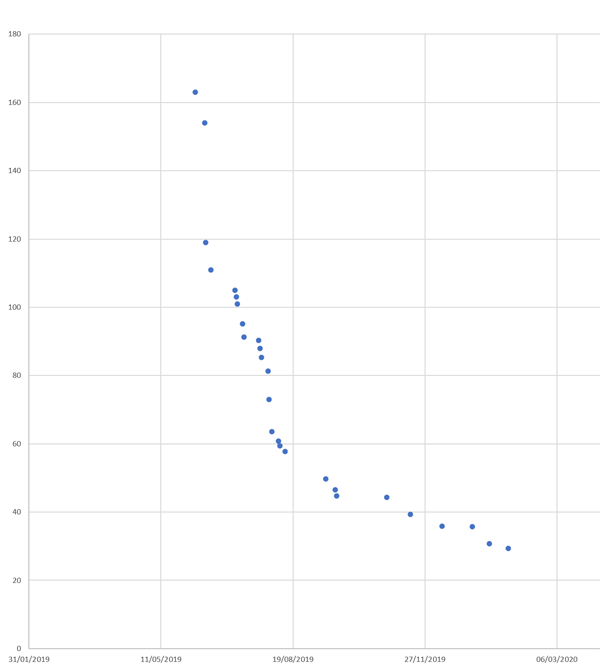
PB.png


Thanks for reading.

Kevin
 
20,000 attempts
wow you're serious about it!

My dad has your age and he solves in 2min, but he doesn't have the same persistance as you.

you'll be solving under 30sec avg with no time :)
 
My recommendation is to focus on efficiency. You aren't going to have the lightning reflexes and fast turning to get away with being inefficient. So learn full PLL. That will pay immediate dividends. Then learn full OLL. That will also pay dividends. In your spare time, drill algorithms. If you're sitting around doing nothing, do a bunch of T-perms. For me, my dog can't be outside alone (he's weird), so when he's gotta be outside to use the bathroom, I walk around doing algs. This has two benefits: 1) You learn the algs even better; 2) You improve your overall turning speed.

Sub-30 average at your age is definitely do-able. Keep it up!
 
Welcome from another older cuber. I'm 37 and I just broke a sub-40 average of 100 with Roux. You'll surely reach your goal soon. I second what Coach Tabe said - my worst part of a solve is second block since that requires fast recognition and quick intuitive thinking.
 
My recommendation is to focus on efficiency. You aren't going to have the lightning reflexes and fast turning to get away with being inefficient. So learn full PLL. That will pay immediate dividends. Then learn full OLL. That will also pay dividends. In your spare time, drill algorithms. If you're sitting around doing nothing, do a bunch of T-perms. For me, my dog can't be outside alone (he's weird), so when he's gotta be outside to use the bathroom, I walk around doing algs. This has two benefits: 1) You learn the algs even better; 2) You improve your overall turning speed.

Sub-30 average at your age is definitely do-able. Keep it up!

I like that idea. While I wouldn't normally recommend to learn 2LLL right away, for someone who has a limited turning speed it would probably help a lot
 
Another thing people say is too use more efficient methods. J Perm said that using roux would be a good idea if you can't phisically turn as fast, and Petrus and ZZ should also work. But if you think turn speed isn't a problem, you can stick with CFOP
 
My recommendation is to focus on efficiency. You aren't going to have the lightning reflexes and fast turning to get away with being inefficient. So learn full PLL. That will pay immediate dividends. Then learn full OLL. That will also pay dividends. In your spare time, drill algorithms. If you're sitting around doing nothing, do a bunch of T-perms. For me, my dog can't be outside alone (he's weird), so when he's gotta be outside to use the bathroom, I walk around doing algs. This has two benefits: 1) You learn the algs even better; 2) You improve your overall turning speed.

Sub-30 average at your age is definitely do-able. Keep it up!

Thanks for all of your replies.

So next is full PLL then maybe full OLL + my cross needs work and lots more F2L practice.

This is what I will work on and practice, practice, practice.

Cheers all.
 
Another thing people say is too use more efficient methods. J Perm said that using roux would be a good idea if you can't phisically turn as fast, and Petrus and ZZ should also work. But if you think turn speed isn't a problem, you can stick with CFOP
I agree with this, seeing as your main problem would be turn speed I would recommend roux as it has a much lower move count than CFOP and it only has 42 algorithms which would mean you could focus on efficiency sooner.

another thing is that I highly recommend you attend a competition and luckily for you there is a comp in Bristol in September so you wouldn't even have to travel. https://www.worldcubeassociation.org/competitions/BristolOpen2020
 
another thing is that I highly recommend you attend a competition and luckily for you there is a comp in Bristol in September so you wouldn't even have to travel. https://www.worldcubeassociation.org/competitions/BristolOpen2020
Great advice
I agree with this, seeing as your main problem would be turn speed I would recommend roux as it has a much lower move count than CFOP and it only has 42 algorithms which would mean you could focus on efficiency sooner.
Terrible advice
 
Great advice

Terrible advice

Owen, I'd like to do a Q&A session with you. After it's done we can delete our posts so as not to clutter the thread

Q: How many moves does CFOP take on average?
A: 46-53

Q: How many moves do ZZ, Roux, Petrus, and other low movecount methods take on average?
 
Owen, I'd like to do a Q&A session with you. After it's done we can delete our posts so as not to clutter the thread

Q: How many moves does CFOP take on average?
He said it took him 46-53 moves on average. I told him to give me some solutions and he didn't answer.
 
Forget the Q&A, honestly it'll just clutter stuff up :P

My point is that ZZ, Roux, Petrus, and others have much lower movecouts than CFOP. Of course, TPS can be very high on CFOP, which is its advantage. The problem is that Kevin's TPS speed will be limited, and he probably won't be able to reach high TPS, eliminating a main advantage to CFOP. Considering his TPS is limited, a method with a lower movecount may be better suited for him. Not to mention that he hasn't even looked at other methods, he may find he loves ZZ a lot and wants to switch to it because he likes the method. Of course, very fast averages can be achieved while slow solving, but it's much easier with a lower movecount. That being said, if he has 20,000 solves in his session, it may be smart to simply stick with CFOP, as he can still get very fast with it while slow solving(Feliks has posted sub-10 averages while slow solving).

Also I use CFOP so you can't say I'm a Roux/ZZ freak like WCC XD

(Also we should probably delete the Q&A posts so we don't confuse Kevin :))
 
Back
Top