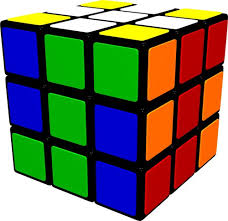
Between 1981 and 1990, very few people could solve the cube in general. Most cubes available were horrible; only the 'original Rubik's cube' had any chance of turning properly. All other clones were a joke (funny that the opposite is true today); by joke I mean 'wonderful puzzler' clone cubes were so hard to turn that a child was unable to make even a quarter turn. It took an adult with very strong arms to make a turn. A big thing with speed solvers was to try to modify the cube to make it work better. At the time, silicone lubricants didn't exist. Since water based lubes don't last more than a day and oil would destroy the plastic, vaseline (petroleum jelly) was really the only option. We would take the cube apart, apply the correct amount of jelly, then put it back together, and it would create a mess of jelly that would make the entire cube slippery, so it had to cleaned & washed well. Next, the stickering on cubes was weird & random; often blue was opposite of white. Some cubes came with purple stickers or brown or other weird colors. We would steal stickers from junk cubes and re-paste them onto your 'main' cube to create a good set of colors with the correct opposites. We also found that solving a cube 500 times would smooth out the plastic as the injection molded parts had parting lines and other jagged features. So the general pattern was fairly similar as today; solve 500 times, take apart, lubricate with vaseline, change the stickers. Some cubes did have screws to adjust tension as well. If you made the cube even slightly loose it tended to explode every few solves.
Regarding competition, it was almost impossible to race anyone because you could not find anyone who could solve the cube. If you were lucky enough to find someone who could solve it, they needed a book open in front of them and would take 20-30 minutes to solve it using the book; not competitive when you were trying to find sub-60 second solvers.
There was no internet, and no real magazines about cubing. The entire development of Waterman's method went on without anyone barely knowing about it, because there was no way to communicate between cubers. Each solver typically tried to create new algorithms (not by PC, but by random experiments), and we all tried to improve our method & speed by tweaking the method & algorithms, but there was little to compare it to, and no one to really talk to. Only the 1982 episode of 'That's Incredible' followed by the 1982 world championships made the news. So throughout the rest of the 1980's I was chasing the 22.95 second world record, never knowing if a new record had even been set.
After 1990, cubing began to disappear entirely. It became too lonely to try to be a cuber or to keep improving, with no one to compete against or talk to. It wasn't until the internet in 1998 that it became really possible to try to connect with other cubers. I recall in 2003 or 2004 seeing a web news article that stated there was a guy who was averaging 11 seconds on the 3x3, which I thought was pretty amazing.