For the last two months I have been developing a new speedcubing method, the details of which are irrelevant, but what is important for Roux solvers is that my method ends with Roux L6E. While a couple of people like Alex Lau and Guroux can do L6E in 2 seconds, this is a huge challenge for most people. It is not the number of moves, but rather you need 3 looks and/or an incredible ability to keep track of several pieces moving at blazing speed. I spent a good amount of time trying to come up with a 1-look solution and here it is. I call it 1L5E (1 look 5 edges).
1. After CMLL, don't orient edges or do anything
2. Then, solve either the UR or UL edge piece, which is extremely fast (typically U M' U', or some U/M/U three move combination, max four moves or a good chance one is already solved so 0 moves)
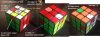
3. Place the remaining unsolved UR/UL edge piece, in the DB or DF position with its L/R color facing front or back (i.e. see pics below)
4. As you perform items 2/3, watch the other M slice edges of which there are three
5. The remaining three M slice edge pieces must have their status identified as you compare them to the centers above and below them. There are six combinations (solved, solved+flipped, opposites oriented, opposites flipped, one matching color oriented, one matching color flipped). My recognition system numbers those from 0 to 5, so any config is a 3 digit number, for example 554
6. In addition, I prefix the number with A or B, based on whether my setup is mirrored or not (UL slot open and UR solved, with UR in DF is the mirror of UR in DB)
7. Once you have the full identifier (i.e. B-554), you execute one of 112 algorithms (+112 mirrors). If you choose to skip the mirror set you can force a particular set but this will set you back either a rotation or 3 more moves.
8. The result is that you solve L6E with 0-4 moves setup and then the algs are anywhere from 6-11 moves (average is around 8), totalling 10-15 moves for this style of L6E vs. about 18-20 for normal L6E
9. Although you do save moves, the fact that you only have to do one look is a big gain. It might seem like the recognition system is slow and cumbersome (I thought so too), but after only 2 hours of practice I could generate the three digit code at blazing speed
I haven't finished generating all 112 algs but the cases I do know inspire me as the entire L6E process seems way faster. If you can already do L6E in 2 seconds it is probably not worth learning this, but most of us will never reach 2 seconds for L6E. If you are at 3.5 seconds or more for L6E I think you will gain for sure with this method.
Here are some example algs:
B-203 M2 U M' U' M U' M' U
B-055 M' U' M U M' U' M' U
B-325 M' U' M U' M' U M' U
Below is a photo of the B-325 configuration, which is solved by the B-325 algorithm posted above.
For the technically minded, a few interesting observations:
- We start with 6 unsolved edge pieces
- We forcefully solve a single one, leaving 5 unsolved
- Of these remaining five, you force one to a fixed location/orientation, so there are 4 pieces in a random orientation/location
- Since the cube cannot have just one piece unsolved, you only need to recognize/ID the locations of 3 of the 4 random pieces and the 4th one is pre-determined from the state of the first three
- The algorithms are way shorter than similar sets (i.e. ELL) because the M-slice with the open keyhole slot at UR or UL creates tremendous freedom of movement
Eric Fattah
Vancouver, BC